In her famous poem, One Art, Elizabeth Bishop begins by pondering “The Art of Losing” with the idea that some things are fated to be lost.
In the moment of loss, Bishop starts the poem with the notion that losing should not be viewed as a heartbreaking event.
In fact, she goes on to write that it should be practiced.
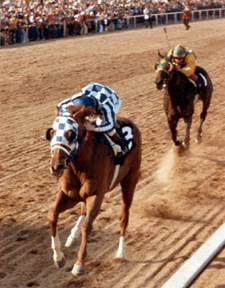
In my view, it is hard to point to many horses that practiced “The Art of Losing” with the same grace of Sham.
And, decades after Sham raced, there is a certain lingering sadness over Sham’s fate of being born at the wrong time – the year Secretariat was making his bid for the Triple Crown.
As Secretariat shattered records in his Triple Crown season, Sham stood in the shadows waging a beautiful racing performance.
He was a great horse in his own right.
And, in a sport where winning is nearly everything, Sham demonstrated that there is an “art” to losing.
As Sham entered the 1973 Kentucky Derby, the colt banged his head on the side of the starting gate, knocking out two of his teeth.
As he bled throughout the race, Sham never stopped chasing after Secretariat with his determination to win.
At the wire, Secretariat beat Sham by 2 ½ lengths – capturing the record time of 1:59 2/5 in the Kentucky Derby.
However, Sham also broke the Kentucky Derby record during his loss – finishing at a time of 1:59 4/5.
As Secretariat was draped in roses, Sham was guided toward his barn to cauterize the wounds to his two teeth.
Although Sham received no records or roses for his efforts, he stood a victor in ”The Art of Losing.”
Two weeks later, Sham set foot on the track in the Preakness.
As Secretariat began his graceful stride from last to first, Sham banged the rail on the clubhouse turn.
However, despite being rattled, Sham kept his eyes on his rival.
He raced onward to chase Secretariat to the finish line.
In the end, Secretariat beat Sham by 2 ½ lengths in the Preakness – the champion arguably breaking the record time for the race in his victory.
However, Sham didn’t stop in the face of an impossible rival.
As a master of “The Art of Losing,” Sham went back to his barn and prepared to challenge Secretariat in the longest race in North America.
And, when the day of the Belmont arrived, Sham demonstrated a powerful lesson in “The Art of Losing.”
When he entered the gates, Sham was soaking wet and nervous.
But, he didn’t back down.
Instead, Sham broke from the gates and challenged Secretariat to a virtual match race in the backstretch.
In the golden seconds that followed, Sham gave everything he had to challenge fate and beat his rival.
But, having been practiced at “The Art of Losing,” Sham found that fate isn’t subject to argument.
As Secretariat blasted forward to win by 31 lengths, Sham tired and fell back to finish dead last.
While Secretariat received a Triple Crown coronation, Sham was led back to the barn in defeat.
However, Sham proved himself a champion though his losses.
He poured his entire heart into trying to win.
And, quite possibly, Sham may have won the Triple Crown in a different field.
But, he was racing a giant that could not be matched.
After the Belmont, Sham never raced again. He retired to Spendthift Farm in July of 1973 and eventually moved to Walmac International.
On April 3, 1993, the nightwatchman discovered that Sham had passed away from an apparent heart attack in the early morning.
Upon examination, it was discovered that Sham had a heart that weighed eighteen pounds – roughly double the size of the average Thoroughbred.
There was only one known Thoroughbred heart larger than his on record in North America.
The heart of his lifelong rival – Secretariat.
In three single races, two amazing horses met their fate in 1973.
Thorough his victories, Secretariat set new records for the racing world to marvel over for countless decades.
And, through defeat, Sham delivered some of the most poetic moments in racing by practicing “The Art of Losing.”

I had a new colt the year Sham raced Secretariat in the 3 races of the Triple Crown. I love that horse and named my colt after him.
This is a GREAT article! Thank you for posting it, and ‘Thank You’ for reminding me of the Triple Crown races that year, and my colt, Sham, who I love and miss very much…
Thank you, Pamela.
This is really good Jennifer, what a beautiful way to tell Sham’s story. I had no idea he had such a large heart!
One of the greatest rivalries in racing for sure.
Thanks, Brian. (I enjoyed your article the other day as well!!!) Hope all is going great.
Nice Articles, thanks for this, looking forward to your next post. Keep your good work.
Ironically, Sham had the same great Princequillo heart that Secretariat had and he passed it on through his daughters just as Secretariat did. I have spent the past 18 years chasing the origin of Secretariat’s heart and it is the subject of my latest book, due out this fall, “Solving the Mystery of Secretariat’s Heart.” Secretariat’s great heart was in Rags to Riches when she beat Curlin in the Belmont Stakes. It was also in Summer Bird last year when he won the Belmont, courtesy of Summer Squall, maternal gradson of Secretariat, who was Summer Bird’s broodmare sire. This year’s Belmont winner, Drossellmeyer, also had the great Princequillo heart from his broodmare sire, Moscow Ballet, the stallion we used to prove the large heart inheritance on the X chromosome. It seems fitting that the sire we started with in our research should be the heart we finish with in this final book on the X Factor. Great heart in racehorses truly means a great heart.
Thanks for the great information, Marianna. I look forward to the release of your book!
Jennifer, thanks for the great article on Sham. It is always so refreshing to hear from Sham fans. With the “Secretariat” movie scheduled to be released October 8, 2010, Sham will once again be in the news. Learn more about Sham in my book: Sham, In the Shadow of a Superhorse, at http://www.ShamRacehorse.com.