April 27th, 2011 §
 Recently, a male handicapper and I were engaged in a debate about treating racehorses with respect regardless if they win a race.
My opinion was pretty clear: The horse comes first in horse racing. It is never acceptable to bash any horse because they failed in a race or caused a bettor to lose money. We aren’t racing automobiles. These are living creatures that deserve respect despite any outcome in a given race.
The male handicapper’s opinion differed from my viewpoint. In his opinion, a losing horse can cost a bettor a lot of money. And, as he pointed out, a professional bettor relies on his winnings as income. It can be a cause of frustration when the horse of your choice loses a race since it impacts your earnings.
At the close of our exchange, I believed that we had simply agreed to disagree on the subject of what racing means from our personal vantage points.
Yet, moments after ending our debate, I received a private message from the same male handicapper. And, in three classless words, he made my blood boil with his sexist ignorance about women in racing.
“Female Racing Groupie.”
Those were his words to describe my enthusiasm and participation in horse racing as an owner, blogger, bettor and racegoer.
Admittedly, I have a healthy sense of humor and a thick-skin when it comes to silly remarks. And, although I’ve never been called a “groupie,” it made me laugh to envision myself hanging out in a dress next to horse trailers to try to grab the attention of a (male) member of the industry to let me stare at a racehorse.
I can stare at them anytime I like at the track without a male escort to guide me or babysit me while I am betting.
So, why am I so disgusted with this remark? In my view, it wasn’t simply an attack on myself as a racing fan. It was an attack on females and their role in racing.
In this man’s mind, a guy is a fan if he is at the races. If a lone woman without a “Rockefeller” portfolio or a slew of children is standing at the track, she is a “female racing groupie.” And, the only separation between a respectful title and a denigrating descriptor for the exact same activity is the gender of the racegoer.
Now, I’m not saying that all men share this view. There are plenty of males who embrace both women and men equally at the track and I am thankful to call many of them friends. Yet, I would like to put to rest a couple of sexist ideas that a few bad apples in the batch like to use as bargaining chips in classless commentary.
Women have a role in racing. The female roles are as follows: Owners, Breeders, Jockeys, Trainers, Bettors, Backstretch Workers and Fans. And, when we are being fans, we aren’t being “groupies” or cheerleaders to handicappers or the men in the industry. We are fans in our own right. Fans of horse racing.
As fans of horse racing, women have every right to get excited or emotional about a horse, just like their male counterparts. I imagine that plenty of men, along with women, cried in many exhilarating moments of racing. Jack Nicklaus admits that he cried as he watched Secretariat win the Belmont by 31 lengths. And, he wasn’t the only spectator without a dry eye at that moment from most accounts.
And, women had every right to get excited when Zenyatta won the Breeder’s Cup in 2009 and when she made her campaign for Horse of the Year in 2010. During that period, I read more than a few comments about how women were “just being emotional” about Zenyatta. I am at loss for words on why we weren’t supposed to be emotional while staring at a horse that is arguably among the greatest mares of all time.
It does this sport no justice if average female fans and participants are trivialized as being “groupies” or if we are considered to be irrationally “emotional” when we get excited about our equine athletes and the welfare of the horses.
Yes, Zenyatta, as well as other horses, have brought new fans into this sport in recent years. Many of the new fans are female. And, the new female racing fans won’t stay if they aren’t allowed to hold the same ranks as men in this sport.
Yet, I have been a female fan of this sport before, during and after Zenyatta appeared on the track. And, in being a female fan, I won’t stand for the new generation of women at our tracks to be relegated to “groupies” or spoken to like children.
This sport is not restricted to men. And, being a fan of it is not a title bestowed upon men alone. Being a fan of this sport is equal opportunity and the word “groupie” should hold no place in our dialogue on what it means to be involved as a female participant at any level of this sport.
April 16th, 2011 §
 Last week, Toby’s Corner won the Wood Memorial and stamped his ticket to the Kentucky Derby.
Beyond the surprise of many fans that Uncle Mo had been defeated for the first time in his career, a few other folks were shocked when Toby’s Corner won the race. Namely, the connections surrounding the winning colt.
After the Wood, Trainer Graham Motion commented that he hadn’t expected Toby’s Corner to beat Uncle Mo in the race. In fact, Motion stated that he had never even discussed the idea of Toby’s Corner starting in the Kentucky Derby with Dianne Cotter, Owner and Breeder of the colt.
The trainer was unsure if the Cotters even knew that he had nominated Toby’s Corner to the Triple Crown.
Yet, in a few golden seconds, Toby’s Corner delivered a victory that would provide him with the necessary graded earnings to start in the upcoming Kentucky Derby. And, in the same moment, the home-bred colt also gave Cotter and Motion the opportunity to point toward a highly-elusive prize, namely, a win in the Kentucky Derby.
Many onlookers completely missed the beauty of the victory for Toby’s Corner and his connections.
Instead, as Toby’s Corner made his way to the winner’s circle after the Wood Memorial, many fans fixed their eyes on Uncle Mo as he passed the stands in a third-place finish. The colt garnered more attention through his lone defeat than the actual winner of the race received in his spirited victory.
And, since the Wood, Uncle Mo has been subject to scrutiny that falls nothing short of brutal. The bulk of the news stories from the Wood Memorial don’t focus on the victory of Toby’s Corner, but rather, the fact that Uncle Mo finished third in the race.
Further, many racing fans are relishing in the loss of Uncle Mo in comment threads from related articles and blog posts. A lot of the opinions focus on highlighting any flaw they can find on the colt. In some cases, the comments are downright mean-spirited and hateful, not only to Uncle Mo, but to the spirit of racing itself.
There is no value in tearing down Uncle Mo, or any other horse, for competing in a race and losing it.
And conversely, there is no respect for the achievement of Toby’s Corner, or any other winning horse, if we fail to celebrate the victory.
I am fan of horse racing. As a fan of horse racing, I am a fan of horses. Being a fan of horses, I respect the achievements of Uncle Mo and Toby’s Corner in their own right, without comparison or criticism to the other athlete.
Whether a horse wins or loses a race, the equine athletes in our sport deserve respect during and after every outing.
This isn’t just racing. It’s horse racing. And, respect for the horses should remain the first priority above the outcome in a race.
April 2nd, 2011 §
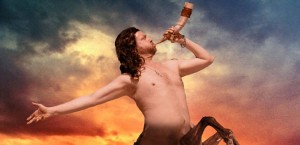
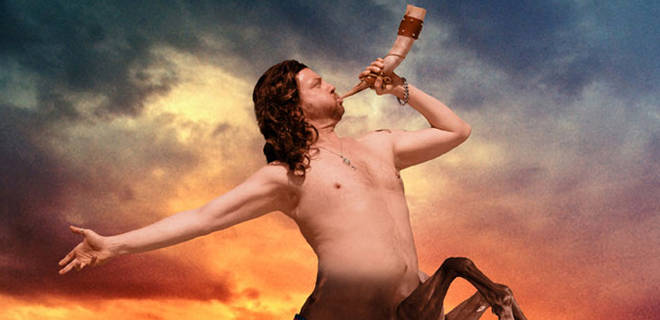
Meet “Kegasus.”
“Kegasus,” a half-man, half-horse creature, is the new mascot for the Preakness marketing campaign to draw larger crowds to the infield during the middle-jewel of the Triple Crown. With his pierced nipple and beer gut, Kegasus was recently unveiled with the goal to “promote a party” at the infield festivities on Preakness day.
Kegasus’ party is intended to reach a demographic between the ages of “21 and 35 or 40,” according to Tom Chuckas of the Maryland Jockey Club (MJC). And, in order to conjure up a “Party Pro” like Kegusas in the first place, the MJC paid Elevation, a marketing firm, $400,000 to dream up this creature for the infield crowd.
Sadly, I find myself in the age demographic that has now become “Kegasus Territory.” And, being a younger fan, I feel like “Kegasus” denigrates the sport of horse racing to a drunk fest that insults the accomplishments of all of the equine athletes that will race around the oval surrounding “Kegasus Land” on Preakness Day.
In my view, the “Kegasus Campaign,” like “Kegasus himself, is marketing mythology. The idea that these alcohol-laden infield campaigns will allure intoxicated young people to throw money down during the races, and ultimately, become lifelong fans of the sport, isn’t a long-term strategy to bring newcomers, or young people, in the sport.
Let me dispel that rumor so that we can kick “Kegasus” out of the park and ask for our $400,000 back to do something worthwhile for horse racing.
Of my friends who have been to the infield parties, I hear a common reporting of their experience. Here are a few direct quotes from my friends and acquaintances who visited the infield during their twenties:
“I didn’t see a horse that whole time I was there.”
“I saw a band play and they were really good.”
“I had so many shots of Jager that morning, that I was too drunk to hit on a girl and wound up sleeping all day on a blanket.”
It has been a few years since the above-quoted individuals have been to an infield party. And, in the meantime, they have never showed a spark of interest in horse racing. In their mind, the event was about pounding down as many drinks as possible, and, if they ever feel like revisiting that experience in the future, they can go to any local bar of their choice to get “too drunk to hit on a girl” or to listen to a band play some music they might enjoy.
In contrast, as a young person that truly loves the equine athletes in this sport, “Kegasus” is a mockery of what I find beautiful about horse racing. He distracts newcomers from the horses and the stories of their connections. They become mere landscape to a liquor-slamming contest that has nothing to do with the sport.
And, for the young people who are regularly involved in this sport, “Kegasus” is an insult. If the industry wants true fans who marvel over the athletes and bet on races, they need to target young people who aren’t there for a cheap drink promotion. They need to accommodate the young people who have jobs and enjoy horses.
As a young professional and racing enthusiast, I don’t want to drunk kids falling around me while I am trying to watch the races in a sundress and heels. And, as a woman, I don’t want slobbery drunk guys hitting on me after countless shots of Jagermeister when I am trying to see if I won my trifecta. Finally, I don’t want my equine heroes to be relegated to a mere sideshow while “Kegasus” parades around the infield for drunken enjoyment.
For me, there is a wealth of beauty in this sport that can allure young people. The power of equine athletes. The human interest stories. The pageantry of the major races. The quiet triumphs in the minor races. The glamour of women in their best dresses and beautiful hats. The raw beauty of the horses as they parade past the crowd. The idea that your fortune can be changed in a single winning ticket. And, the sacred principle that an equine athlete can deliver what you previously believed to be impossible.
“Kegasus” is the opposite of all that I find beautiful in racing. And, the crowd that he will attract won’t marvel over these things. They are will come and go as soon as the cheap alcohol promotions run their course. And, when they go, “Kegasus” will be a part of how they remember their day at the race track. A beer-gutted, nipple-pierced, shirtless guy who wore a centaur-suit and glorified the idea of becoming a drunken “legend.”
If I ran the MJC, I’d want my $400,000 back and a written apology from the marketing firm that felt “Kegasus” best defined our sport for the young demographic.
And, I would start asking young people with jobs, who may actually bet or own a horse someday, about the things they find alluring and worthwhile in their world.
At the end of that dialogue, I’d put my $400,000 toward accommodating the young people who would actually return to the track with a true interest in horse racing.
 Recently, a male handicapper and I were engaged in a debate about treating racehorses with respect regardless if they win a race.