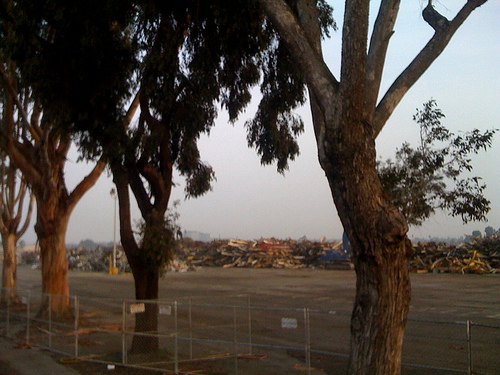
 Bernard Fontenelle once said, “It takes time to ruin a world, but time is all it takes.”
Perhaps, the time of ruin arrives when a single generation forgets why certain places are important. Or possibly, the importance of the events that occurred on that ground fail to excite a culture with changing values. It may take time to ruin a world, but if time is all it takes, the way we spend our time has an ever-increasing value toward determining what the future beholds.
In the case of racetrack closures, I wish I had spent time at those lost tracks prior to the final “Call to the Post.” And, in our tracks that continue to exist today, I do. Because, if it takes time to ruin a world, there is time to prevent the fall of it in the first place.
The question lies in how we can contribute to racing while we spend our time enjoying the sport. I imagine the last day at Bay Meadows race track in California, where, prior to its closure, it was the longest continually-operating track in the state. It was on this ground that Seabiscuit fought to become the two-time winner of the Bay Meadows Handicap, John Henry finished second in the same race years later, and Triple Crown Winner Citation graced the now-demolished oval near the end of his illustrious career.
In 2008, Bay Meadows was shut down after being purchased by a real estate development company. Prior the final race, “The Last Dance Stakes,” the track bugler played “Auld Lang Syne.” The crowd gave a standing ovation to the final string of horses to race that day, while the athletes broke from their post-parade to face the audience. While facing the crowd, the jockeys gave a salute to the witnesses who showed up to watch the last race ever to be run on that track. And, moments after that final salute, Bay Meadows closed for good.
When I view the six and seven figure prices paid for a single horse in a sales ring, I wonder why no one had ever thought to set up a foundation to provide funding to help save the tracks that require emergency funding, to promote the sport in general and to help fund Thoroughbred retraining and retirement.
As an owner, I would happily pay a surcharge on a sale price to ensure that the tracks can keep racing horses in the future. Further, I would pay a nominal fee when registering a foal to help provide the necessary funding to prevent such closures. And finally, I would happily give a percentage of my winning purse share toward a foundation that funds the promotion of Thoroughbred racing and retirement. Because, in the final equation, it does not serve myself, nor the industry, any good to have a racehorse without a racetrack to race upon. In the same time that leads to the closure of a track, there is time to prevent the collapse of it if funding is provided and used to promote the future of racing.
If such a foundation had existed to save Bay Meadows, the site of Seabiscuit’s two-time victory in the then-longest running race in California may not be slated to become a shopping area today. It would be a racetrack where wonder existed as to when the next Citation, Seabiscuit, or John Henry may set foot that ground.
And, if such a foundation had existed in Illinois, Washington Park would have been rebuilt in Homewood after it was destroyed by a fire in 1977. I would have enjoyed racing a horse in the same place where Triple Crown Winners Whirlaway and Citation competed on that ground. I would have felt humbled to stand where Native Dancer left that track victorious before later retiring with a record of 21 wins in 22 lifetime starts. I wish I could have watched my horses race on the same oval where Nashua and Swaps held a $100,000 match race and Jockey Eddie Arcaro became the two-time winner of the American Derby. Yet, Washington Park was sold for commercial and residential development in 1992. And, with that sale, the living monument to those moments disappeared in a dismal demolition.
If I were born a few decades earlier, I would have gone to the Wood Memorial when it was held at the former Jamaica Racetrack prior to its’ demolition in 1960. Jamaica Racetrack was where Omaha won the Wood on his road to becoming a Triple Crown Winner. Native Dancer made his debut at Jamaica. Even Seabiscuit raced there. And, before Bold Ruler retired to stud and gave the racing world Secretariat, he ended his career of 23 wins in 33 starts with his last race at the Jamaica Racetrack. Yet, I’ll never visit that park because the Rochdale Village Housing Development occupies the site now. The greatness that took flight on that soil has long been forgotten in exchange for one more residential area.
And finally, I wish I was at the former Sportsmans Park in Illinois in 2002 to watch War Emblem capture a victory in the Illinois Derby and stamp his ticket to Churchill Downs to race in the Kentucky Derby. But, it appears that Fontenelle’s proposition, “It takes time to ruin a world, but time is all it takes,” proved true for Sportsman’s far too soon. By the time War Emblem set foot in the gates to win the Kentucky Derby at odds of 20-1, Sportsman’s had already closed for good. Whatever may have been celebrated from War Emblem’s road to the roses the following year was ultimately replaced with plans to develop a shopping center on that site.
Now, Hollywood Park is facing closure with the same swan song from developers that, in time, it will become a commercial and residential development. And sadly, it seems that time may be all it takes to demolish it.
Yet, in the time it takes to close a track, there is time to try to save it. Every day spent at a track is a day that supports the continuity of its existence. I make a point to go to the track to see the races. And, because I go to the races, I stood in the crowd and saw my favorite racing moment at Hollywood Park. It was the day that Zenyatta broke the modern Thoroughbred record when she won her seventeenth consecutive start.
During the race, the crowd cheered in unison for one single mare from start to finish as if she were racing alone. And, when she claimed her seventeenth consecutive victory, Zenyatta stood on that site, a perfect Thoroughbred, and took in an ovation from a crowd that was absolutely in awe of her presence. It was not simply a horse race. It was a historical moment. And, the site of that historical event is the same site, which, if developers get their way, will be demolished and turned into a retail and residential area.
I fail to see a need for another commercial or residential development on grounds where our champions tested their limits and showed us what we had deemed impossible. Rather, there is a need to protect the monuments to those moments, and ultimately, provide a site for future racehorses to showcase their talent.
Thankfully, “It takes time to ruin a world.” Because in the time it takes, the industry can rethink how to help save our remaining tracks and fund the future of this sport. And, as participants and fans, we can use our time to think about how we spend our time enjoying this sport, contributing to this sport and protecting it.
We can take time to attend the races to show our support. We can help fund the preservation of this sport. And, in the end, we can honor the achievements of our heroes and heroines through saving the very places where they laid their hearts down and fought for a victory.
Photo Credit: Photo of Bay Meadows taken by Dylan Tweeney.


Beautifully said..absolutely beautiful! It’s too bad noone thought of this before they flattened Garden State Park & Rockingham Park.
I’m glad I got to spend time there as a horseman. Rockingham Park was a bit of a “coming of age” time for me in my career. I loved the old rustic, turn-of-the-century feel of the place. Both track hold fond memories.
I am saddened to hear of yet another Thoroughbred racetrack closing. I fear it’s like dominoes. I’m not sure why Thoroughbred racing has taken such a turn. I know there is a lot of bad press about the fate of the average Thoroughbred when they can no longer race. The social media networks are full of horrid photos and stories. That may be part of it, but certainly not the whole story.
As the author of the Thoroughbred racetrack novel “Favored to Win” I am currently working on the sequel, which addresses these issues. My main characters have just purchased a bankrupt racetrack that not only can’t fill races, they can’t get a crowd. I am attempting, if only in fiction, to turn Nottingham Downs back into a profitable business with pride for the Sport of Kings!
Once a racetrack closes it’s never get replaced. When they close racetracks never reopen.
Thanks for the awesome piece!
Wednesday afternoon was a day many used to take off work, and many went to the track. My mom and dad saw Seabiscuit race at Baymeadows. I heard a lot, enthusiastically, about Seabiscuit at the dinner table. Then there was The Southern in Buri Buri very near the track with the best fried chicken next to my mom’s. The waiters were old Pullman Train stewards in tight white jackets; our waiter was Seabiscuit, always OUR waiter. There was celebrity rubber necking as the jockies came in with their families, like the Shoemakers. Baymeadows was hallowed ground as my childhood mind understood it. Now it is gone.
Hialeah, from what I could see on TV was a fantasy place, old Florida and better than Disney World. Even Hollywood Park did not have those flamingos. Now I understand they are racing there again in what is left of the landscape. I understand they are in part racing quarter horses. Well, I say if that is what it takes to keep a track going, so be it. In part we go to see a horse race. I am not going to be a purist at this point to forego a fun day because I don’t get to see all thoroughbreds. I pretty much melt at the sight of any horse.
If this is what it takes in part to keep Hollywood Park going, I am all for it. And boy are there some exquisite horses out West … Whatever it takes.
Hi Jane ~ Thank you for a wonderful comment. I’ve never ever heard of those two parks Curious where they were located. (Also ~ I bet you have some great stories about your time there - and pictures!)
And, Mary Anne ~ I can’t wait for your next book. You are one of my favorite writers. I love it when you post new stories (and photos!). Thank you for such a nice comment.
Buck ~ Thank you for your comment. I was thinking when I wrote this piece, you never really see new racetracks being built, just old ones being torn down. You put it best.
Finally ~ Tori. Thank you for adding “life” to this piece by telling your stories. I always love hearing your comments.
Thank you! This is beautiful. When there are houses sitting empty in developed neighborhoods, strip shopping centers with 6 months rent free advertising, begging for tenants, I fail to see this constant need to tear down something historic just so we can build newer, fancier houses and sprawling shopping malls. We don’t need them! We do need to honor the history of these grand old tracks, the talented horses who ran there. Thank you.
It’s not too late to save Hollywood Park! But, in order to survive, it has to offer people reasons to come year-round. It needs the support of the California horse racing industry. It needs to be owned by people who are dedicated to the sport, not land developers.
There are so many possibilities for the future of Hollywood Park. Please visit http://www.savehollywoodpark.info and the Brainstorming Barn page to check out the architectural drawing incorporating ideas and suggestions for the property.
two views to the sport:
1. the Fred Pope-NASCAR view-central administration of a drastically contracted sport and the profits headed for a few deep pockets.
2. Expansion of the sport and continuation of its democratic nature where everybody with a few bucks can participate.
OP get’s it exactly right. If u have a horse u need some place to race it. Without the tracks, sport dries up and dies except for the very few.
My dad was top rider at aksarben in 1949 I finally got my dad in the Kentucky derby museum this year know book coming out on him and 30 other jockeys from Kansas and Oklahoma bush tracks in the 40’s called boys from the bushes by lou dean and I hat that I can’t go to aksarben to where my dad was top rider at 19 years old he started riding 10 are 12 years old and he made top rider at this track he was from Ponca city Oklahoma I have the trophy still from falstaff
Jennifer, you would think that a national population of over 300 million people would have an abundance of thoroughbred racing enthusiasts like yourself. Unfortunately, that is not the case. Without a strong fan base, the racetrack becomes far more attractive for its real estate value. But you present some interesting ideas, rather appealing ideas for securing the future of the remaining racetracks as well as those in jeopardy like Hollywood Park. We’re not on lifesupport yet, but if we don’t make an effort to take suggestions like you make to heart, I’m afraid we’ll see more racetracks close down.