June 1st, 2010 §
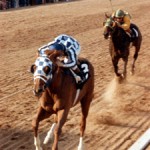
In her famous poem, One Art, Elizabeth Bishop begins by pondering “The Art of Losing” with the idea that some things are fated to be lost.
In the moment of loss, Bishop starts the poem with the notion that losing should not be viewed as a heartbreaking event.
In fact, she goes on to write that it should be practiced.
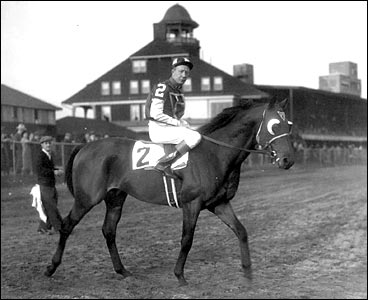
In my view, it is hard to point to many horses that practiced “The Art of Losing” with the same grace of Sham.
And, decades after Sham raced, there is a certain lingering sadness over Sham’s fate of being born at the wrong time – the year Secretariat was making his bid for the Triple Crown.
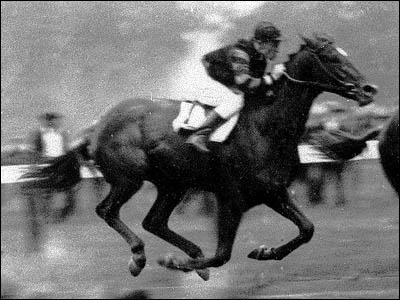
As Secretariat shattered records in his Triple Crown season, Sham stood in the shadows waging a beautiful racing performance.
He was a great horse in his own right.
And, in a sport where winning is nearly everything, Sham demonstrated that there is an “art” to losing.
As Sham entered the 1973 Kentucky Derby, the colt banged his head on the side of the starting gate, knocking out two of his teeth.
As he bled throughout the race, Sham never stopped chasing after Secretariat with his determination to win.
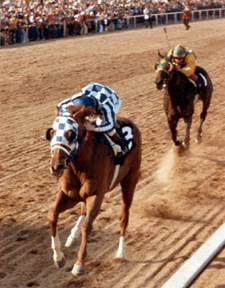
At the wire, Secretariat beat Sham by 2 ½ lengths – capturing the record time of 1:59 2/5 in the Kentucky Derby.
However, Sham also broke the Kentucky Derby record during his loss – finishing at a time of 1:59 4/5.
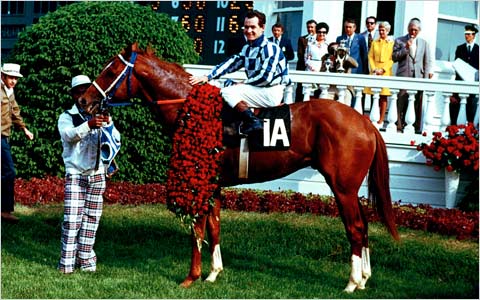
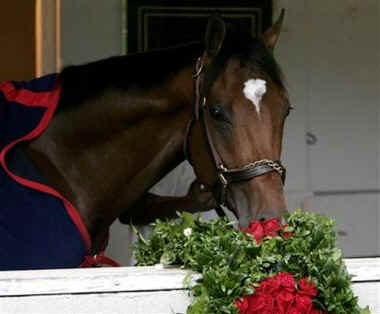
As Secretariat was draped in roses, Sham was guided toward his barn to cauterize the wounds to his two teeth.
Although Sham received no records or roses for his efforts, he stood a victor in ”The Art of Losing.”
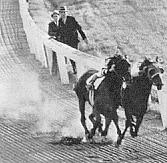
Two weeks later, Sham set foot on the track in the Preakness.
As Secretariat began his graceful stride from last to first, Sham banged the rail on the clubhouse turn.
However, despite being rattled, Sham kept his eyes on his rival.
He raced onward to chase Secretariat to the finish line.
In the end, Secretariat beat Sham by 2 ½ lengths in the Preakness – the champion arguably breaking the record time for the race in his victory.
However, Sham didn’t stop in the face of an impossible rival.
As a master of “The Art of Losing,” Sham went back to his barn and prepared to challenge Secretariat in the longest race in North America.
And, when the day of the Belmont arrived, Sham demonstrated a powerful lesson in “The Art of Losing.”
When he entered the gates, Sham was soaking wet and nervous.
But, he didn’t back down.
Instead, Sham broke from the gates and challenged Secretariat to a virtual match race in the backstretch.
In the golden seconds that followed, Sham gave everything he had to challenge fate and beat his rival.
But, having been practiced at “The Art of Losing,” Sham found that fate isn’t subject to argument.
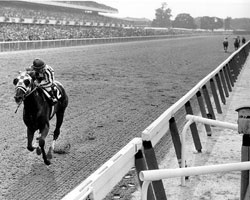
As Secretariat blasted forward to win by 31 lengths, Sham tired and fell back to finish dead last.
While Secretariat received a Triple Crown coronation, Sham was led back to the barn in defeat.
However, Sham proved himself a champion though his losses.
He poured his entire heart into trying to win.
And, quite possibly, Sham may have won the Triple Crown in a different field.
But, he was racing a giant that could not be matched.
After the Belmont, Sham never raced again. He retired to Spendthift Farm in July of 1973 and eventually moved to Walmac International.
On April 3, 1993, the nightwatchman discovered that Sham had passed away from an apparent heart attack in the early morning.
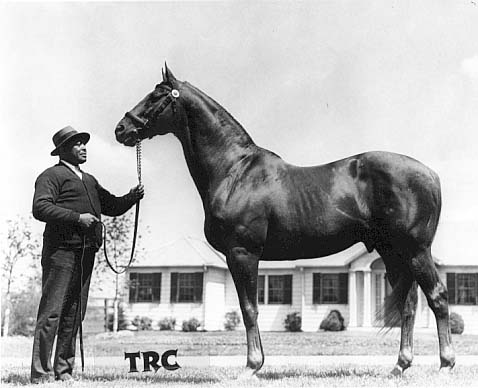
Upon examination, it was discovered that Sham had a heart that weighed eighteen pounds – roughly double the size of the average Thoroughbred.
There was only one known Thoroughbred heart larger than his on record in North America.
The heart of his lifelong rival – Secretariat.
In three single races, two amazing horses met their fate in 1973.
Thorough his victories, Secretariat set new records for the racing world to marvel over for countless decades.
And, through defeat, Sham delivered some of the most poetic moments in racing by practicing “The Art of Losing.”
April 13th, 2010 §
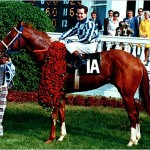
“Secretariat” is a name often spoken as a sacred word.
After spending years marveling over Secretariat’s spectacular racing achievements, I became curious about his lifestyle once he retired from racing.
Upon making several calls to find someone with first-hand experience with the legendary horse, everyone pointed to one man: John Sosby.
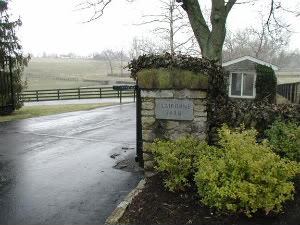
A few weeks later, I entered the gates of Claiborne Farm to meet John Sosby. Sosby was General Manager of Claiborne Farm from 1975 until he retired in 2006. 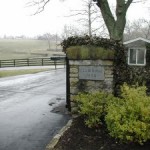
As we walked along the paths of Claiborne Farm, Sosby, whose father was a groom for broodmares and foals, explained that he lived at Claiborne since he was a three-year-old child.
Through observing his father’s work, Sosby learned to be gentle with horses, while exercising patience and control.
The lessons from his childhood eventually led to his own career at Claiborne Farm. In 1964, Sosby became supervisor of the yearlings at the farm.
In regard to Secretariat’s initial arrival at Claiborne, Sosby remarked, “I was still in charge of breaking yearlings, which I thought was the best job here.”
However, Sosby soon earned a promotion to General Manager in 1975. In the years to follow, his daily life became interwoven with the legendary presence of Secretariat.
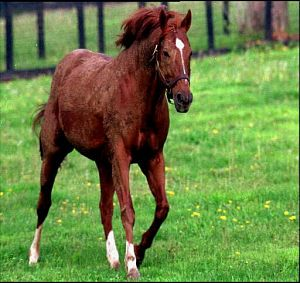 The Grand Entrance: Big Red Arrives at Claiborne Farm.
As with his career, Secretariat’s arrival to Claiborne Farm was no small event.
When he retired from racing, Secretariat made a farewell appearance for roughly 30,000 fans at Aqueduct race track. At the time, the date had been set for him to be shipped to Kentucky, but it remained a secret to the public. Sosby explained:
After the parade for the general public, a plane flew him and Riva Ridge to Bluegrass Field, across from Keeneland. Two vans were waiting, along with an escort from the Paris and Lexington Police.
It was one of those situations where you knew he was coming to Claiborne, but the general public didn’t know exactly what time, so that we could keep the crowd down.
[At Claiborne,] we had security. When they backed down into the loading chute here, we were waiting. Seth [Hancock] did not want a bunch of fan fare. He just put the guard at the gate. If you weren’t on the list of whomever Seth had invited in, you weren’t coming in.
Sosby then recalled the moment that Secretariat first set foot on the grounds of Claiborne Farm.
When they unloaded him, they turned him around. As they led him out, I can remember him looking at the barn and his new surroundings.
He was a beautiful animal. He walked with pride. He had something about him. And, somehow or another, he knew it.
Sosby reflected, “He was The Man.”
Perhaps, they both knew it.
 The Camera Eye: Secretariat’s Presence at Claiborne Farm.
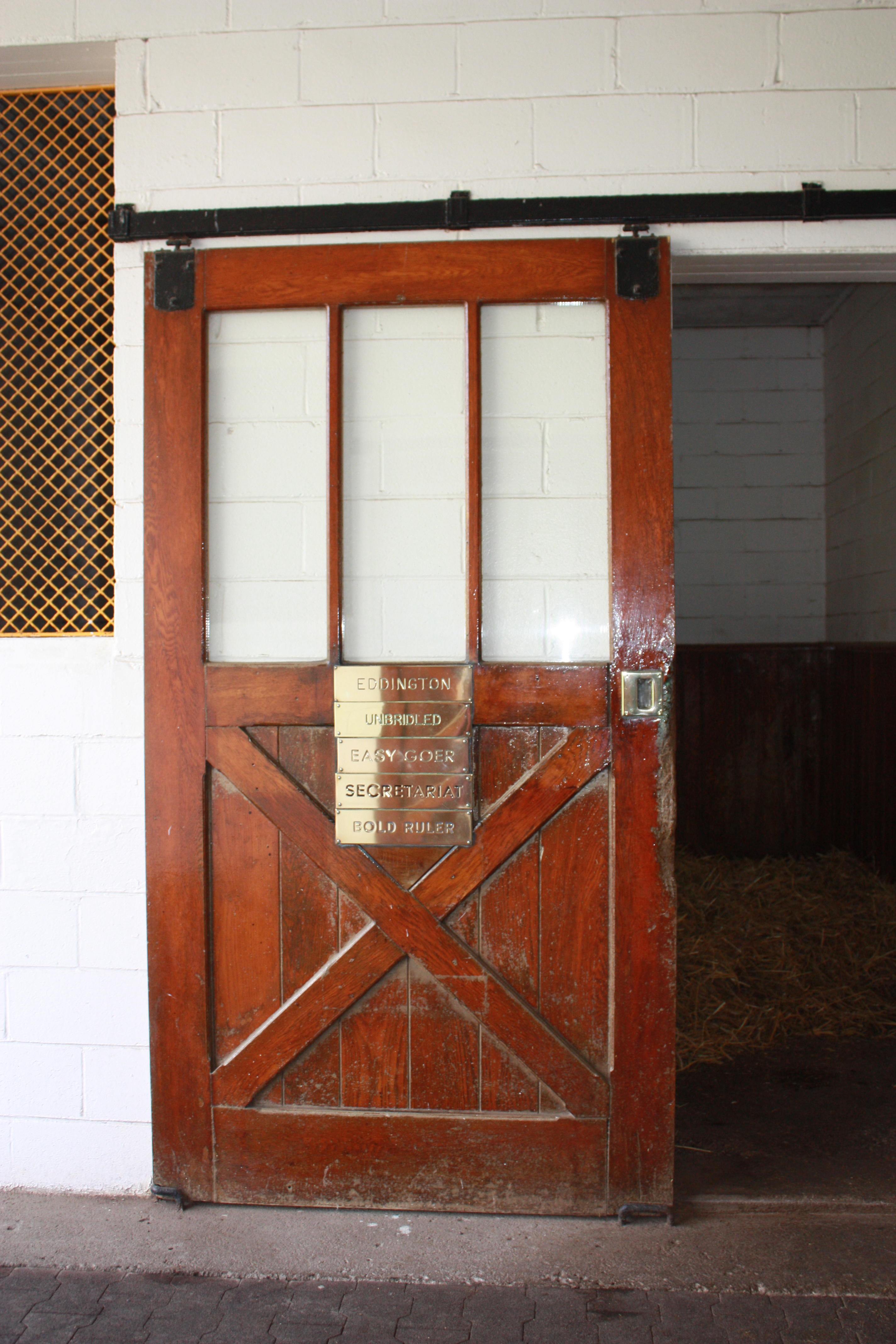
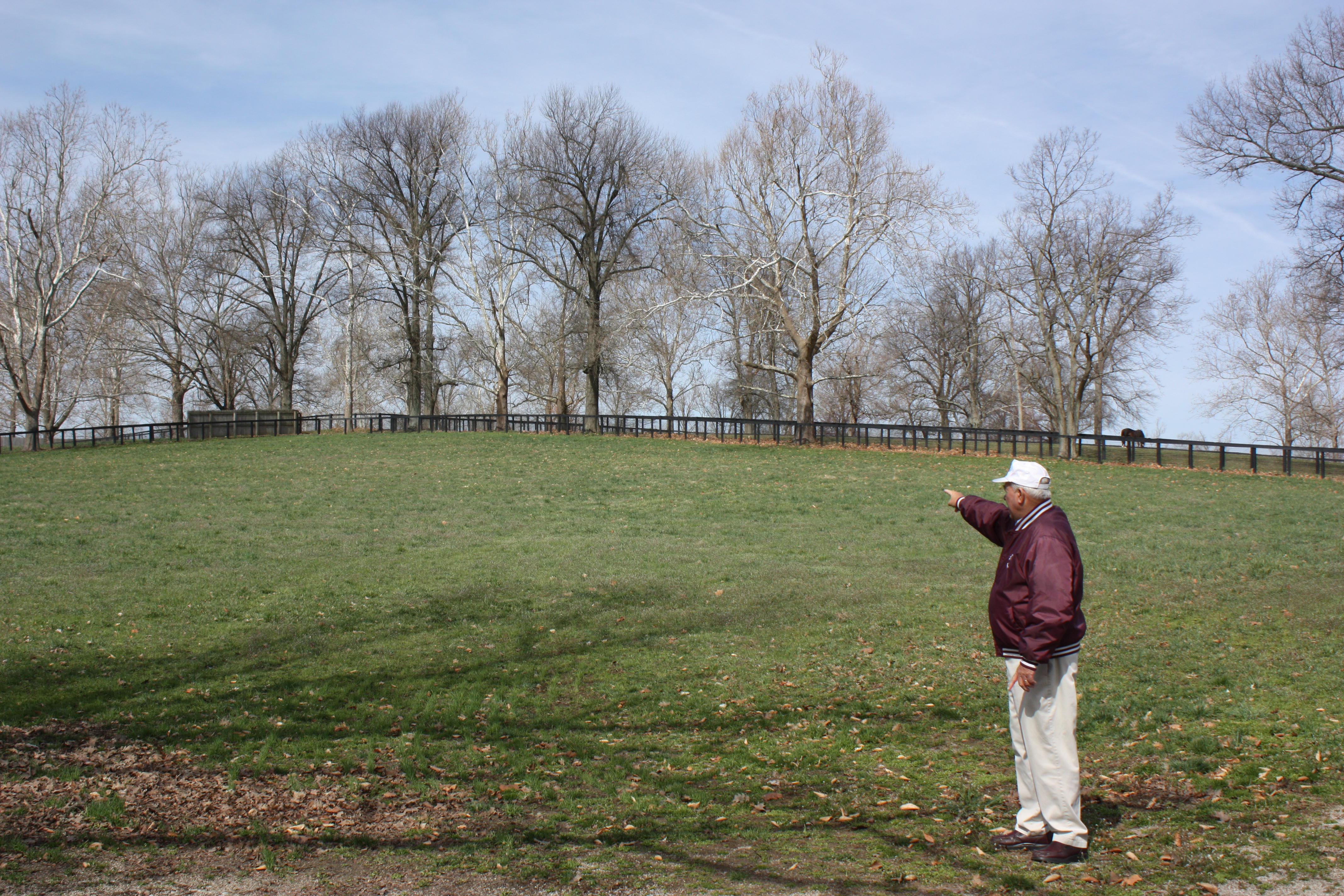
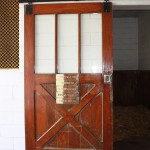
As we walked down the trail to the stables at Claiborne Farm, Sosby directed me to Secretariat’s former stall. As he stood beside Secretariat’s golden name plate, Sosby talked about the fans that visited Claiborne to meet the legendary horse.
Between 8,500 and 10,000 people a year came to Bourbon County to visit Secretariat.
Some of them would go in the stall and lay in the hay. They would say, ‘If it’s good enough for Secretariat, it’s good enough for me.’
Every now and then, fans would bring Secretariat an apple or peppermint candy during their visit. His groom was in charge of giving those gifts to Secretariat.
In an interesting note, Sosby recalled that the horse particularly enjoyed two items – cameras and shiny objects.
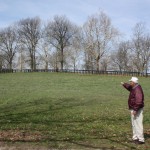 As we arrived at Secretariat’s paddock, Sosby recounted Secretariat’s “Trademark Greeting” to his visitors. Pointing to the top of the hill, he explained that when a person walked up to Secretariat’s paddock, the horse would run up to the gate and stop.
Sosby then elaborated, “With a camera, he’d pose. He was a showman, but he was kind. You could walk right up and get your picture taken with him.”
I began to wonder about Sosby’s earlier comment about how Secretariat enjoyed “shiny things.” Was it a simple flash on a camera or did it go beyond that?
It was then that Sosby recounted the tale of “Secretariat and The Golden Earring.” He explained:
One day, I had gone to lunch in town. I got a call from the farm saying ‘You need to come out here. Secretariat just bit a woman.’
I was a mile and a half away from the farm. My first thought was a million-dollar lawsuit.
Well, I get there and they called a doctor out to try to stop the bleeding on her earlobe.
She had taken a picture and turned away. He reached to get her earring and just pulled it through her ear.
Sosby laughed when I asked if the woman was upset.
No. She was happy. She’d been bit by Secretariat!
As he smiled, he clarified, “He was not mean. It wasn’t his character. The earring was there - and it was shiny. He just reached and grabbed it.”
 The King of Roses: Secretariat’s Legacy.
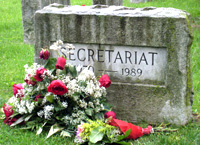
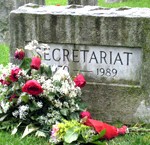
In 1989, Secretariat lost his battle with lamanitis and was buried at Claiborne Farm. As Sosby stood next to Secretariat’s grave, he briefly discussed the private service that was held.
He was put in the ground late in the afternoon. It was Claiborne family [present]. Nobody in the gate.
We didn’t want a circus or festival atmostphere.
We had just laid a good one to rest.
Sosby recounted that after Secretariat’s burial, “Over a hundred flower arrangements were on his grave by the next morning.”
In over two decades since his death, Secretariat still leaves his mark at Claiborne Farm. Sosby explained, “On his birthday, there will be twelve red roses on his grave [from an] unknown source. It’s been [going on for] twenty-one years.”
In his closing remarks, Sosby marveled, “I don’t know who his critics would be. He was perfect.”
April 3rd, 2010 §
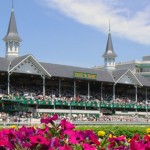
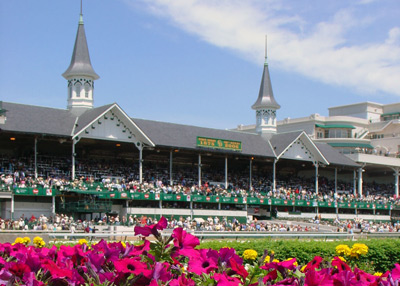
On a sunny Friday afternoon, I arrived at the gates of Churchill Downs to interview John Asher about the history of the Kentucky Derby. Asher, Vice President of Racing Communications at Churchill Downs, has been working in the thoroughbred industry for over two decades – serving on boards, acting as a publicist, and providing award-winning media coverage of the sport. He joined Churchill Downs in 1997.
In his coverage of horse racing, he has achieved celebrity status in his own right. On Kentucky Derby day, it would be near-impossible to watch any major televised report about the race without seeing John Asher appear on the screen. Amidst the crowd of racing enthusiasts, he is the man to follow on Kentucky Derby day.
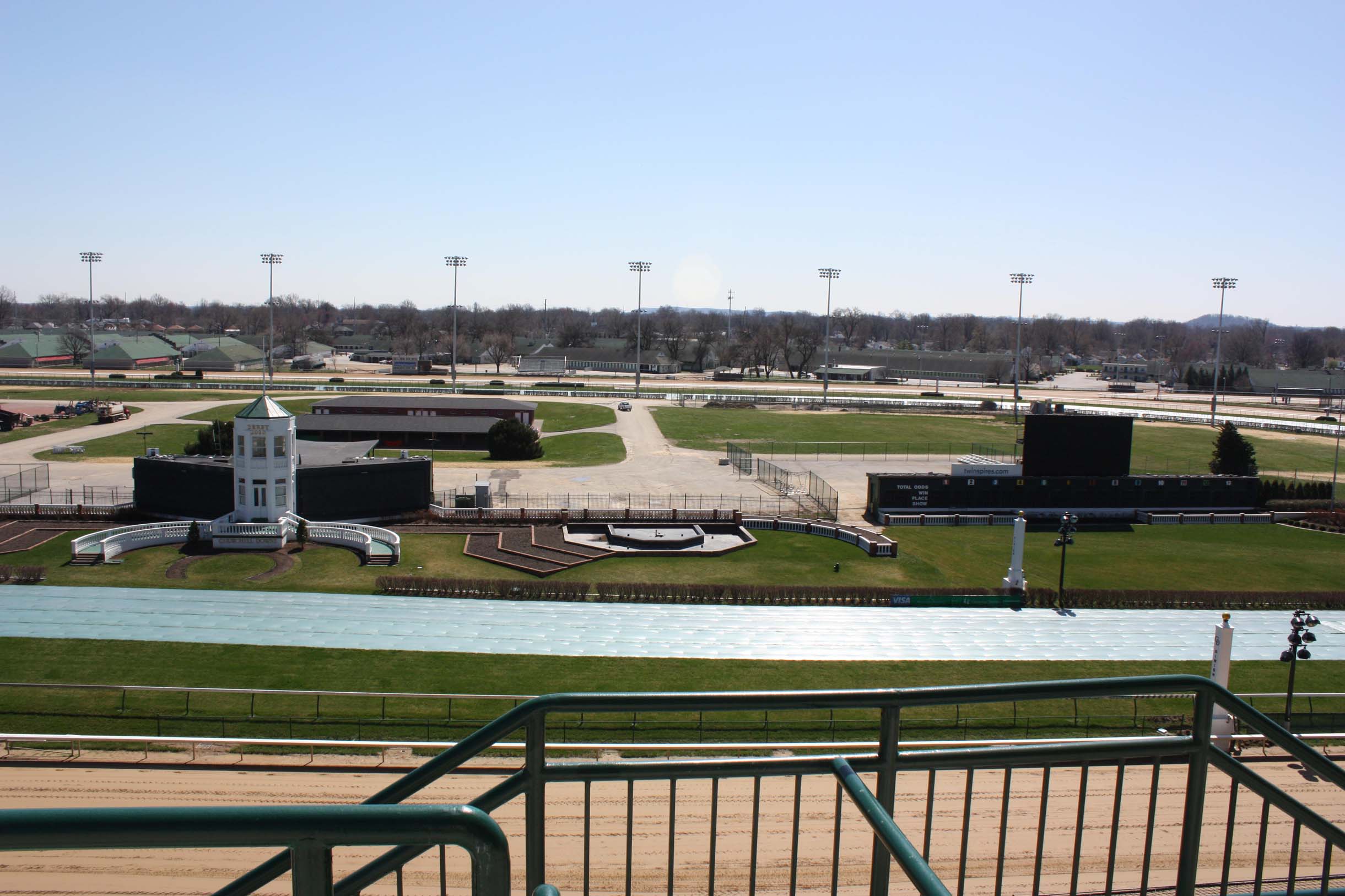
When first I met Asher at Churchill Downs, it came as no surprise that it would be in a grand fashion. To me, the Kentucky Derby is all about excitement, tradition, pageantry, and witnessing history in motion. Churchill Downs is the cathedral for this one-of-a-kind event. After my entry to through magic gates, everything that followed was spun like a fairy tale adventure.
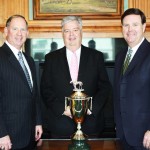 Asher appeared for the interview in the Director’s Room at Churchill Downs. This sacred ground is the site upon which the Kentucky Derby winners celebrate their win with a champagne toast following their victory.
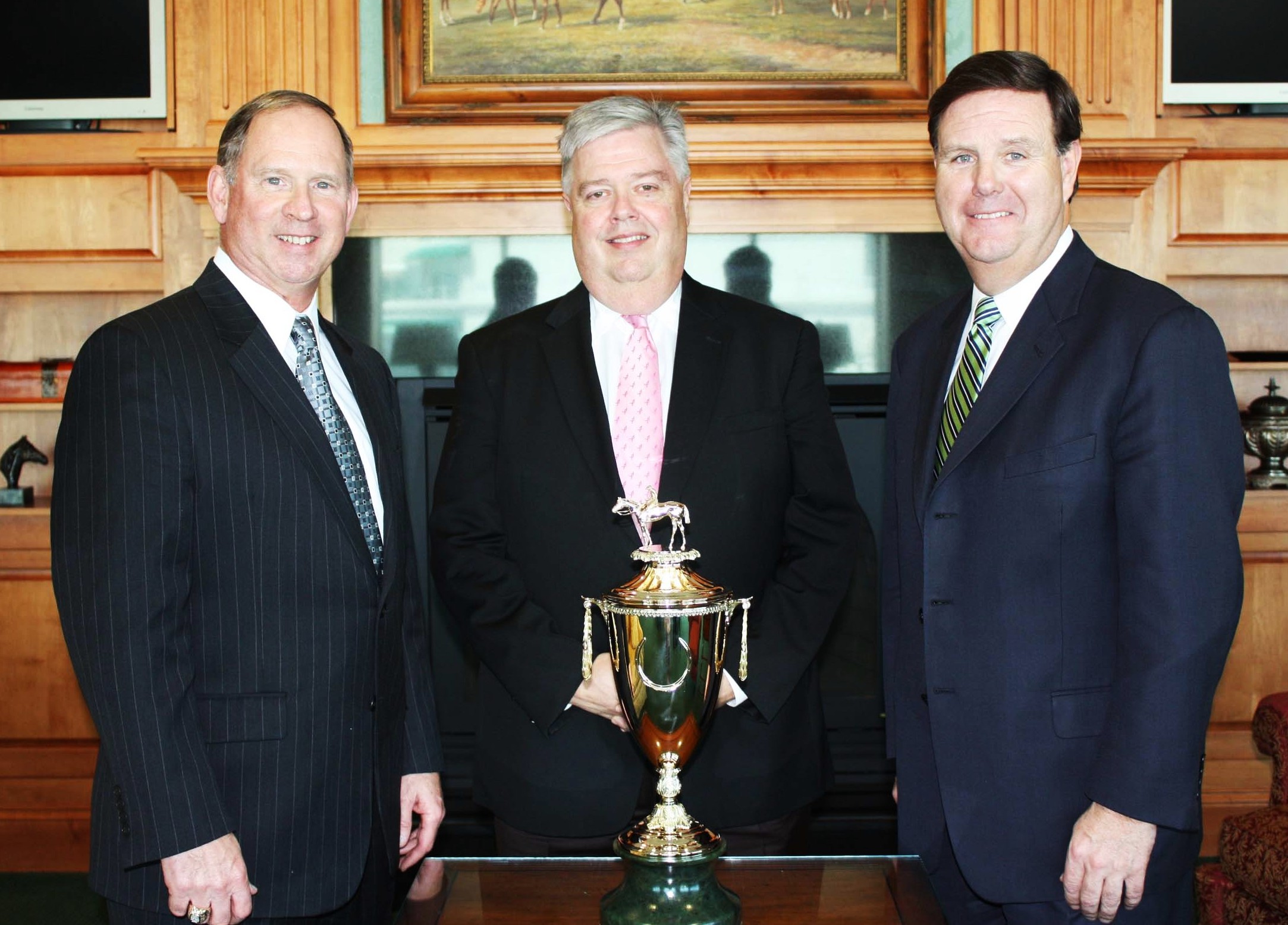
In the center of the room, the press was gathered around a small table to view one of the most largely-coveted items in horse racing - the winner’s trophies for the 2010 Kentucky Derby.
The Winner’s Trophies for the Kentucky Derby.
Carefully handling each trophy with white gloves, the CEO of New England Sterling, Marc Forbes, informed me that the first person to personally touch each trophy would be the respective winner on Kentucky Derby day.
Forbes explained that the largest trophy, awarded to the owner of the winning horse, is comprised of sixty ounces of 14-karat gold and has remained largely unchanged from its’ original design, dating back to 1924. In the three major milestone races – the 75th, 100th, and 125th anniversaries the Derby, the trophy was modified to include diamonds, emeralds, and rubies.
Among the historical variations on the trophy, the major alteration came in 1999 – when the horse shoe in the center of the trophy was reversed to point upward. Forbes explained, “Racing lore has it, that [when] a horse shoe is facing downward, the luck runs out of the horse shoe. So, in 1999, the horse shoe was changed and facing upward.”
Forbes stated that fifty employees are involved in the 1,600-hour process of handcrafting the owner’s trophy- comprised of 25 different components. The company also creates three smaller sterling silver replicas of the gold trophy, which are awarded to the trainer, breeder, and jockey of the winning horse.
As I marveled at the beautiful trophies that we set before me, I envisioned the past Derby winners who have stood in this room, clutching their trophies, in a champagne toast to beating the mind-bending odds to win the Kentucky Derby.
The historical wonders of Churchill Downs would soon be illuminated through my interview with Asher. After the trophies were carefully placed back in their cases, Asher led me outside to begin the journey through the history of the Kentucky Derby at Churchill Downs.
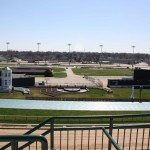 The Kentucky Derby is America’s Oldest, Continuously Held, Sporting Event.
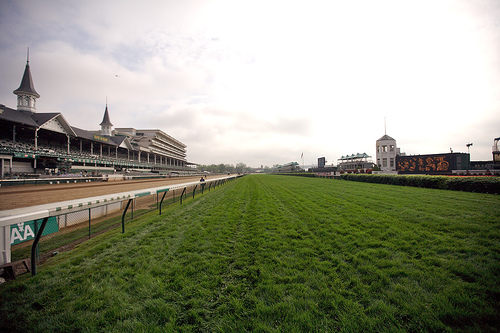
From our Eagle-eye view of the legendary Churchill Downs dirt track, Asher explained, “The track dates back to 1875, when the first Derby was held. We have run the Derby every year, without interruption, since 1875. This year, May 1st, will be 136 consecutive years.”
Asher then elaborated, “We are America’s oldest, continuously held, sports event. We have survived two world wars, The Great Depression, [and] the flood of 1937, which had us underwater.”
In a few sentences, I learned my first lesson. The Kentucky Derby is a testament to perseverance. Not only for the lucky handful who arrive in the winner’s circle – but to those who ensure that the race is run in the first place. And, as Asher would soon explain, Matt Winn embodied the spirit of perseverance.
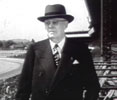 Matt Winn: The Architect of the Revival.
Although the Kentucky Derby had been running for 27 years, the track had never turned a profit at the time Matt Winn began managing Churchill Downs in 1902. When Winn arrived at Churchill Downs, he had a powerful vision for the track. Asher explained:
He really led the revitalization of the track. He had three goals… he wanted the Derby to be a major league sports event – a prominent sports event. …He wanted the race to be much more than a horse race – he wanted the fashion aspect, … the celebrity, all that. He wanted it to be just a huge celebration. Not just of the sport, not just of racing. And, also, he wanted Churchill Downs to be an important part of life in the community year-round, not just when we were racing.
Winn’s vision paid off the following year when Churchill Downs turned its’ first profit in 1903. However, Winn didn’t slow his efforts to revive the track in the wake of his initial success. In furtherance of his vision, Winn would eventually host state fairs on the grounds, locomotive collisions in the infield, bring pari-mutuel machines to the racetrack, and begin radio broadcasts of the Derby.
Asher explained that the community outreach initiatives of Churchill Downs even extended to the Catholic Church. “From the mid-1940s to the mid-1970s, there was a Roman Catholic archdiocese that held a religious celebration here every year – the feast of Corpus Christi. Thousands of people would come out. There was a procession on the track… it was a huge religious celebration.”
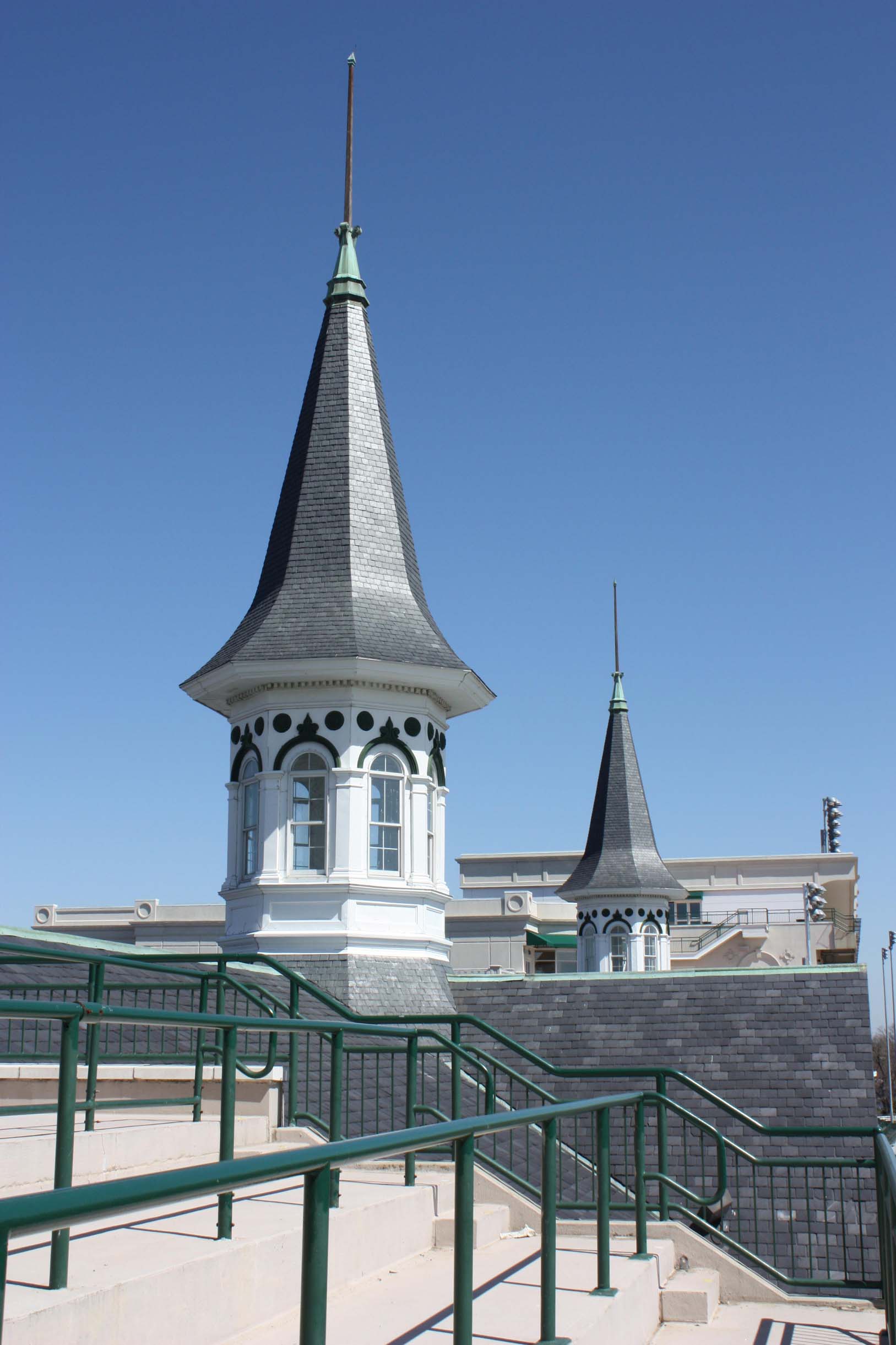
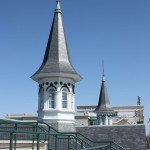 Through hosting community events, the track went beyond horse racing for many guests. In reference to “The Feast of Corpus Christi” celebration, Asher noted, “When you think of the people who came out here, the thousands that came out here, a big chunk of those people would never come to Churchill Downs for a horse race, or to bet a nickel on the nose of a horse. They came out here because Churchill Downs was special to them. Those Twin Spires were special, because of the experience they had here. That’s part of the emotional investment people have in this place.”
In the eyes of Asher, Winn’s vision has become a reality at Churchill Downs today. “Most of the times in a year, you can come up and find something going on. This year, we have Derby and Oaks, which will draw 250,000 people here.” Churchill Downs also hosts weddings, music festivals, and various other events – ranging from the previously hosting a Rolling Stones concert to the upcoming Breeder’s Cup Championship races in 2010.
The Artist’s Muse: Artwork at Churchill Downs.
In a painted collage at Churchill Downs, stands a quote by Irvin S. Cobb, Kentucky native and writer.
“Until you go to the Kentucky Derby with your own eyes, behold the Derby, you ain’t never been nowhere and you ain’t never seen nothing.”
As you walk through the halls of Churchill Downs, the work of many artists is on display in their effort to add their own definition, tribute, or voice to the Derby. Considering the collected pieces of art throughout Churchill Downs, one thing is clear – the Derby has been the muse for several artists.
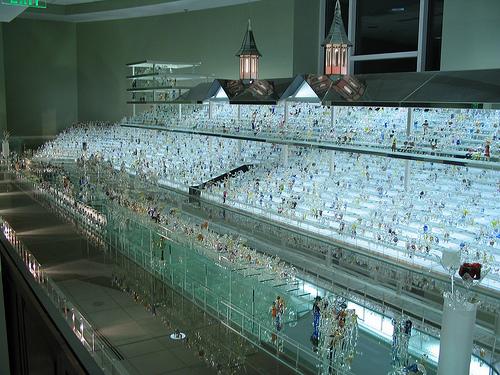
During our interview, Asher showed me a piece of work by artist, Craig Colquhoun, that defies description in ordinary language. In an endeavor to follow his dream of creating something great, Colquhoun constructed a glass replica of Churchill Downs. As we studied the thousands of pieces, Asher explained:
When we were getting finished with the renovation, we got a call from an artist named ‘Craig Colquhoun.’ He says, ‘I’ve got this glass sculpture of Churchill Downs, would you be interested in looking at it?’ We said, ‘Sure.’
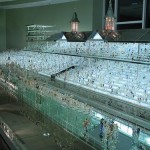 Pointing to the masterpiece standing before us, Asher remarked, “This was it. It is thirty feet long, ten feet wide, ten feet high, and 4,000 individual pieces he made – which represents every part of the Derby experience. [There are] fans in the infield, TV cameras and media, hats, the marching band, roses, ushers, and the horses.”
It was breathtaking.
While viewing the piece, Asher told the tale of the “Leading Horse,” in which the glass horse on the lead mysteriously changes position in the race. “[It’s] one of two things. Right now, it’s in the normal spot. We either have a spirit at work or an employee with a sense of humor. Every now and then, you will come up here and the horse on the lead will be about halfway up. I’ve never heard it explained or seen it explained. I just know the horse moves sometimes.”
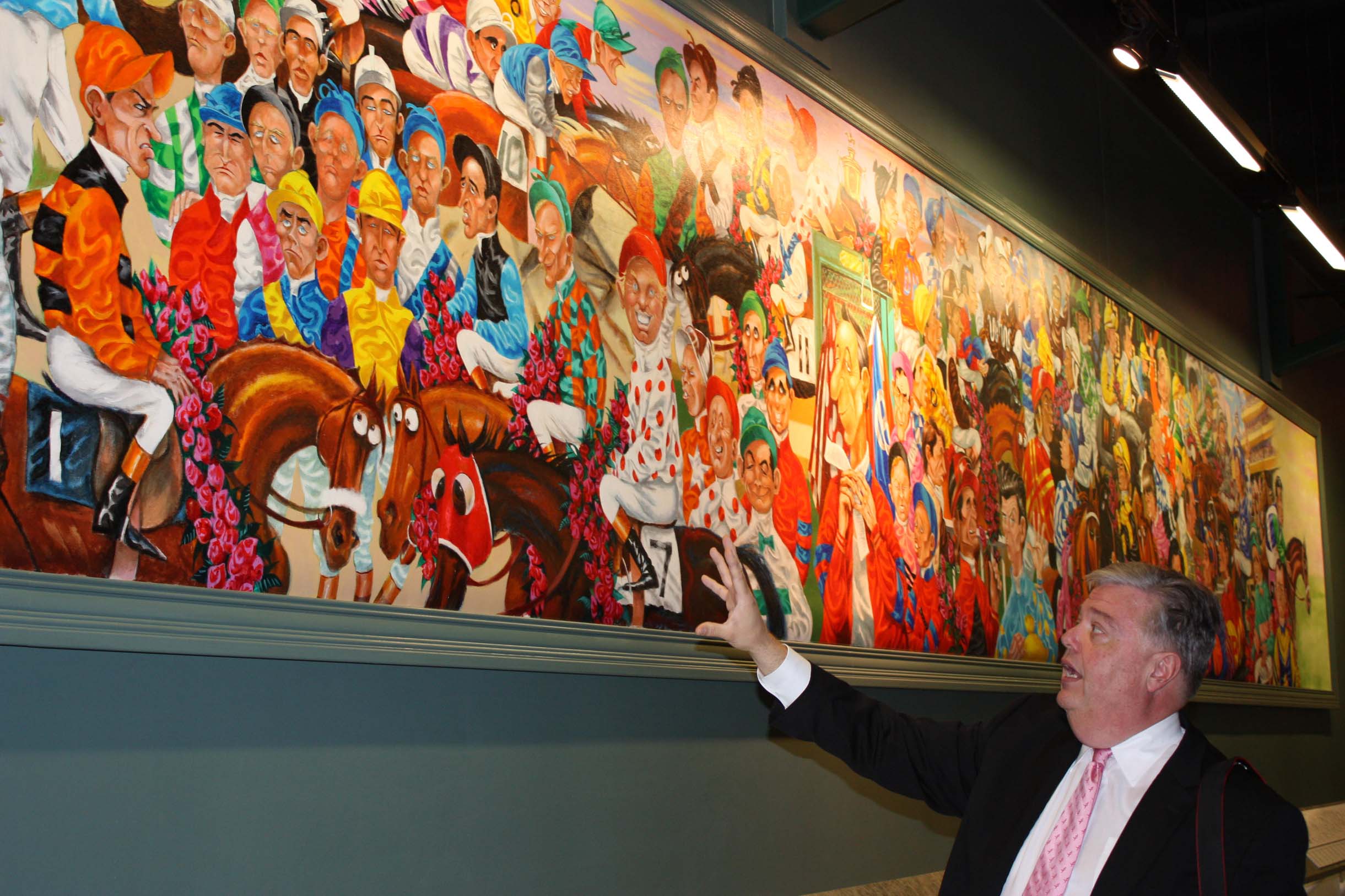
While Colquhoun’s piece tries to capture the “spirit” of the Derby experience, there are also two murals in the clubhouse, painted by Pierre “Peb” Bellocq, that depict the winning jockeys and trainers in the Kentucky Derby.
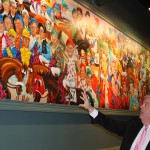 In Bellocq’s mural of the winning Jockeys, the artist has painted every jockey to ever win the Kentucky Derby. Asher explained that the mural is a timeline. The end of the mural used to depict a woman looking forward with a horse in the background that wore “figure eight” silks to symbolize infinity. Later on, the silks on the horse were modified to reflect the silks of Smarty Jones.
In recent years, Calvin Borel’s victories have led to the modification of the jockey’s mural. In 2007, Calvin Borel was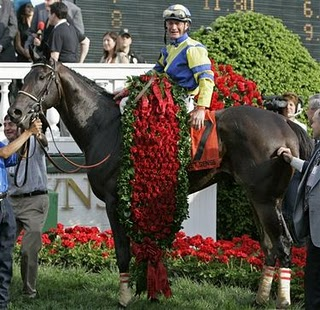 painted into the mural for his winning ride on Street Sense. After Calvin Borel won his second Derby on “Mine that Bird,” the mural was again modified to show Borel holding up two fingers – signifying his two wins in the Kentucky Derby.
After viewing numerous works of art inspired by the Kentucky Derby, it was clear that the race has the power to serve as an artistic muse. When I asked Asher about his opinion on why the Kentucky Derby has the power to inspire artists. He responded:
It’s a dream. I think it’s amazing. The whole thing about the race is a dream. Our purse is two million dollars. …It think we’d have thirty horses fighting to get into the race if we just gave them roses…
It’s the reason we get up in the business every day. If you breed a horse, own a horse, [or] you train a horse. If you’re thinking, ‘Is this horse the one?’ … I think it’s the dream aspect of it.
Building upon the concept of “the dream,” Asher shared his own story about how the Kentucky Derby led to his interest in horse racing. “[It’s] why I’m here. I watched the Derby with my family. We grew up in Kentucky, but we weren’t horse people. I was on a farm. It was my grandmother’s farm and it had nothing to do with horse racing. We were horse racing fans one day a year. We gathered around the TV and one day it just bit me. It’s amazing that I’m here, coming where I came from.”
 The Kentucky Derby: The Allure of the Greatest Two Minutes in Racing.
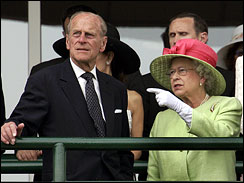
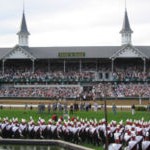
On the first Saturday in May, eyes from all across the world spin around the oval track at Churchill Downs to watch the Kentucky Derby. Guests have included royalty, presidents, and celebrities. In recent years, Queen Elizabeth attended the race.
During our interview, Asher elaborated on why the race itself has such an alluring aspect. “You get one chance. It’s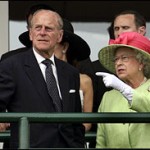 three-year-olds only. One Saturday. Two minutes in the afternoon. … In this year’s crops of three-year-olds, we have a maximum of twenty horses in the gate. And this year’s foal crop is about 37,000 – just in the United States. So, your odds are 37,000 to 1 to start. And that doesn’t include European-breds. …And even if you get here, … there are so many ways to lose a race.”
Despite the odds, the dream of ‘getting to the Kentucky Derby’ continues to captivate many individuals – whether owners, trainers, jockeys, breeders, or fans. Aside from the race, many people arrive at Churchill Downs for the pageantry and celebration surrounding the Kentucky Derby.
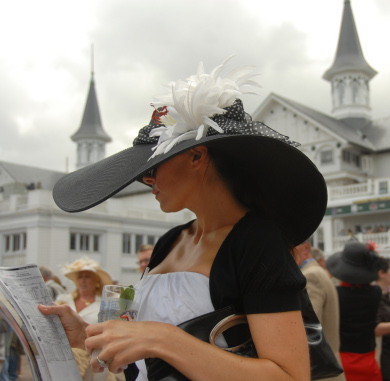
The glamour and tradition intertwined with race is nearly an event in and of itself. With women wearing wide-brimmed hats, celebrities weaving throughout the crowd, and the beloved traditions interwoven with the Kentucky Derby, individuals from all walks of life attend the race.
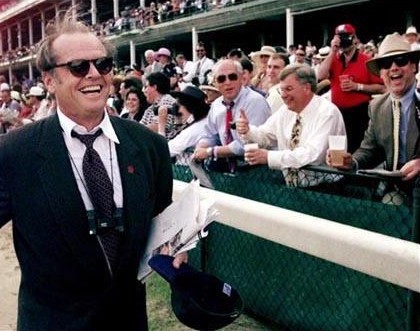
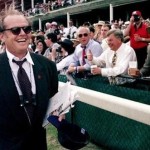 In light of the fan fare surrounding the Derby, I asked Asher which celebrity has drawn the most attention in his experience. He responded, “Jack Nicholson. He’s the biggest celebrity I’ve ever seen at the Derby. He stopped the show everywhere he went. Presidents… Queens… Nobody compared to Jack.”
Aside from the celebration in the stands, the horses on the track rule the day. In response to my question about his most memorable moments at the Kentucky Derby, Asher explained, “My absolute favorite moment is when they walk around the first turn to be saddled before the Derby. They are all coming over and everybody is accompanying the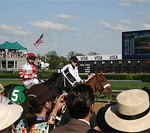 horse. The grooms are there. In a lot of cases, the owners and trainers are there.”
It is a heart-stopping moment. Fans who have labored over choosing their horses finally get to view them in the flesh. As for the connections to each horse, they are moving through the rapture of a dream.
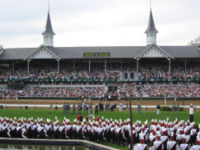
Amidst the electric atmosphere surrounding the race, many individuals point to the moment that the crowd sings, “My Old Kentucky Home,” as an experience that defies description. As the marching band plays the music, it is hard to find a dry eye in Churchill Downs.
During our talk, I asked Asher, “What is it about ‘My Old Kentucky Home’ that makes grown men cry?” He responded, “It is everything about the Derby. It is the dream of everybody in the business. The Derby has got a romance. It just does. You look at the horses that win it, the people who had spent their whole lives in the business… Whatever it is, it touches people in a myriad of ways.”
However, for the hardened bettors, Asher gave a tip. “If you’re not a sentimentalist, it’s the best time to bet because there is nobody at the windows. They’re all outside crying. …Every window is wide-open.”
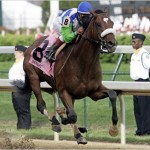 Barbaro: His Memorial at Churchill Downs.
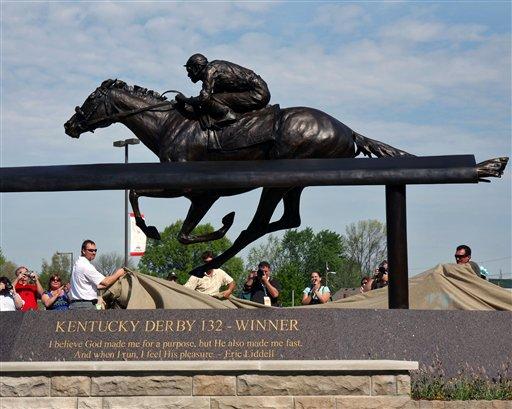
The story of Barbaro struck a chord with many individuals throughout the world. After his death, the decision was made to commission a statue of Barbaro and make Churchill Downs his final resting place.
The inscription under the statue quotes Olympic Gold Medal winner Eric Liddell: “I believe God made me for a purpose, but he also made me fast. And when I run, I feel his pleasure.”
Asher noted that the statue was constructed with a purpose. “The Jacksons wanted all four feet off the ground. That’s the perfect photo of a 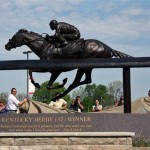 thoroughbred. They are in flight.”
During our interview, I asked Asher about the decision to lay Barbaro to rest at Churchill Downs. He explained, “The Jacksons made the decision [on] where they wanted him to be. They looked at a farm up in Pennsylvania, they looked at Maryland, and they looked at our place. They ultimately decided that this was the greatest moment of his career and they wanted him to be here. We obviously welcomed him.”
In response to my follow-up question regarding his continued fans, Asher explained, “The letters that came following Barbaro were countless. They came from everywhere. We still get them now.”
Secretariat: The Kentucky Derby Track Record.
Throughout Churchill Downs, several photos of Secretariat line the walls throughout the track.
In 1973, Secretariat not only won the Triple Crown, but broke the official track record at the Kentucky Derby and the Belmont.
Regarding the Preakness, the official track clock was broken when he won and the time did not reflect a new track record. However, the Daily Racing Form publicly disagreed with the official time at Pimlico. According to their watch, Secretariat broke the official track record in the Preakness.
If the Daily Racing Form time was correct, Secretariat is the record holder in all three Triple Crown races.
During our interview, I asked Asher about his personal opinion as to whether Secretariat holds the record for all Triple Crown races. He responded, “Yes. For me, it’s no question.”
Asher elaborated, “The official time, I think everybody agrees, was wrong. Everybody who had a hand-held watch got it faster.”
In an interesting follow-up, Asher noted that the Preakness was his favorite performance during Secretariat’s Triple Crown bid.
My favorite race of Secretariat’s Triple Crown is probably the least known. He did something I’ve never seen a horse do in that race. He was dead last going into the first turn and then took off. It looked like jets were firing.
He goes into the first turn dead last [and] he came out of the first turn in front. So, he just passed everyone on the first turn – not the second turn. You just don’t see that happen.
As for Secretariat, Asher is not alone in his reverence for this champion. With the many articles and books written about this Secretariat, it is hard to find any new words to encapsulate his talent. In Asher’s description:
Secretariat is the most amazing thoroughbred ever created as far as I’m concerned. He’s the perfect physical specimen. I don’t know who to compare him to. He’s like Schwarzenegger in his prime. In terms of physical, it’s just a perfect build. He had a heart… bigger than anybody else. That’s the big guy. That’s the one that defines our sport.
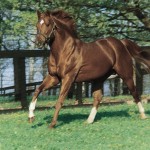 Asher then recapped his visit to meet Secretariat while he stood at Claiborne Farms. When he arrived at the farm, Secretariat was in his hillside paddock. Asher stated:
I was walking through with one of the farm hands. We had heard all these things throughout the years about what a ham he was and how he posed for pictures.
He was at the top of the hill. The groom I was with didn’t speak loudly. He just said, ‘Hey, Red.’
Boom! Here he comes. Flying down the hill. Absolutely flying down the hill. [He] gets to the fence at the end of the paddock where we were standing. He gets there. Stops. And poses.
In his final comments about Secretariat, Asher highlighted that the champion still gets roses and flowers at Claiborne Farm on the anniversary of his birth and death.
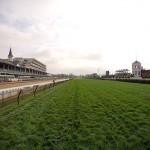 The Last Word: Asher on the Art of Handicapping
Among his many talents, Asher is widely-known for his handicapping picks relating to the Kentucky Derby. He explained that he changes his choices every Sunday during the prep race season for the Derby.
Handicapping a horse race is no easy feat.
In response to my question as to whether he ever wishes that he could change his picks on Derby day, Asher responded with a recap of the upset delivered by Mine that Bird in the 2009 Kentucky Derby:
Yes. I wanted to change it last year. … I was sitting there watching the race with my daughter on Derby day. I’m looking up. …I said, ‘Aww, Eight is the winner.’ And, I go, ‘Who is Eight?’ And I looked at my program and realized it’s Mine that Bird with Calvin at 50 to 1. And for the next quarter mile, I couldn’t believe it. As soon as he crossed the finish line, I looked at my daughter and said, ‘You know, I’m not sure, but I think I picked him dead last.’ When I looked, sure enough. Dead last.
However, Asher has a good sense of humor. He appears perfectly at ease with being proven wrong in a race. “It’s very complex. It’s one of those businesses where, if you don’t learn something every day, you’re not paying attention.”
April 1st, 2010 §
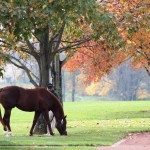
Smarty Jones captivated the nation in his bid for the Triple Crown in 2004. When he won the Kentucky Derby, the track announcer called out more than his victory. “Here is the first undefeated winner of the Kentucky Derby since Seattle Slew in 1977.” The public and industry began to marvel at the Triple Crown potential of Smarty Jones.
Following the Derby, Smarty Jones maintained his undefeated record by delivering an electrifying 11-1/2 length victory in the Preakness Stakes. As he pointed toward the Belmont, Smarty Jones had captured more than another win in his career – he had enlivened the imagination of spectators and won the hearts of fans across the nation.
As he entered the gates in the Belmont, Triple Crown dreams weighed heavily on Smarty Jones. Throughout most of the race, he ran at the top of the field. At the wire, Birdstone defeated Smarty Jones in a one-length victory. As the jockeys of both horses galloped from the finish line, Edgar Prado, rider of Birdstone, leaned toward Smarty Jones’ jockey, Stewart Elliott, and apologized.
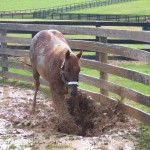 Smarty Jones retired in 2004 with a career record of winning eight of his nine races. He was sent to Three Chimneys Farm and housed in the former stall of Seattle Slew, the only undefeated Triple Crown winner in history.
In 2005, Smarty Jones reportedly had visitors every day at the farm, except for Christmas. Three Chimneys Farms graciously allowed me to join the many individuals who have come to visit Smarty Jones and provided me with an interview about this exceptional horse.
JW: What were the primary factors that led to the decision to retire Smarty Jones to Three Chimneys Farm?
TCF: The Chapmans had never before had a horse of this caliber and were very thorough when choosing a farm at which to stand Smarty at stud. They obviously wanted a farm that was well-versed in successfully marketing and developing young stallions, but they were also keenly concerned about finding a farm that would allow the public to maintain their relationship with Smarty once he was retired to stud.
With Three Chimneys having managed the careers of such popular fan favorites as Seattle Slew, Silver Charm and others, we knew how to accommodate the public’s desire to have access to the horses without jeopardizing the horses’ stallion careers and the focus on presenting them in the best possible light to potential breeders.
‘Three Chimneys was such a great fit. They are used to having the public visit their horses like Seattle Slew, Silver Charm and Point Given,’ said Pat Chapman, who raced Smarty Jones with her late husband, Roy, and still maintains significant ownership in the horse as a stallion. ‘They believe in limiting a stallion’s book of mares, and they are experienced in standing an important horse and making him a success as a sire. It’s just a really great fit.’
At the time of the announcement that Smarty Jones would stand at Three Chimneys upon retirement, Three Chimneys owner Robert Clay was quoted as saying the following:
‘We are grateful for this awesome responsibility. This is a very special horse in so many ways. The Chapmans and the Servises have earned the gratitude of the entire racing world by the way they have served the needs of the press, and the public, and of Smarty Jones all at the same time. We hope, and plan, to do just as good a job as they have done. We have always welcomed fans to Three Chimneys Farm and look forward to sharing Smarty Jones with his public.’
JW: Was the decision to retire Smarty Jones to Three Chimneys Farm made prior to the Belmont race or afterward?
TC: The decision to retire Smarty was made after the Belmont Stakes, but not in any way due to that race being his first and only loss. When the Chapmans chose Three Chimneys as the farm to stand Smarty at upon his retirement, it was with the intention that he would get a nice rest after a demanding Triple Crown bid, then go on to race in the late summer and fall of his three-year-old year and possibly as a four-year-old.
Soon after the Belmont Stakes, it was found that Smarty had significant bone bruising on the bottom of all four cannon bones. While it is a fairly common injury for racehorses to sustain and many come back after some time off to race successfully, the Chapmans were not willing to risk putting Smarty Jones in harm’s way.
‘After all he’s done, I couldn’t live with myself if I thought we were putting him in harm’s way,’ said Pat Chapman. ‘He doesn’t owe us anything, and we owe him A LOT.’
JW: Was the decision to house Smarty Jones in the former stall of Seattle Slew a tribute to Smarty Jones’ near-miss in his Triple Crown bid?
TC: In a way, yes. Smarty was one of few horses that has truly captured the attention and interest of the general public. Whether someone was a horseracing fan, a general horse enthusiast, or simply an ‘average Joe,’ they knew about Smarty Jones and his ‘Rags to Riches’ story. Seattle Slew was another horse who carried with him that ‘celebrity status.’
When Smarty retired to Three Chimneys, we wanted to pay homage to all that he had accomplished on the track as a runner, but also for the sport in general. He brought so many new fans into the racing industry. Even in his retirement here at Three Chimneys, he gets tens of thousands of fan visits each year.
When visitors walk up to his stall, they see his nameplate on the door and, as with every stall in our stallion barn, if they look up to the right corner above his stall, they will see the nameplate of the previous occupant. Above Smarty’s stall is the nameplate of Seattle Slew.
JW: Why do you think the public experienced such a strong connection to Smarty Jones?
TC: Smarty was kind of a blue collar horse. He was modestly bred, hailing from, at the time, a $10,000 stallion and was born and raised in Pennsylvania, which was also where his home track of Philadelphia Park was located.
He overcame adversity as a youngster when he had a serious, potentially career and even life-threatening, accident while schooling in the starting gate. Then, when it came time to show what he was made of, he just kept on winning and winning.
Every bar that was set for Smarty, he exceeded, which is how he got to the Kentucky Derby as one of only a handful of horses to ever win the Derby to remain undefeated.
Another very compelling side to the story was the connections of smarty Jones. His owners/breeders Roy and Patricia Chapman were living a fairytale. Smarty Jones was the best horse they had ever raced and they were kind and gracious with both the media and his many fans.
Their trainer, John Servis, was also living the dream, as Smarty was his first Kentucky Derby starter and propelled his career to new heights. The public was able to connect with the Chapman’s and John Servis because they were appreciative of Smarty’s many fans and willing to give them access to their lives.
 JW: How would you describe the character and temperament of Smarty Jones?
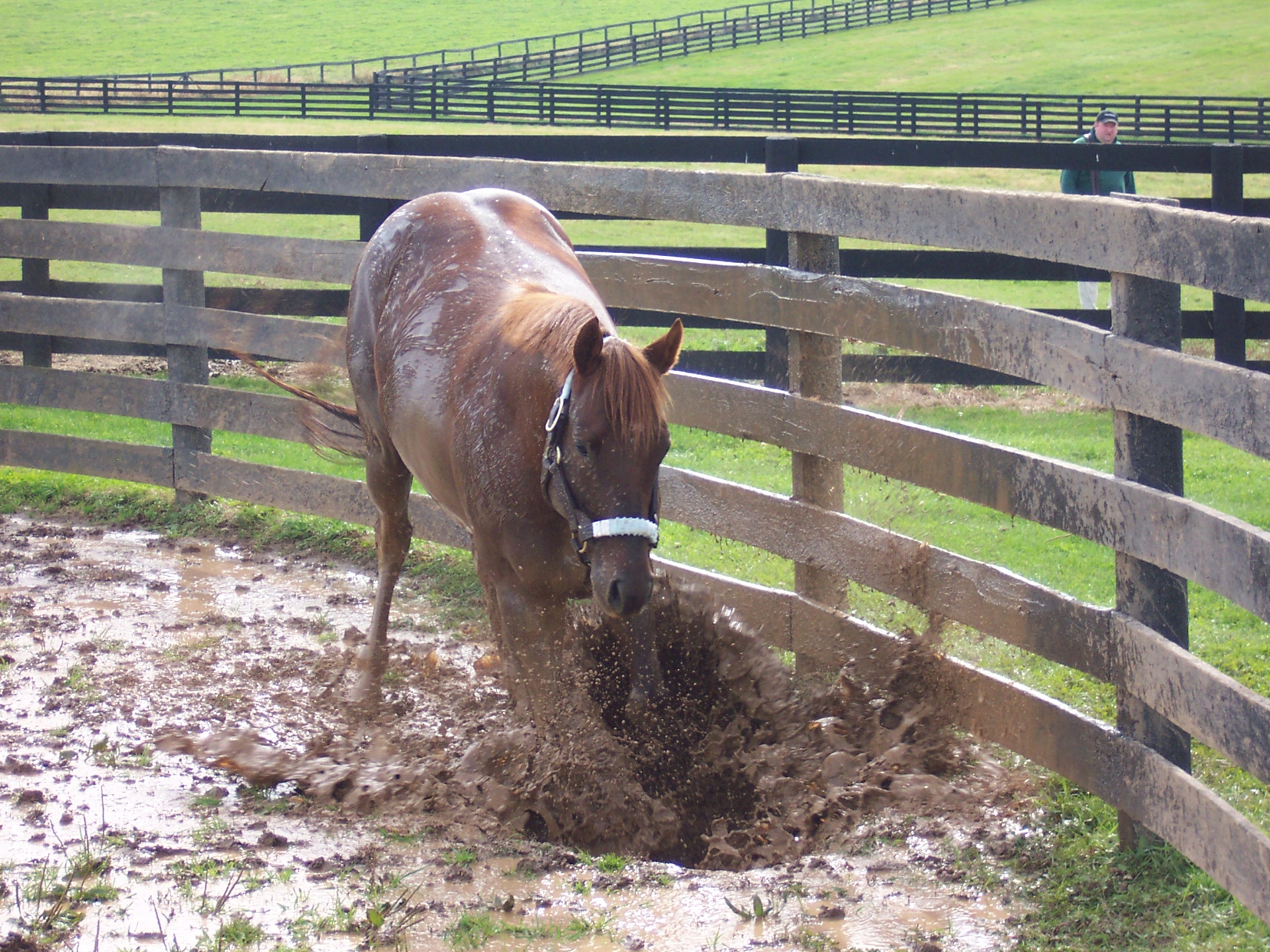
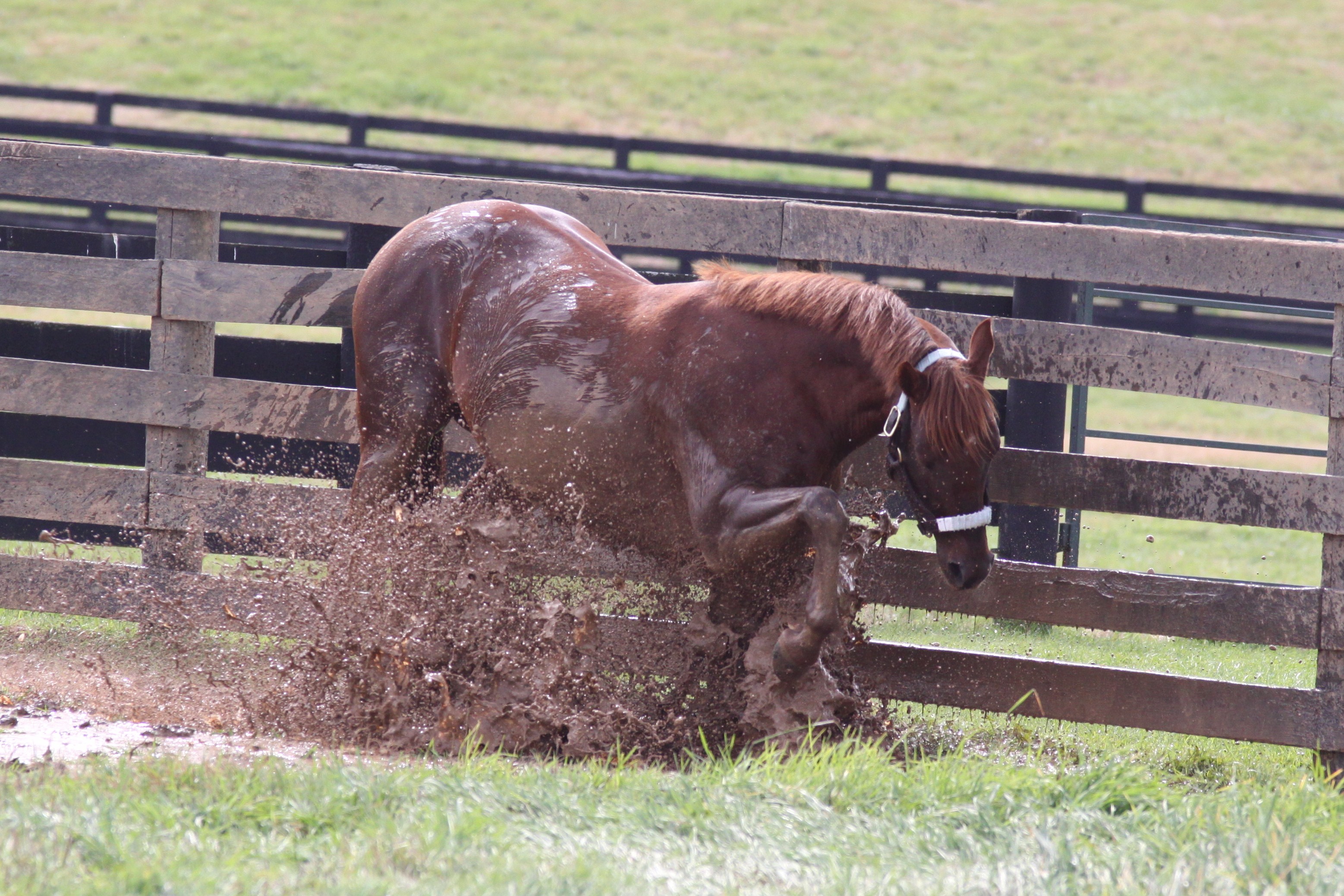
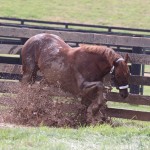
TC: Smarty sure isn’t a dummy! He enjoys his daily routine, which includes coming in from his paddock in the morning and being walked, bathed, and fed (he’s especially a fan of the feeding portion of that routine). He’s actually not one to crave a lot of human interaction. If it was his choice, he’d probably opt out of his daily grooming and would prefer to say dirty.
He’s a huge fan of mud, which seems to fit right in with his disdain for grooming. After a good rain, the lower corner of his paddock can get especially soggy and, as soon as he’s turned out on a day like that, he goes straight for that corner and starts working on his ‘mud masque.’
He loves peppermints and, while we can’t give him all of the treats his fans send him throughout the year, we do make sure that there is a never-ending supply of mints in the tack room that the grooms pamper him with.
JW: Smarty Jones has produced several foals in the past few years. Can you discuss some of the notable racehorses among his progeny?
TC: Admittedly, Smarty’s offspring didn’t give his career at stud the launch we had anticipated initially, however, he has had high caliber runners each year since his first crop hit the track and recently he’s had several of the best few months of his career. Some of his current budding stars include:
Backtalk is going to the Illinois Derby and, if all goes well, to the Triple Crown
Brilliant Sunshine was so impressive with her last two wins (broke maiden by 4-1/4 under wraps, then won an allowance by 7 being geared down) that she’s being pointed for her first stakes start next time out; she was profiled in the TDN’s “Sharper Focus” section last week as a horse to watch.
Follow the Leader is 4-3-1-0 (all in Msw and Alw company) and is likely headed for stakes competition – owned by the President of Oaklawn.
Keiai Gerbera won an allowance in January and came back to score a 5 length win in a stakes race in Japan over a field of 15 males – she was the only female in the race.
No Equipment won first time out by 8 lengths at Philly Park
Gracie Jones won second time out so impressively that she’s being pointed toward the Oaks Trial S. with the goal of starting in the South African Oaks later this year. Creating a LOT of buzz in South Africa – Smarty’s only runner in that country.
Sommelier Smarty is unbeaten in 2010 and is riding a 3 race winning streak.
JW: In terms of breeding, what are traits that make Smarty Jones desirable at a stud?
TC: Smarty Jones has a unique and obviously very favorable combination of good looks, balance and athleticism. He is a 16-hand powerhouse and his offspring resemble him, with that distinctive head, big hind-end, and cocky attitude.
Some of his best foals have been out of mares from the Seattle Slew and Deputy Minister lines and is working well with mares carrying Northern Dancer blood, especially Danzig and Storm Cat daughters.
JW: In your estimation, how many fans have visited Smarty Jones since he retired to Three Chimneys Farm?
TC: Smarty Jones and the rest of our stallions are greeted by at least 25,000 a year. Due to the high demand from fans to see our stallions, starting way back with Seattle Slew, we had to build a visitors’ center separate from our main office and an auxiliary parking lot due to all of the additional traffic.
We expect to FAR exceed that 25,000 visitor estimate this year. Due to the World Equestrian Games being in Lexington this fall, we have had numerous requests (we’re talking about hundreds upon hundreds) to see Smarty and the rest of the stallions and the farm. Due to the vastly increased demand during this event, we are modifying our tour schedule to be able to accommodate as many requests as possible.
To comment on this post, click here. The Saturday Post has recently launced a Facebook Page. To follow us on Facebook, click here.
March 30th, 2010 §
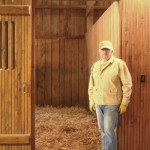
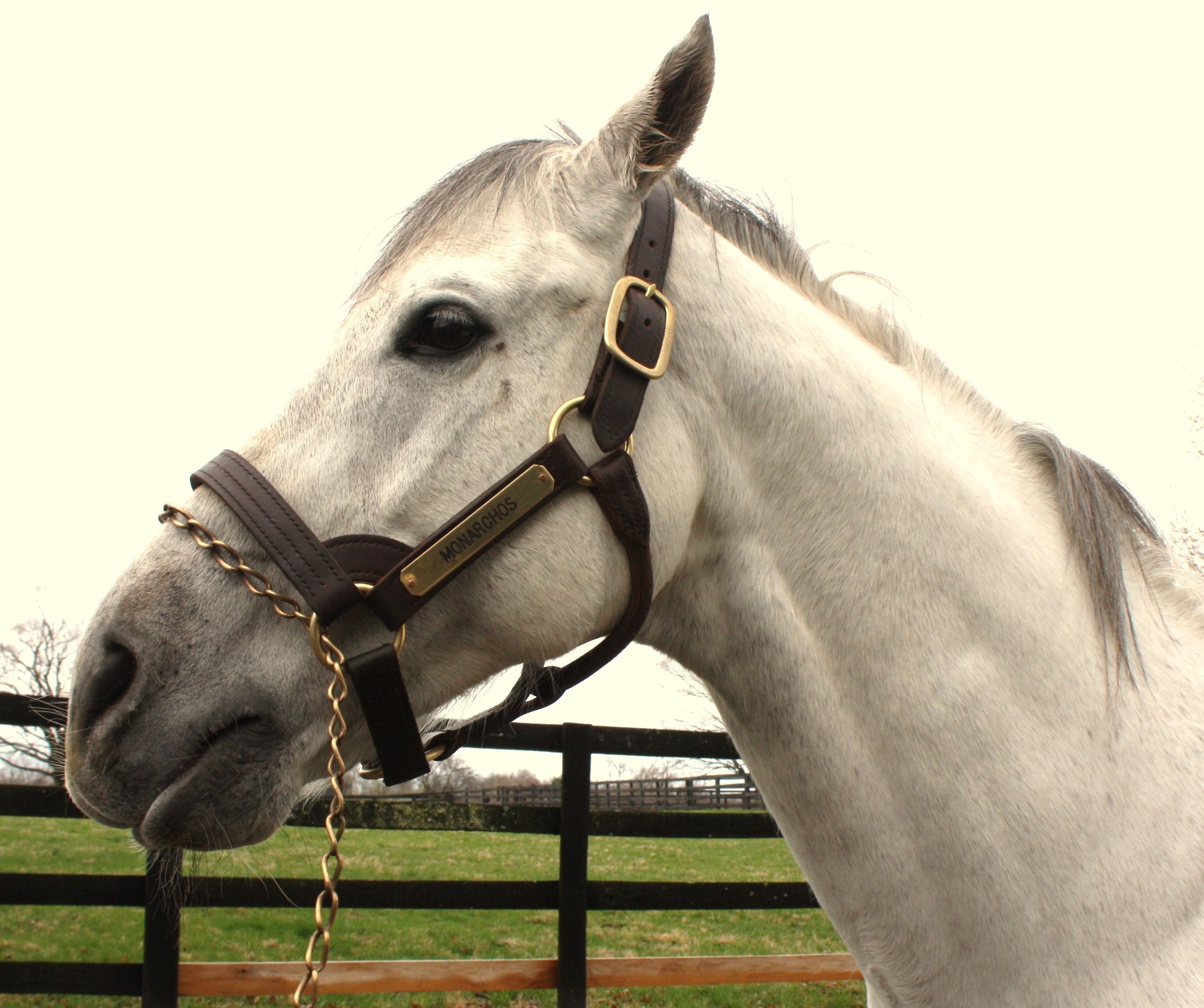
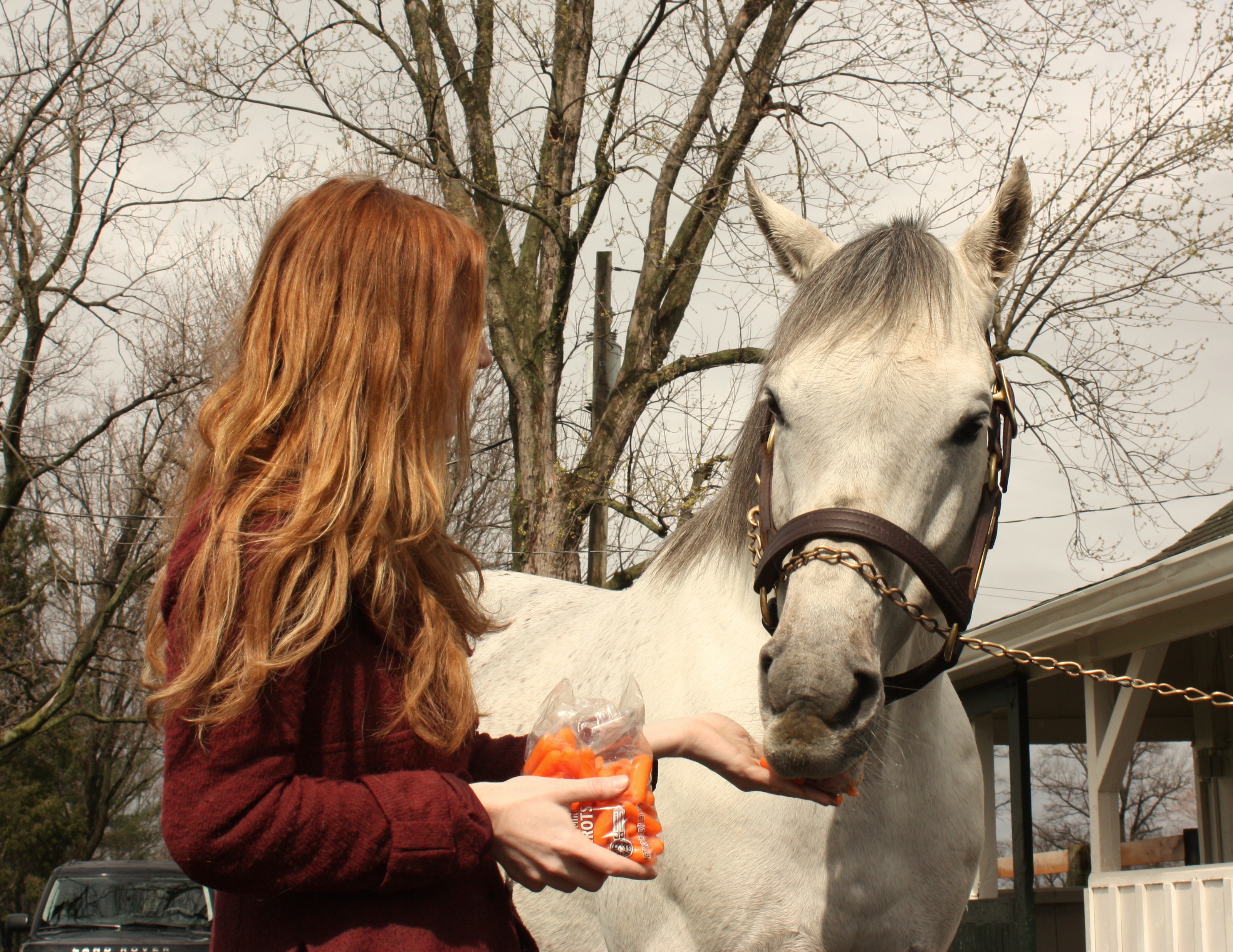
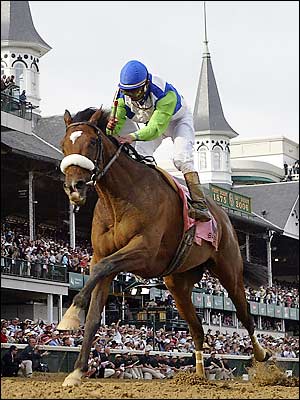
In the 2001 Kentucky Derby, Monarchos blazed toward the wire to win with a time of 1:59 4/5 – just two tenths off the record time of Secretariat. In less than a second, Monarchos had become the fastest living Kentucky Derby winner.
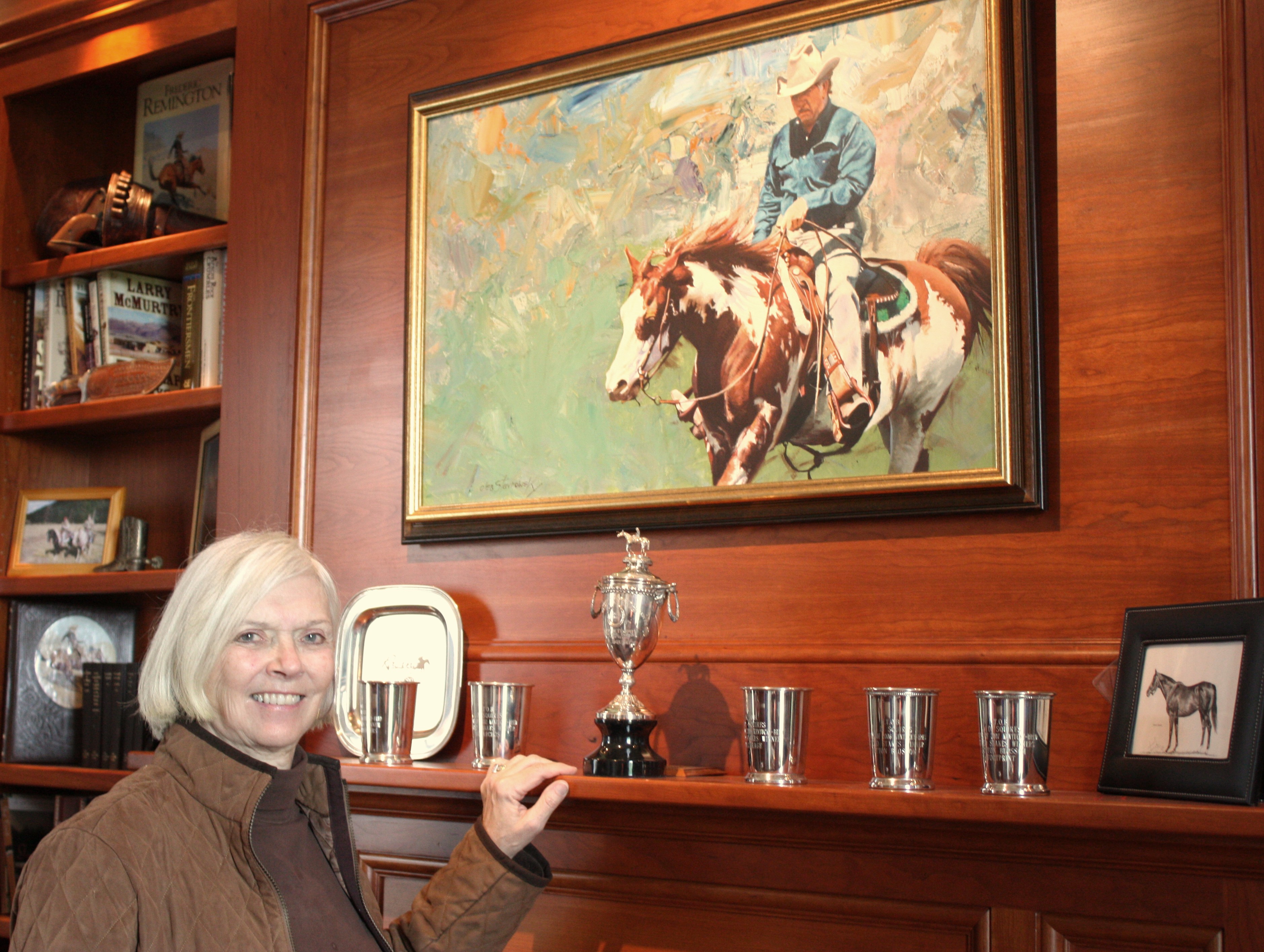
The man behind Monarchos, breeder Jim Squires, stood in the crowd in disbelief. Having retired from his profession as a journalist, Squires had just witnessed a steel gray colt blur the ordinary lines between fact and fiction.
Squires was now cast as a subject in one of the most fantastical stories in horse racing.
Born in Tennessee as the son of a textile-mill worker, Squires was fascinated by horses as a child. He would draw horses when he was in first grade rather than concentrating on arithmetic and save his money to ride “Tony,” a carnival pony, for a nickel.
As we stood watching a two-year-old colt breeze across a track, Squires quipped about how “Tony” would bite him on his legs when he rode him. He laughed as he remembered his mother making him wear pants in the summer since his legs had bite marks from riding “Tony” during carnival season.
As an adult, Squires worked as a journalist. When he moved to Illinois to become editor of the Chicago Tribune newspaper, he brought two cutting horses with him from Florida.
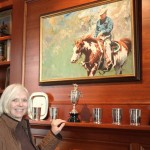 While searching for a home for his horses, he met his wife, Mary Anne, a Chicago native and Northwestern graduate. She had been working as a real estate agent and was selling farms in the Barrington Hills area. Squires married Mary Anne six months after their meeting and they lived on the farm he had purchased.
In 1988, the couple moved to Kentucky and formed their current farm, “Two Bucks.” They bred Paint horses, cutting horses, and Quarter horses. Jim Squires began to write books in his retirement.
After serving on the Kentucky Racing Commission, Squires developed a growing interest in thoroughbreds, which led him to purchase a few mares. As his mare population increased, Squires found Regal Band, Monarchos’ dam, at a Keeneland sale in 1995. When she failed to meet her reserve price, Squires later purchased Regal Band for $14,000.
Squires eventually made the life-changing decision to breed Regal Band with Maria’s Mon. In his book, Horse of a Different Color, Squires explains how both horses “had fallen a good ways from the thoroughbred aristocracy” at that point. He recounts, “…Only the offspring would determine the worth of the parents and the wisdom of their union.”
In a few golden fractions, Monarchos validated Squires’ belief in the value of these two horses. Their union had proven genius.
During my recent visit with the Squires, I not only learned about Monarchos, but also, the amazing character of these two people. Their kindness and generosity is as astonishing as Monarchos’ near record-breaking victory. I would like to extend the warmest thanks for the following interview.
JW: When did you gain your appreciation for horses in life?
JS: Two of my earliest memories are of being hoisted upon the back of a red pony named Peaches by a grandparent (I couldn’t have been more than three or four years old at the time), and not long after that standing at a fence flirting with a group of Palomino ponies at eye level on the other side.
I suspect these are what ignited a horse gene passed down from Cherokee Indian ancestors on my mother’s side. I remember drawing horses on my tablet in the first grade when I should have been learning arithmetic and dreaming about them at night.
JW: Prior to starting your farm, “Two Bucks Thoroughbreds,” you were Editor-in-Chief of the Chicago Tribune newspaper. What led to your decision to move to Kentucky and begin breeding thoroughbreds?
JS: When I became editor of the Tribune, I already owned some riding horses, so I purchased a small farm in outlying Barrington Hills, an equine community where and Mary Anne and I soon became active in the breeding and showing of American Paint Horses.
Ten years later when I left the Tribune, we owned two stallions and 20 mares and Kentucky seemed like the ideal place to move them. We had no intention of raising Thoroughbreds but it is difficult for a horse person to live in the Bluegrass without falling in love with them.
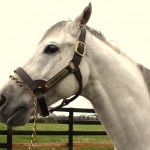 JW: Monarchos was a product of sire, Maria’s Mon and broodmare, Regal Band. What did you see in these two particular horses that led you to determine they would be a good breeding match?
JS: My quarter and paint horse experience of the previous 15 years had given me a basic understanding of equine conformation and breeding patterns, particularly a belief in the importance of female families as the conduit of good genes.
Regal Band was from one of the best families in the Jockey Club book that already produced a great mare Andover Way and a great stallion Dynaformer. Equally important was the fact that physically she resembled the dam of Doc Bar, an immensely influential sire of performance quarter horses.
I had watched Maria’s Mon win a 2-year-old race in New York and believed him to be the toughest, soundest and best-looking of all the freshman sires in my price range—and he fit my breeding theory in that he had descended from two good broodmare sires—Caro and Wavering Monarch.
JW: You were in the stable when Monarchos was born and watched his early development. Did he stand out from the other foals?
JS: By the time Monarchos was born, I had probably foaled 150 babies. Of those none came into the world brighter eyed and more ready to go. He was small, black as coal with a very big, bright eye, a lovely sloping shoulder and his mother’s star. Within a very few minutes—15 or 20 at the most—when startled by a cat in the rafters he got to his feet with ease and never once fell backwards.
Within a few hours, he was a whirling dervish doing circles around his mother and later as a weanling running, running, running long after his mates were winded, which is exactly what happened at Churchill Downs.
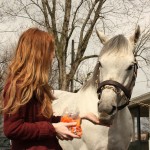 JW: When I met Monarchos during our visit, I found him to be a very gentle and kind horse. What factors do you believe contribute to good temperament in a horse – breeding, training, or both?
JS: Both I suspect. I never saw any mean temperament in any of Regal Band’s foals. But I give more weight to the latter. How a horse comes to relate to humans and other horses is probably behavior learned directly from the mother and the people who handle them. I believe the success of Two Bucks horses at the racetrack has a great deal to do with how we raised them on the farm.
JW: Can you describe how you felt when Monarchos won the 2001 Kentucky Derby?
JS: It took me an entire book - Horse of a Different Color - to describe it. And even then I failed to do it justice. I was up on the roof of Churchill Downs with the press photographers, most of whom I did not know. And they did know me.
Disbelief might have been the first emotion, realization of the extraordinary luck in involved the second. I did, however, lose my hearing for five or ten minutes afterward. I could see clearly, but heard nothing until I found Mary Anne in the crowd on the floor below. From that point on, it was a blur for a couple of days.
JW: Monarchos has the second fastest winning time in the Kentucky Derby. Do you think that Monarchos had the capacity to beat Secretariat’s track record in the 2001 Kentucky Derby?
JS: Jorge Chavez wrapped up Monarchos after he passed Congaree so easily and later said he could have gone a fraction or two faster had he known he was close to the record.
JW: Would you have enjoyed it if Monarchos had set the new track record for the Kentucky Derby?
JS: All of us connected with Monarchos were pleased to hear what Chavez said. Monarchos was indeed a very fast horse and had already proven that in the Florida Derby. But the Churchill Downs track surface was faster that day than normal.
A couple of records had been broken earlier in the day and the pacesetter in the Derby—Songandaprayer—had taken the field faster than it had ever gone before, setting records for the first few fractions. So a new Derby record would have always been suspect and an asterisk in the minds of many.
Secretariat is such an icon his record should last forever.
JW: You have been called a “Breeding Genius.” What do you think are the key elements that are present in a well-bred racehorse?
JS: The Breeding Genius moniker is a joke stemming from the point of view from which Horse of a Different Color was written. A friend of mine, the novelist Jane Smiley, once told me that after you reach the age of 50, a writer best writes with his tongue in his cheek. I did that in that Horse, writing from the third person as if the Breeding Genius (myself), and the Dominant Female (my wife Mary Anne) were characters in a piece of fiction.
Any success I have had as a breeder of horses - quarters, paints and thoroughbreds - can be contributed to an enormous amount of luck, great Kentucky ground, a well-constructed feeding program; faith in the power of female genes; and a wonderful way of dealing with horses that I learned from the experiences and teachings of two old cowboys—Tom and Bill Dorrance. What I learned from them and their followers cannot be overestimated as a factor.
JW: Do you believe that you could breed a future Kentucky Derby winner?
JS: The odds are not good. But once you do it, you never stopped trying until you run out of money or energy. I am growing shorter on both.
JW: What have been some of your most memorable moments in your years of breeding thoroughbreds?
JS: Nothing can compare with winning the Derby as a positive emotional experience.
Unfortunately, not all memorable experiences are positive. Both Regal Band and For Dixie, another great broodmare who produced several great horses including one that sold for $2.3 million long after we no longer owned her, both died at my feet.
So did my favorite riding horse and my favorite quarter horse champion mare.
But as long I keep raising horses, the memorable moments both positive and negative will keep on coming. That is the beauty of spending time with these magnificent creatures.
Jim Squires authored “Horse of a Different Color,” which is an exciting and informative book about his breeding farm and his experience with Monarchos. To view this book on Amazon.com, click here.
To comment on this post, click here.
The Saturday Post has recently started a Facebook Page. To join our group, click here.
March 15th, 2010 §
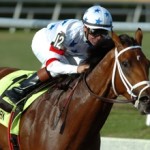
In 2008, Big Brown captivated the American public with his flashy wins and charismatic bid to win the Triple Crown. With a career record of seven wins in eight starts, he defied the odds in several races and produced mind-bending accomplishments on the track.
As a two-year-old, Big Brown broke his maiden at Saratoga in a dazzling 11-1/4 length victory. When he entered his three-year-old season, Big Brown won four consecutive races between March 5 and May 17, including the Kentucky Derby and Preakness.
In the Kentucky Derby, Big Brown won by a thrilling 4-3/4 length victory after having had only three prior career starts. He became the only horse in history to win from the 20th gate post.
Entering the Preakness, Americans fixed their attention on Big Brown after his dominating win at the Derby. Big Brown delivered an astonishing 5-1/4 length win in the Preakness. When all eyes turned toward Big Brown in the Belmont, he experienced the sole heartbreaking loss in his career. However, his tremendous presence and star quality drew new fans into the sport of horse racing – the fourth largest crowd in history showed up at the Belmont Stakes to watch Big Brown make his bid for the Triple Crown.
Prior to retiring, he won his last two career starts – the $1,000,000 Haskell Invitational (Grade 1) and the $500,000 Monmouth Stakes. Jockey, Angel Cordero, encapsulated the exceptional talent of Big Brown: “He’s like a car – he comes with everything. Just step on it, and you’re there.”
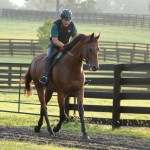 Since his retirement, Big Brown has bred over 100 mares at Three Chimneys Farm. As the first foals by Big Brown are emerging at various stables, he continues to make his mark on the sport of horse racing. This year, Big Brown will travel to Australia to stand at Hunter Valley farm.
Prior to his anticipated departure for Australia, Three Chimneys Farm graciously provided me with an interview. After chasing him from the Derby to the Belmont, I was elated to finally catch up on Big Brown.
JW: After winning the Kentucky Derby and Preakness in 2008, Three Chimneys Farm struck a deal to stand Big Brown prior to the Belmont race. At the time the decision was made, did the farm believe that Big Brown was going to win the Triple Crown?
TCF: We thought he had a better chance than just about any horse in recent decades. From his first start to his runaway win in the Preakness, he really hadn’t been tested. His rivals couldn’t even get close to him and in the Preakness, running against some of the best of his generation, he won under wraps by 5 ¼ lengths.
JW: What are the overall qualities about Big Brown that led to the decision of Three Chimneys Farm to acquire him for breeding?
TCF: Obviously the brilliance he showed in his first three races was a major factor. He achieved a series of “firsts” and “bests” that rank him with the all-time greats, such as being the first horse to win from the 12 and 20 posts in the Florida Derby (G1) and Kentucky Derby (G1) respectively. On top of that, he ran the best Ragozin number in Kentucky Derby history. He’d come to the Derby virtually untested, and on racing’s biggest day, left the rest of the field eating his dust.
Combined with that is his physical appearance. He is beautifully conformed and well-balanced. He’s not too big or small; not too heavy or light. The way he’s built makes for an effortless stride, allowing him to float across the track with minimal exertion.
From a pedigree standpoint, he’s inbred 3 x 3 to Northern Dancer, making him a likely candidate for crossing well with Mr. Prospector-line mares, not to mention Halo, Roberto, Seattle Slew, and Blushing Groom strains as well.
Also factored into the mix is his temperament, which couldn’t be better. We saw time and time again during his racing career that he took everything in stride. He’s level-headed, intelligent and kind. He doesn’t fight his rider in the morning or in a race and, as a result, is not hard on himself whatsoever.
JW: Big Brown has bred with over 100 mares in his first season. How is it determined which mares are bred with Big Brown?
TCF: We have an expert pedigree consultant on staff at Three Chimneys by the name of Anne Peters. She looks at the pedigree of each mare submitted to Big Brown and also considers the physical qualities the mare possesses, any soundness issues on either the sire or dam’s side, and other factors.
Based on what similar breedings have resulted in the past and what the mare has produced or accomplished herself on the racetrack, Anne makes a judgment as to whether the mare would be a suitable mate for Big Brown (this is done with mares submitted to all of our stallions).
If, for example, she feels the mare would not pair up well with Big Brown, she then suggest other mating options (either stallions at our farm or at other farms) that might pair up more favorably.
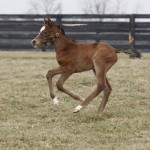 JW: The first reported foal by Big Brown was born on January 12, 2010. How many foals by Big Brown do you anticipate being born this year?
TCF: We limit all of our stallion’s books so as not to saturate the market with their offspring and so the horse is not over-used, so we expect Big Brown to have a crop of around 100 foals. 71 of the mares he was bred to are either stakes performers or stakes performing producers, so it is definitely a quality book.
So far, the feedback we’ve received has been extremely positive regarding his foals. He’s really stamping them with his build, athleticism and balance and they seem to have his temperament as well. Obviously mares come in all shapes and sizes, but his foals are surprisingly similarly built.
JW: On the track, Big Brown produced flashy wins and had an intimidating build. Having had the opportunity to establish a more intimate understanding of this horse, how would you describe Big Brown’s personality?
TCF: Big Brown is the epitome of a healthy, happy horse. He has an outstanding temperament in that he is not easily rattled and is quite personable. We ride our stallions 6 days a week (they gallop a mile and a quarter) and Big Brown just floats around the track with his ears pricked – if horses could smile, they would look like Big Brown under saddle.
That’s not to say he doesn’t have a bit of a wild side. Some days he puts on quite a show in his paddock for visitors who come to the farm for our daily tours. He loves to kick up his heels and tear around his paddock, throwing in a playful rear here and there just for fun.
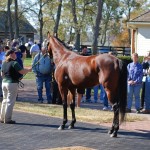 JW: In his retirement, does Big Brown continue to receive attention from fans and visitors?
TCF: Three Chimneys began offering daily public tours when Seattle Slew stood here and still conducts them five days a week. We estimate that our stallions receive more than 25,000 visitors a year from the tours alone and the horses that we receive the most requests to see are Big Brown and Smarty Jones.
We also have a visitors’ center near our main office, where tourists gather before and after the stallion division tour to see photos of the stallions, purchase hats with a stallion’s name and silks on them, and look through farm literature and all of the fan mail our stallions, especially Big Brown and Smarty Jones, receive (and they do receive A LOT of fan mail).
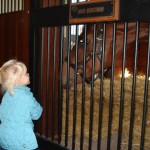 JW: Does Big Brown have any unique personality traits or favorite items?
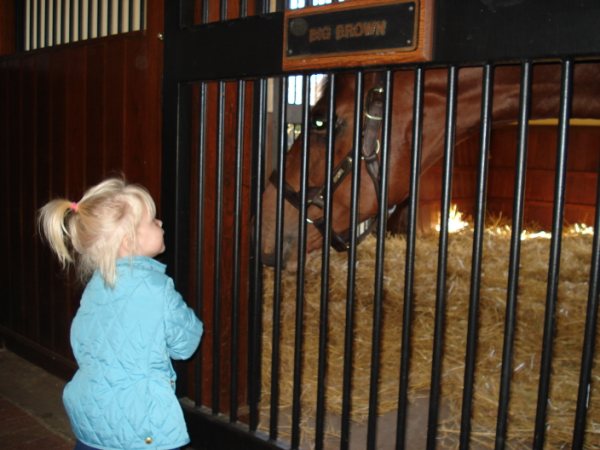
TCF: Big Brown loves peppermints and butterscotch candy. He also seems to be fascinated with children. Anytime a child comes to the front of his stall, Big Brown lowers his head to greet them.
This past fall we also saw Big Brown’s uncanny ability to adapt to any situation. Make A Wish brought a child out to meet Big Brown. The child had severe disabilities, so petting Big Brown was a very slow process (and wouldn’t have been possible without that wonderful temperament he possesses). Big Brown stood like a statue while the child pet his mane and shoulder and even pressed the “go button” birthmark on his side. The child’s eyes were wide and bright and he let out numerous giggles, bringing tears to the eyes of his parents and just about everyone else in attendance.
JW: Recently, it was announced that Big Brown will be shipped to Australia to stand at Hunter Valley Farm. What led to this arrangement and do you anticipate that Big Brown will return to Three Chimneys Farm in the future?
TCF: Big Brown’s pedigree is highly desirable in the Australian market, as it matches up favorably with many of the mares in that part of the world. Big Brown will shuttle, meaning that he will ship to Australia (accompanied by his groom) and stand the Southern Hemisphere breeding season, which is during the opposite time of year as our Northern Hemisphere breeding season.
Once the Southern Hemisphere breeding season has concluded, he will travel back to the United States to Three Chimneys. This will be an ongoing arrangement, so long as Big Brown handles the physical and mental demands of shuttling (which we expect him to have no problem doing).
Click here to comment on this article or email Jennifer Wirth at blog@thesaturdaypost.org.
For more information on Three Chimney’s Farm, please visit their website.
Three Chimneys Farm also has a fan club, “Club Three Chimneys.” For a $35 annual membership fee, members receive trial subscriptions to the Blood-Horse and Thoroughbred Times (8 week subscriptions to each, with the option to subscribe on an annual basis at a heavily discounted rate) a hat, weekly emails about stallions, progeny and farm updates, free farm tours, quarterly newsletters, contests, and more. You can find more information about the club at on their membership page for Club Three Chimneys.
February 28th, 2010 §
 Recently, I read a book entitled, “Letters to Seabiscuit,” that published various letters written to the horse and his owner, C.S Howard, throughout the racing career of this legendary athlete. Howard’s wife, Marcella, had lovingly saved the collection in a treasure chest for several decades.
While reading the various letters, one thing became clear: The admiration that people expressed for this horse went well beyond his racing accomplishments. Among the collection, Seabiscuit received congratulations, birthday wishes, suggestions on the name for a foal, drawings, poems, pleas to retire him, requests to continue to race him, and even a valentine.
One writer, Mrs. Magie, sparked my curiosity about this phenomenon, by stating, “I am not a horsewoman or a racetrack follower. I do, however, love Seabiscuit.” I began to think about what peaked her interest in this horse.
Later in the book, a woman named Helen Thompson, added some clarity to Mrs. Magie’s sentiment. Thompson wrote to Howard, “You own the greatest racehorse in the world today – at least you think you own him – actually he is the property of all of us who love thoroughbreds – and recognize that a horse has something else besides the ability to earn a few dollars for the gaming public.”
Ms. Thompson’s statement hit upon something profound. Seabiscuit was a public horse. He was a living representation of American ideals, dreams, and principles. No single person could own these concepts.
After reading these letters, I started to wonder about the rare horses that have been able to stir public adoration outside of the winner’s circle. Not every champion racehorse is as beloved by the public as was Seabiscuit. I began to consider what wins a racehorse the “Crown of Love” in the public field.
Seabiscuit.
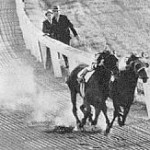 In the case of Seabiscuit, his career embodied the dreams and ideals of many Americans. As the Great Depression and World War II weighed upon the nation, Seabiscuit was running in rock bottom claiming races when he was purchased by the wealthy C.S. Howard. After Howard invested in Seabiscuit, the horse went on to beat the Triple Crown winner, War Admiral, in a nationally broadcast match race that captivated an audience of roughly one in three Americans. Seabiscuit later suffered an injury that threatened to end his career. He defied retirement and recovered to win the Santa Anita Handicap – a victory that had previously eluded him.
The accomplishments of Seabiscuit amounted to more than a moment in the winner’s circle. This horse mirrored the dreams of the general public during the depression. As stated by Director Gary Ross, Seabiscuit illustrated the “American idea that hidden inside you is huge potential that is untapped and undiscovered… If only people had the understanding to explore it, or to nurture it a little bit, what could possibly emerge?” To Ross, Seabiscuit demonstrated the potential for outstanding achievement if given a second chance.
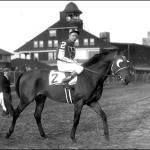 In a time of war and financial desperation, Seabiscuit illustrated the ideal of struggling against the odds. In his career, Seabiscuit fought the stigma of being a lesser horse by virtue of racing on the west coast in a time when the east coast horses dominated the sport. In his famous match race, Seabiscuit, the clear underdog, demolished the stigma of being a low-grade horse by defeating his east coast rival, War Admiral. When he returned from injury to clinch a victory in the Santa Anita Handicap, he only reinforced the theme of prevailing against the odds. With the nation embroiled in struggle, Seabiscuit’s victories touched upon their own hopes and dreams. He represented the ideal that an underdog can succeed through hard work, determination, and endurance. In his struggle to victory, Seabiscuit became a principle owned by a nation.
Man O’ War.
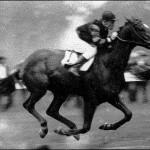 Man O’ War illustrated throughout his career that public favor is also won through awakening human imagination and rewriting record books. Likened to a “living flame,” Man O’ War embodied the raw perfection that captivates the human heart and spirit.
In his sixteen month career between June 1919 and October 1920, Man O’ War won twenty of his twenty-one races. He was the favorite in all of his races, with odds of 1-100 in three of his starts. He won one race, the Lawrence Realization, by 100 lengths. Man O’ War set three world records, two American records, and three track records. He retired as the greatest money-winning Thoroughbred in history.
During his career, the public was in rapture by Man O’ War. Police had to protect the horse at tracks from souvenir hunters who tried to grab hairs from his mane and tail. His notoriety also attracted death threats. His Owner, Samuel Riddle had to hire a private detective to watch the horse’s trainer.
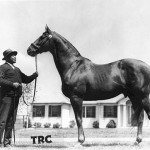 At the time of his retirement, Riddle was reportedly offered $500,000 for Man O’ War by Texas oil millionaire, William Waggoner. Riddle rejected the offer. Waggoner made a second offer to purchase for $1 million, in which Riddle again rejected. When Waggoner provided his third offer in the form of a blank check, Riddle countered, “You go to France, and bring back the sepulchre of Napoleon from Les Invalides. Then you go to England and buy the jewels from the crown. Then to India and buy the Taj Mahal. Then I’ll put a price on Man O’ War.”
After his retirement, Will Harbut, the groomsman for Man O’ War, managed the farm tours for visitors who traveled for a glimpse of the legend. It is estimated that the number of visitors ranged between 1.5 to three million. Harbut, having become a famous figure for being the groomsman to Man O’ War, would display the horse to the crowd and explain, “He broke all the records and he broke down all the horses, so there wasn’t nothing left for him to do but retire.”
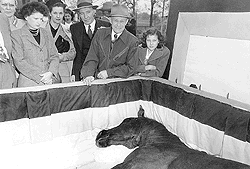 When Man O’ War died at age 30, he was the first horse to be embalmed and he lay in state for two days in a specially-made casket lined with his racing colors. It is estimated that nearly 2000 people attended his funeral and the burial service was broadcast nationally with nine speakers providing eulogies.
Man O’ War remains a portrait of beauty, strength, power, and perfection. In the 1920 Travers, the starter described the awe that drew people toward the legend. “He was so beautiful that it almost made you cry, and so full of fire that he made you thank your God you could come close to him.”
Secretariat.
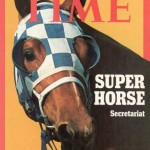 Secretariat exploded into the public eye through producing mind-bending victories that shattered all records in Triple Crown racing. Secretariat’s record left the public speechless and captivated by his magic.
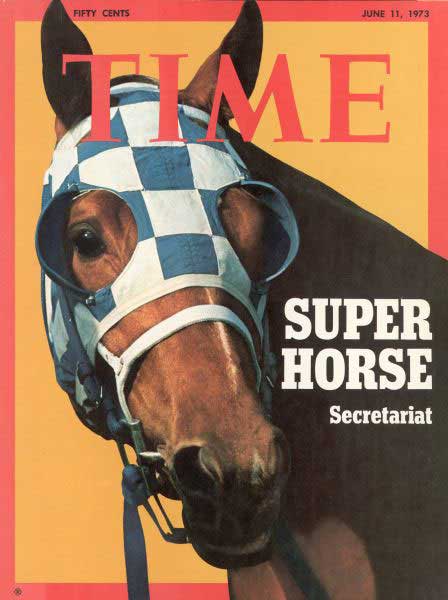
When he arrived at the Belmont Stakes for the third leg of the triple crown, Secretariat led the news headlines in North America and had captured the covers of Newsweek, Time and Sports Illustrated. The sport has never enjoyed the same media attention since Secretariat’s 1973 Triple Crown season.
“Secretariat generates a crackling tension and excitement wherever he goes… When he accelerates… he produces a breathtaking explosion that leaves novices and hardened horsemen alike convinced that, for one of those moments that seldom occur in any sport, they have witnessed genuine greatness,” explained Pete Axthelm from Newsweek.
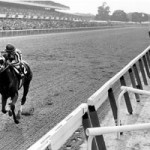 After his 31-length victory in the Belmont Stakes, his greatness has never been matched. In two minutes and twenty-four seconds, Secretariat set the world’s dirt track record for 1 1/2 miles, which many argue may never be broken. As Charles Hatton wrote in The Daily Racing Form, “His only point of reference is himself.”
In his sixteen-month career, Secretariat won sixteen of his twenty-one races. He was the odds-on favorite seventeen times. He won back-to-back “Horse of the Year” awards. He still holds the record time in the Kentucky Derby – 1:59:25. The Daily Racing Form clocked him as setting the record in the Preakness at 1:53 2/5. Because the track clock was malfunctioning, the official time was recorded as 1:54 2/5 and Canonero II remained the holder of the official record with his time of 1:54 2/5 the 1971 Preakness.
Secretariat was retired to stud at Claiborne Farms. His popularity continued long after his racing career ended. He received many letters and birthday cards each year from his fans and thousands of vistors came to Claiborne Farms to see Secretariat during his lifetime.
In the fall of 1989, he was afflicted with laminitis and was euthanized on October 4. He was buried at Claiborne Farm, receiving, in death the ultimate honor for a horse. By tradition, the only parts of a Thoroughbred buried at a gravesite are their head (to symbolize intelligence), heart (to symbolize strength), and legs (to symbolize power). As homage to the greatness of this legend, Secretariat was buried whole.
The legacy of Secretariat endures over two decades after his death. Penny Chenery, Owner of Secretariat, explained “It’s hard to believe after all these years, but hardly a day goes by that I don’t get mail about Secretariat.”
The Last Decade - Barbaro.
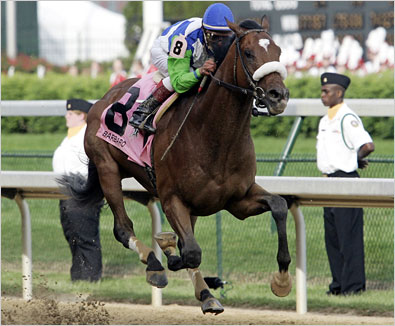
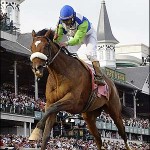 In recent years, Barbaro arguably captivated public interest and adoration more than any other horse – both for his performances on the track and after the races. After entering the Kentucky Derby with an undefeated record, he romped to the finish line to win by six lengths. I was among the 40,000 fans in attendance and could barely catch my breath as he drove alone toward the finish line. It was my first Derby.
When Barbaro broke down in the Preakness, I sent him a dozen roses in remembrance of his victory at the Kentucky Derby. I certainly was not alone. As the nation hung on for months in hopes that Barbaro would recover from the life-threatening injury, cards, flowers, carrots, and other gifts flooded the New Bolton Center. Signs were hung outside the gates of the facility. National news coverage covered the story on a regular basis. It is somewhat bittersweet that the most attention the sport had gained in years was a product of one of its’ saddest moments – the ultimate loss of this great horse.
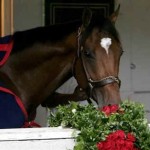 When it was announced at the subsequent Derby that Barbaro would be buried at Churchill Downs, I watched as schoolchildren, who had sent letters and drawings to Barbaro, lined up to deliver Gretchen Jackson individual roses in the winner’s circle during a tribute ceremony. As she held a full bouquet of roses in the end, I was overwhelmed by the dignity and grace of Mrs. Jackson.
The Jacksons, along with Barbaro, had fought the odds and lost. In their journey, the Jacksons demonstrated honor, dignity, and concern for the well-being of the horse above all financial motives. Barbaro illustrated courage and determination throughout his fight for survival. He had the qualities that not only won on the track, but captured the hearts of the public.
Of the horses that have generated widespread national reverence, they all possessed common traits – strength, ability, power, and excitement. They mirror the human spirit in its’ purest form, and, in turn, these athletes become larger than the sport. They become a reflection of our greatest dreams and ideals.
Please feel free to email me directly with questions or comments at blog@thesaturdaypost.org.
NOTE: There are many other horses and facts that were not mentioned due to space restraints - I would have had to write a book. I hope to add more to this post in the future.
February 14th, 2010 §
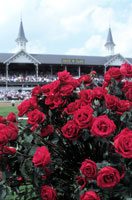 Since the first run of the Kentucky Derby in 1875, the race has evolved throughout the years into one of the grandest society events – steeped with many unique traditions and customs. The Derby is the showcase for lavishly feminine hats, sugar-soaked Mint Juleps, countless displays of red roses, decadent local cuisine, and extravagant parties on the Eve of the Derby. This resource provides a basic overview of the popular traditions and cultural novelties that surround what is termed, “The Greatest Two Minutes in Sports.”
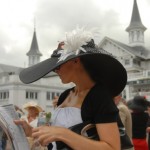 Femininity is in Fashion: Derby Hats and Elegant Dresses. From its’ inception, the Derby was envisioned to be a luxurious event in American Thoroughbred Racing. Beginning in the late nineteenth and early twentieth century, affluent women arrived at the race wearing fashionable hats, gloves, and stylish dresses. Throughout the years, the tradition of Derby hats and feminine couture has endured, and perhaps, grown more colorful and expensive with each new season. Today, women wear many styles of glamorous hats, along with a wide variety of dresses and suits. The feminine pageantry surrounding the race has become nearly as iconic as the horses on the field.
 One Sweet Day: The Mint Julep. The Bourbon-charged “Mint Julep” is the official drink of the Kentucky Derby and is composed of sugar syrup, fresh mint, crushed ice, and Kentucky bourbon. On race day, vendors weave through the crowds with fresh “Mint Juleps,” served in the commemorative annual Kentucky Derby glass. The famed “Woodford Reserve $1,000 Mint Julep” is also available through auction prior to Derby day, with the proceeds benefitting charity.
Although the mixing ingredients have varied in the past few years, the lavish drink remains served in a 24-karat Gold Cup and is made with Woodford Reserve Kentucky Bourbon. In 2006, the “Woodford Reserve $1,000 Mint Julep” benefitted retired horses and jockeys through donating the proceeds to the Thoroughbred Charities of America, That year, the Mint was imported from Morocco, the ice was obtained from the Arctic Circle, and the sugar was acquired from the South Pacific. Upon announcement, our blog will feature the 2010 ingredients and auction link for the “Woodford Reserve $1,000 Mint Julep.”
The Traditional Song: “My Old Kentucky Home.” As the Derby contenders are paraded before the crowd prior to the race, “My Old Kentucky Home” is played by the University of Louisville Marching Band. There are no words to describe this mesmerizing moment. For new Derby attendees, the words to the song are inscribed in the racing program. Many Kentuckians know the tune by heart and it is considered a moment of pride when the song is being sung throughout the crowd.
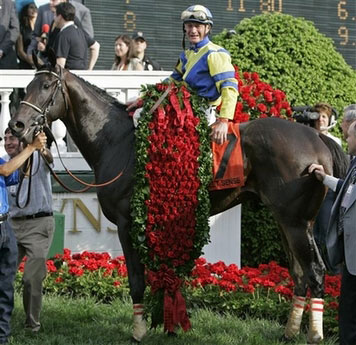
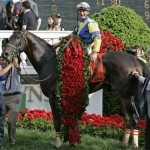 The Emperor’s New Clothes: A Garland of Roses. The Garland of Roses that cloak the winning Derby horse hold an interesting history. Roses first appeared on the radar when they were presented to all the ladies attending a glamorous Louisville Derby party, held by a New York socialite and attended by the President of Churchill Downs, Colonel Lewis Clark. The roses were such a phenomenon that Clark adopted the rose as the race’s official flower. The rose garland first appeared at the Derby in the 1896 when the winner received a floral arrangement of pink and white roses. In 1904, the red rose was chosen as the official flower of the Kentucky Derby.
Each year, a garland of more than 400 red roses is sewn into a green satin backing with the seal of the Commonwealth on one side and the twin spires and number of the running on the other end of the garland. Each garland is also adorned with a “Crown” of roses, ribbon and green fern. The “Crown,” is a single rose pointing upward in the center of the garland, to symbolize the struggle and heart necessary to reach the winners’ circle.
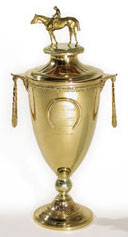
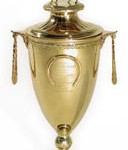 The Gold Standard: The Kentucky Derby Trophy. The Kentucky Derby Gold Cup is awarded each year to the winning horse’s owner. The trophy is made from a combination of 20 and 14-karat gold and weighs more than 100 ounces. A sterling version of the trophy is awarded to the winning trainer, jockey, and breeder. The Gold Cup trophy takes over three months to produce and is one of the few solid gold trophies awarded in any American sporting event.
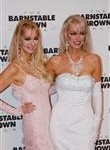 The Society Pages: The Derby Eve Galas. All throughout the nation, Derby parties are hosted on an annual basis. However, in Louisville, there are a few lavish society parties that honor the Eve of the Derby with unparalleled pageantry and style. The most sought-after tickets in Louisville on Derby Eve are to the Barnstable Brown Gala and the Mint Jubilee.
The Barnstable Brown Sisters (the former “Doublemint Twins”) have been hosting the most exclusive party for two decades in celebration of the Derby on the night before the race. Celebrities and guests are given access by invitation only to the event comprised of 1,200 attendees.
Founded in 1996, The Mint Jubilee Gala is another Derby Eve party that carries prestige among partygoers. Tickets to this 1,000 person event cost approximately $500.00 per individual in 2009. The event is attended by political figures, celebrities, and ticketed guests.
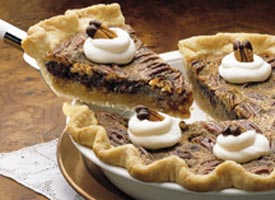
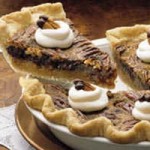 Derby Pie: Decades of Decadence. On Derby Day, Churchill Downs will sell more than 25,000 slices of Derby Pie to track attendees. At off-track parties, many Derby events order the pie from Louisville and have it shipped to their home for dessert. The Derby Pie, a trademarked name, is made by Kern’s Kitchen with custard, chocolate chips, and walnuts – all baked into a 9-inch crust. The recipe is highly coveted – only three people know the actual recipe. All employees of Kern’s Kitchen are required to sign an agreement not to divulge any of the Derby Pie secrets. The Derby Pie can be ordered by visiting the company website at http://www.derbypie.com.
February 1st, 2010 §
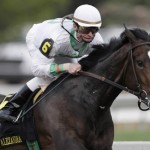
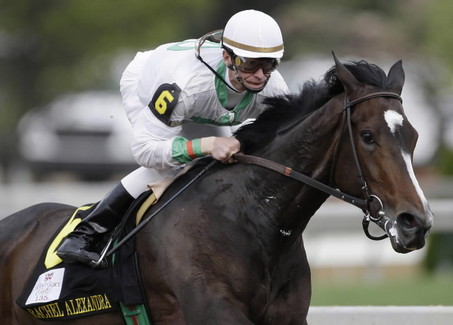
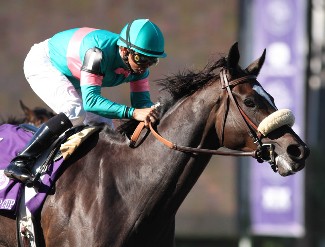
After a contentious debate over the 2009 “Horse of the Year” Eclipse Award, Rachel Alexandra prevailed over Zenyatta when the winner was finally announced on January 19, 2010. Prior to the announcement, the owners of both champion fillies had committed to race their horses in the 2010 season. With the final ballots cast, the industry has moved from the “Horse of the Year” debate toward speculation regarding a match race between these two female rivals in 2010.
Since 1975, there have not been any major thoroughbred match races involving champions in America after Ruffian sustained a terminal injury while competing against Kentucky Derby winner, Foolish Pleasure. In that race, the undefeated filly Ruffian met Foolish Pleasure at Belmont Park in New York. A national television audience watched as Ruffian broke down shortly after the start and had to be euthanized the following day.
Before the sad ending to match racing with Ruffian’s injury, there were several other major match races throughout the century. In 1955, Kentucky Derby winner, Swaps, met Nashua, the Preakness and Belmont Stakes winner of that year. Nashua won the race, but speculation did not cease after the match. Swaps had been nursing a sore foot in days prior to the race. Eddie Arcaro, rider of Nashua, admitted many years later that he doubted Nashua could ever have beaten a healthy Swaps.
In 1947, Triple-Crown winner and 1946 Horse of the Year, Assault, held a $100,000 match race against Calumet Farm’s horse, Armed. Armed beat Assault by eight lengths and went on to win the 1947 title of Horse of the Year.
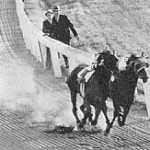 One of the arguably most talked-about match races of the century occurred in 1938, between the rags-to-riches underdog, Seabiscuit, and the Triple-Crown winner and reigning horse of the year, War Admiral. Seabiscuit tracked War Admiral across the country and quickly became the “People’s Horse” during the depression era. After he defeated War Admiral in the 1939 showdown, Seabiscuit went on to win Horse of the Year.
However, match racing existed before the popular match race between Seabiscuit and War Admiral. In 1923, the Kentucky Derby winner, Zev, took on the English Derby winner, Papyrus. The race was dubbed the first “international” race and exorbitant prices were charged for tickets. Zeb won the match race against Papyrus, but doubts lingered about the victory due to track conditions and a mistake in shoeing Papyrus prior to the race.
Finally, in 1920, Horse of the Century, Man O’ War, met Sir Barton, the first horse to win what would later be dubbed the “Triple Crown,” in a match race in Canada. Man O’ War won the race by seven lengths, but the importance of the race was questioned because it was widely-regarded that Sir Barton was not at his peak performance.
With a new century, the industry is faced with the prospect of a major match race between two champion fillies – Rachel Alexandra and Zenyatta. From a brief look at the history of match racing, the unasked question is “What purpose would a match race serve?”
The most obvious answer is financial gain to the industry and owners, as well as reinvigorating public interest in the sport of horseracing. But, aside from these interests, does a match race serve either filly in cementing their championship status over the other filly?
 From the historical view, Zenyatta appears to have more to gain while Rachel Alexandra more to lose if the two are pegged against each other in a match race. In the races in which a reigning Horse of the Year accepted and lost a match race, the prevailing horse went on to win “Horse of the Year” in the following season. Therefore, Zenyatta’s most important targeted race for 2010 should be a match against Rachel Alexandra if she wants to attempt to clinch the much sought-after title of “Horse of the Year.”
In the same vein, if Rachel Alexandra were to lose a match to Zenyatta, Rachel Alexandra’s “Horse of the Year” victory over Zenyatta may be called into question all over again. Rachel would be forced into a rivalry with Zenyatta that could last over several races in an attempt to gain the lead over her rival in the court of public opinion.
Further, the historical record shows that match races rarely seem to settle the score between two rival champion horses. In the case between Ruffian and Foolish Pleasure, there was no true winner since Ruffian was injured during the race. Between Swaps and Nashua, Nashua’s own jockey, Arcaro, felt that Swaps would have won if he had been in better health. The race between Zev and Papyrus only clouded the debate since Papyrus encountered track difficulties and there was a mistake in shoeing the horse. Finally, Man O’ War’s victory over Sir Barton was also questioned since Sir Barton was not at his peak-performance level at the time of the match.
If a match race were to be held between Rachel Alexandra and Zenyatta, it would seemingly do little to settle the debate regarding who is the greater horse between the two champions. However, it would make for an electrifying spectacle to watch these two fillies face off on the track.
Rather than aiming to have a match race settle the ongoing debate of who is the greater horse between Zenyatta and Rachel, a match race, if held, should serve only to showcase the two great fillies of our decade. Their championship status has already been proven in different races, on different tracks.
January 16th, 2010 §
On Monday, the winner of the prestigious “Horse of the Year” Eclipse Award will be announced and two breathtaking fillies remain in a dead heat for title. Throughout most of the 2009 racing season, Rachel Alexandra dominated the sport with flashy wins against other fillies, taking down the boys in three separate races, and, ultimately, being the first filly in 85 years to capture the Preakness Trophy. Of her eight starts as a three-year-old in 2009, she remained undefeated and ended her racing year as the first filly to win the Woodward Stakes.
By September of 2009, I believed Rachel Alexandra was the clear choice for “Horse of the Year” having watched her trample the field in the Kentucky Oaks, take down the Derby Winner in the Preakness, and close her season with her historical win in the Woodward Stakes. If anyone had challenged that notion, I wouldn’t have hesitated to hold a good old-fashioned yelling match to defend Rachel’s right to the title. In my mind, it was inconceivable that any horse could out-perform this “Super Filly.”
And then, the unconceivable arrived. On November 7, 2009, an undefeated five-year old female named Zenyatta walked onto the track at Santa Anita and dared every boy standing at the gate to defeat her in the richest race in America.
It was such a bold move that I skipped a wedding to watch her try.
As the gates opened, Zenyatta trailed the field. Throughout middle of the race, I watched with heartbreak as she hung in last place. It looked as if expectations had exceeded her ability. When it appeared near hopeless, Zenyatta made the bid for her place in history. She began to pick off her opponents near the last turn and went wide on the home stretch to deliver a seemingly late charge for the finish. In the final seconds, Zenyatta drove seamlessly past her contenders at the wire to win the Breeder’s Cup Classic. In this historical moment, my allegiance for “Horse of the Year” shifted from Rachel Alexandra to the first filly to ever take the most expensive race in America – Zenyatta.
Admittedly, Zenyatta’s contention for “Horse of the Year” would not be such a threat to Rachel Alexandra without her historical win in the Breeder’s Cup Classic. However, I am not in the business of rewriting history. In fact, Zenyatta’s bid for “Horse of the Year” is perfectly in sync with the historical background and ultimate spirit of the Eclipse Awards.
 When the Eclipse Awards were founded in 1971, they were named in honor of a British racehorse and sire from the 1800s, named “Eclipse.” As a racehorse, Eclipse did not begin his career until he was a five-year-old and remained undefeated throughout the eighteen races in his career. In recognition of his legacy, Eclipse became the namesake to what are arguably considered the most prestigious achievement awards within the American horse racing industry.
By the very nature of the Eclipse Awards, the award categories provide a separation for age and overall achievement. Aside from “Horse of the Year,” which encompasses all ages and genders, the Eclipse Awards also maintain separate categories for the best “Three-Year-Old Filly” and “Three-Year-Old Male.” The scenario between Rachel Alexandra and Zenyatta appears to have been given some forethought prior to this moment.
Eclipse himself could not have won the best “Three-Year-Old Male” Award, just as Zenyatta can no longer compete for the best “Three-Year-Old Filly” award due to the age restriction. The Awards appear to follow the design that a “Three-Year-Old Filly” may become “Horse of the Year,” but that the rapture of the Triple Crown racing season cannot discount the outstanding performances of all racehorses during a given year.
Admittedly, Rachel Alexandra had an electrifying year as a three-year old horse – irrespective of her gender. If she had shown up to Santa Anita on November 7th to win the Breeder’s Cup Classic, there would be very little debate that she had earned the “Horse of the Year” Award. But, as Zenyatta trampled down the full field of skilled male horses to earn the distinction of the first filly to win the Breeder’s Cup Classic, Rachel Alexandra quietly stepped aside and placed her bets on her three-year-old season. When Zenyatta was first at the wire, Rachel lost her bet.
Zenyatta’s win in the Breeder’s Cup Classic holds more historical significance than any of Rachel Alexandra’s wins within this season. Zenyatta won the most expensive race in the United States. She is the first filly to ever accomplish this feat. The Breeder’s Cup Classic is one of the most contentious races in America – the field is full of great horses from varying backgrounds who are proven winners.
In contrast, Rachel Alexandra’s first Grade One win was in the Kentucky Oaks – among other fillies. Her next race, among males in the Preakness, is an impressive win – but not a “Game Changer.” Prior to Rachel, four fillies had already won the Preakness Stakes – the most recent win being in 1924. Further, the Preakness is the shortest distance of all three Triple Crown races, the Belmont being the longest race in the United States at a distance of 1 ½ miles. When Oaks-Winner Rags to Riches beat Curlin in the 2007 Belmont Stakes, Curlin was still awarded the distinction of “Horse of the Year” despite the fact that a Filly had not won the Belmont in over a hundred years when she crossed the finish line.
Zenyatta also holds distinction for building her undefeated record on a higher grade of races than Rachel Alexandra. In her career, Zenyatta has consistently run in only Grade 1 and Grade 2 races – remaining undefeated. In contrast, Rachel Alexander gradually worked from Grade 3 races into Grade 1 races, finishing second in both of her Grade 3 races. When viewing the overall career record of both horses, Zenyatta is the only undefeated horse who never delved below a Grade 2 race.
Finally, Zenyatta’s wins earned more money in 2009 than Rachel Alexandra. In 2009, Zenyatta was the second-highest ranking horse, boasting $3,330,000 in earnings. In comparison, Rachel Alexandra ranked fifth in 2009, bringing in a total of $2,746,914.
With the entry of more fillies in the prestigious male-dominated horse races, the industry is now squarely-faced with “The Filly Eclipse” for the Horse of the Year. Fillies are running alongside their male-counterparts and winning. When Rachel Alexandra ended her racing season in September, many believed that she had earned “Horse of the Year” over her potential male rivals for the Award. On November 7th, 2009, Zenyatta placed herself in undisputed contention with Rachel Alexandra as she moved past the finish line at the Breeder’s Cup Classic. Those watching the Breeder’s Cup Classic witnessed the first “Filly Eclipse” in history for the Horse of the Year Award.
After the Breeder’s Cup Classic, there have been arguments to hold a match race between Rachel Alexandra and Zenyatta. This would not add or subtract anything from this competition. Zenyatta and Rachel Alexandra are two distinct horses at different places in their career with their own unique character. They race in two separate fields - Rachel performs better on dirt and Zenyatta excels on synthetic track. If they ever settled where to run this race, the next question would be why the race should be run. This is a competition for the “Horse of the Year”- not “Best Filly of the Year.” It just happens to be that the two final contenders are fillies.
In the case of Rachel Alexandra, I truly believe that she has gone above and beyond to win the distinction of being the best three-year-old filly for 2009. She took on the boys, outran them, and bested the field with her astounding margins of victory in filly races.
Then, in a rare moment in November, “The Filly Eclipse” occurred and Zenyatta obscured all opposition.
When Zenyatta crossed the wire in the Breeder’s Cup Classic, she took my vote for Horse of the Year through pioneering a win in the most expensive race in America amidst a field a hard-tested males from various ages and backgrounds. It was an electrifying performance that not only earned her a place in the history books, but also, the well-earned distinction as “Horse of the Year.” I had seen my first ”filly eclipse.” It was breathtaking.