December 3rd, 2011 §
In November, federal lawmakers gave the racing industry a unique opportunity to step into the national spotlight and settle the score on where it stands in relation to the welfare of horses with the passage of HB 2112. The bill, which declined to defund USDA inspections at plants that process horsemeat for human consumption, effectively opened the door for slaughterhouses to resume operations in the United States. And, as the pro-slaughter advocates began championing the economic advantages of horse slaughter in the national media, one key group fell silent – the racing industry.
Rather than seeing any major racing industry figure or association condemn the slaughter of horses and promote the idea of exploring no-kill solutions to overpopulation and welfare-related concerns, I saw a different character representing “horsemen” in the media. It was Wyoming State Rep. Sue Wallis, who also serves as Vice-President of United Horsemen, a pro-slaughter group that is working to open horse meat processing plants in the United States.
As the racing industry stood silent, Wallis took the national media spotlight, referring to horse meat as “tasty,” while the less-than “tasty” issue of phenylbutazone (“Bute”) contamination in racehorse meat was swept under the rug. And, when bute contamination is ignored to promote the tasteless agenda of pro-slaughter advocates, a dangerous toxin enters the food chain that can go undetected and cause serious health consequences to human beings, including the development of aplastic anemia in children who probably did not request for a racehorse for dinner.
But, then again, we can overlook the dangers to children and overall food safety, right? Cross out anemic children and slaughtered racehorses as problems to fuss over in the future. The slaughter business is about money, not morality.
Yet, for some horse lovers, slaughter is more than a money-making business in the equine world. There are good-intentioned horse people that believe that overpopulation has made slaughter a necessary evil to ensure the welfare of horses in North America. I don’t fault them for considering it from a welfare standpoint. However, in my view, the focus should shift to providing a humane lifestyle rather than a humane death. Because, simply put, slaughter simply perpetuates more slaughter when the population of unwanted horses dwindles during the death march. And, as sad as it may seem, when the slaughterhouses lose the unwanted horse population, they don’t simply shut their doors. They begin breeding horses for the sole purpose of slaughter.
In Canada, the Alberta Equine Welfare Group commissioned a Report in 2008 on horse slaughter in their country. In that Report, it describes the “feedlots” where the horses designated for slaughter are held. As the Report states, “These horses are purpose-bred and strictly raised for meat production. They have never been someone’s riding pony, sport animal or draft horse.” And, as the Report boasts, this is no small population. According to the Report, 1/3 of the horses slaughtered at the Alberta plant were “purpose-raised” for slaughter. They were never unwanted. Rather, they bred for the killing.
But, then again, the major players in racing didn’t get on CNN and show a concern to help provide funding to improve the quality of life for the existing unwanted equine population in North America as a counter-approach to slaughter. Nor did they point out that slaughterhouses breed for slaughter when they are done extinguishing the “unwanted” population. However, they should have done it. Because, mainstream media would have finally broadcast the long-overdue message that most people in racing love horses, they are concerned for the welfare of the horses and they would travel to the end of the earth to provide the best care for them.
Yes, travel to the end of the earth and you will find that roughly 138,000 horses were shipped for slaughter last year from the United States. And, if you travel into Sue Wallis’ world, she estimates that between 120,000 to 200,000 horses would be killed for human consumption on an annual basis if slaughterhouses resume operations in this country. Then, travel beyond the idea that slaughter is a necessary evil to ensure the welfare of horses.
The horse racing industry is a multi-billion dollar industry that should spearhead the campaign to raise funding to provide safe homes for unwanted horses so that slaughter in our country is a sad practice that we regret ever existed. This is an industry that offers millions of dollars in purse money on an annual basis, while wealthy buyers spend millions at prestigious sales in hopes of finding that “one” horse. And, as for the gambling aspect, 100 million dollars is bet on Kentucky Derby day alone. Yes, there is plenty of money that filters through this sport. But somehow, the industry is penniless when it comes to saving horses from slaughter.
So, here we are. With slaughter in the national spotlight, the racing industry can begin to speak out against slaughter, promote funding initiatives to care for the existing unwanted horses and create a plan to provide continuous and realistic funding to rescues in the long-term to prevent, if not eliminate, the potential for any future slaughter on U.S. soil. And, instead, the racing industry is letting Sue Wallis serve as the media spokesperson for “horse people.”
As the pro-slaughter media spokesperson for “horse people” Wallis has assured the media that “everyone in the horse world is so excited [that] we might have the opportunity to turn the whole equine market around.” Everyone of her slaughterhouse investors, that is. Yet, in failing to counter Wallis’ remarks in the national media, everyone in the “horse racing world” has been painted as being a part of her pro-slaughter supporters in the national spotlight.
What would the “horse world” look like in mainstream media if prominent trainers, high-profile owners and celebrity jockeys publicly opposed slaughter and called for the passage of the Horse Slaughter Prevention Act?
What if our industry began to brainstorm long-term funding initiatives to ensure the humane treatment of “unwanted” horses throughout their natural lives?
And, what kind of money could be raised to provide for “unwanted” horses this year if we cancelled the races for one single day at every track in this nation and donated the scheduled purse money toward rescue efforts?
I’m certain the racehorses wouldn’t mind a day without racing. I’m sure the rest of us could live without it just fine as well. Because, in the end, a few more horses would live because of that day. And, that’s a big start in the race to prevent slaughter in this country.
To sign the Petition to End Slaughter for the White House, please click this link. If you would like to call the White House to voice your opposition to horse slaughter, you can reach their comment line at 202.456.1111.
November 20th, 2011 §
 As Rapid Redux attempts his twentieth consecutive victory, the five-year-old gelding doesn’t seem bothered that his name rarely appears in the same zip code as contenders for an Eclipse Award.
Possibly, a quiet understanding exists that Eclipse Champions are exclusively found in the graded arena of racing. And, just as likely, Rapid Redux isn’t the least bit concerned about class wars with the graded fields. He seems focused on one single goal that isn’t controlled by Eclipse Award voting - winning his next race in any field.
Since December of 2010, Rapid Redux has been simply showing up at small tracks, facing rivals with similar blue-collar resumes, and grinding out victory after victory without the fuss of fancy awards or winning garlands. He could have had a nearly invisible career, like many of his counterparts, if it weren’t for his quest to capture a prized historical jewel in the racing world - the modern North American record for winning more consecutive races than any other horse in the sport.
There is something about Rapid Redux that makes me wish there was an Eclipse Award for such a horse. Because, ultimately, the working-class gelding is the type of guy that breathes life into the average race card on any given day at various tracks across the country. Eighty-five percent of racehorses are running in claiming races on an annual basis in North America. And, I am sure that nearly every owner and trainer with a horse among that 85 percent would happily take Rapid Redux into their stable without any questions about his ability to climb the class ladder in the future.
Yet, when it comes down to the Eclipse Awards, class seems to matter deeply when we choose our champions. And, though it would be tough to find an owner who would turn down an offer to purchase Rapid Redux for his last claiming price of $6,250, many of the same folks would probably never entertain the thought that he may deserve an Eclipse Award. This sport looks toward graded fields when crowning its champions, and, as for the claiming horses, they need to climb the ladder of class to have a shot during Eclipse Award season.
However, Rapid Redux may be doing something revolutionary in refusing to go beyond claiming and allowance territory while targeting the modern record for consecutive victories in North American racing; he is simply ignoring the traditional criteria of what makes a “champion” racehorse. In doing so, the gelding showcases the enormous heart of the blue-collar racehorse in capturing victory-upon-victory while brilliantly turning the sword on his critics with every winning stride toward the record. It is as if he is defying the very idea that “champions” don’t exist in the lower levels of racing.
In my view, Rapid Redux is a champion racehorse in his own right. No, he isn’t the kind that wins graded outings or millions of dollars. Rather, he is the kind of “champion” that exists where the bulk of trainers, grooms, hot walkers and various other individuals in racing make their living in this sport. He is the “champion” that races in fields where middle class owners can afford more than a small percentage of a racehorse. And further, he is the kind of “champion” that gives smaller owners the feeling of having a winning horse where they could not participate in this sport if they had to spend dizzying dollars to get in the game.
There is something about Rapid Redux that makes me wish that there was an Eclipse Award that the majority of participants in racing could strive to win. Because, without horses like Rapid Redux, the tracks would become cathedrals to the fifteen percent of participants who are extremely wealthy, extraordinary lucky, or to individuals who are extraordinarily lucky to work for someone who is extremely wealthy. And, in my view, racing would lose its heart that day.
Whether or not Rapid Redux reaches his magic number of twenty consecutive victories, he will remain a “champion” even if he stops at nineteen races and never ventures into graded territory. He is simply a different kind of champion; a blue-collar Champion that delivered a captivating number of victories, at seven different tracks, for small purses and little recognition until he started swirling around a coveted record in big-league racing. There is class to any horse that can accomplish that feat, whether the outings are graded, televised or simply everyday claiming and allowance races.
Yes, there is plenty about Rapid Redux that makes me wish there was an Eclipse Award for him this season. And no, it doesn’t have to be “Horse of the Year.” The “Horse of the Year” award wouldn’t serve the spirit of a horse like him anyway, because, in large part, claimers and allowance horses don’t simply retire after one exemplary year. They keep going, year after year, in a quest for more victories and more earnings to help support the everyday workers in this industry.
There should be an award for a horse like Rapid Redux to claim at the claiming level - An Eclipse Award. Because there are “champions” at all levels of racing, just as there are fans at all levels of this sport. And, as a fan of all levels of racing, Rapid Redux is the horse of my year.
Photo of Rapid Redux provided courtesy of Victoria Solzbach.
November 10th, 2011 §
American Runner Steve Roland Prefontaine once likened his running to a creative art form in saying, “Some people create with words or with music or with a brush and paints. I like to make something beautiful when I run. I like to make people stop and say, ‘I’ve never seen anything run like that before.’ It’s more than just a race, it’s a style. …It’s being creative.” Surely, winning is the goal in the running of a race. But, in some rare moments, the runner itself is a work of art.
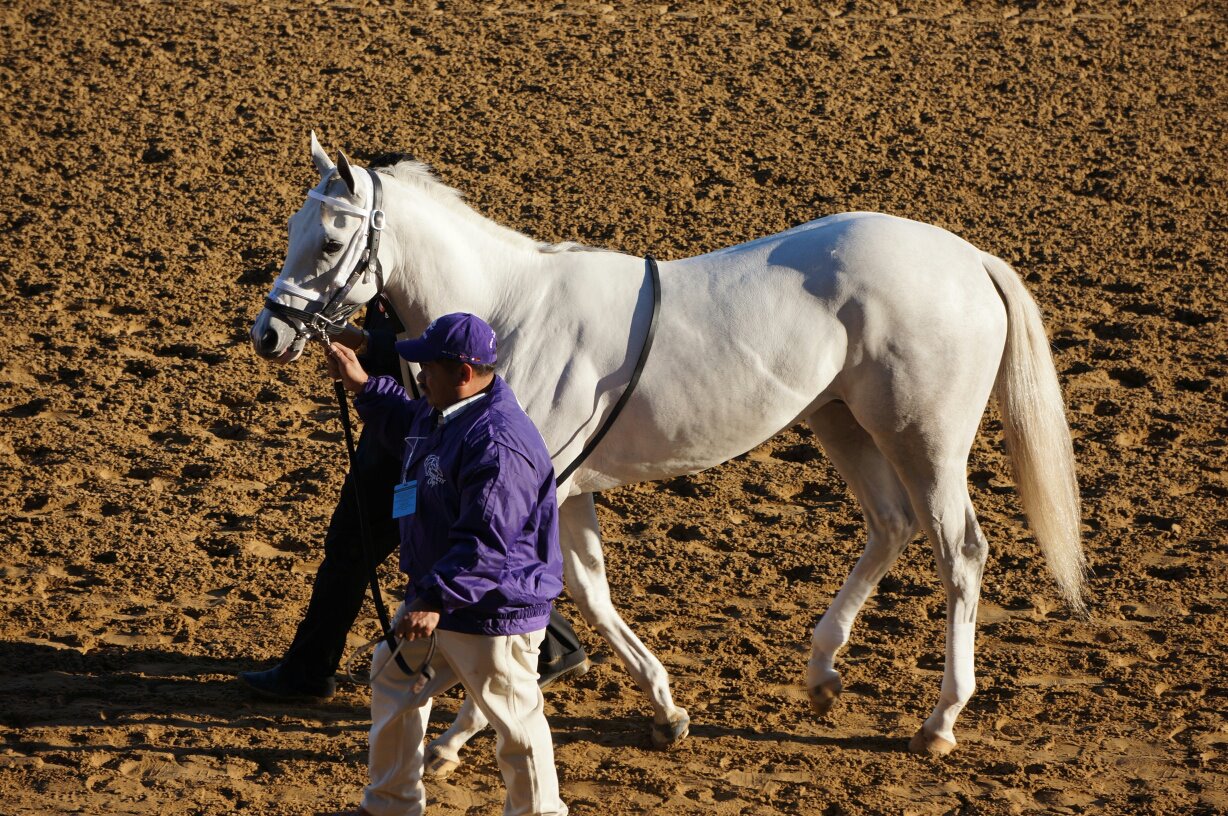
When I think of a runner as an art form, Hansen paints a stunning visual portrait from any vantage point. At 5 1/2 furlongs, the whitish blur can turn his oval canvas into a majestic 12 1/4 length victory in his maiden debut. And, at a mile and sixteenth, Hansen can appear absolutely ethereal while claiming a 13 1/4 length win in the Bluegrass Cat Kentucky Cup at Turfway Park. Yet, perhaps he was in his finest glory clearing a near wire-to-wire victory in the Grey Goose Breeders’ Cup Juvenile. It was more than just a race, it was his style: Hansen is simply beautiful when he runs a race.
“He’s a once in a lifetime horse,” said Dr. Kendall Hansen, who owns the undefeated two-year-old colt in a partnership with SkiChai Racing. And, as for his unique front-running style, Trainer Mike Maker has stated, “We don’t try to change him much, because if we do try, he gets mad and wants to fight. So we let him do his thing, make him believe he’s the boss.” However, if running is an art form, Hansen’s defiance may be a part of his creative genius.
There is something about watching Hansen run that captures some beautiful aspects of Thoroughbred racing.
 Perhaps, a dimension of Hansen’s beauty is the reminder that money alone can’t buy a “once-in-a-lifetime” horse. They simply appear in places where that unwavering hope exists. And, where Hansen first “appeared” was when a $5,000 claiming horse named Stormy Sunday gave birth to a Tapit foal bred by Dr. Hansen himself. The colt never set foot in an auction ring in an attempt to garner millions of dollars in bids. There was simply a near-white colt, born to a seemingly common mare, that appeared one day in a place that could have been any foaling barn.
Yes, there is a beauty to that priceless aspect of Thoroughbred racing.
And, then there is a beauty that Hansen possesses when he is running his race, the way he sees fit. The sight of the near-white colt, racing in front, as if he is simply not subject to the will of anything but his own, is a visually stunning display of the unbridled spirit of a Thoroughbred. Sure, if running is a form of art, any attempt to change his style is a call to battle. An artist, in creating something beautiful, follows their vision. And, the vision that Hansen portrays is the raw beauty of a Thoroughbred in flight.
Yes, there is a beauty to that unbridled aspect of Thoroughbred racing.
And finally, there is an art in how Hansen conquers the critics who search for the limitations in his ability. After his maiden victory at 5 ½ furlongs, observers wondered if he would be able to produce such a flashy, front-running win at the longer distance of 1 1/16 miles in the Kentucky Gold Cup. And, when he answered his critics in a 13 ¼ length victory at that distance, the stakes simply grew higher. Hansen faced the issue of class – Could he win at that same distance against tougher contenders in the Breeder’s Cup Juvenile? And, in a near wire-to-wire victory, the colt provided a beautiful answer to his critics last Saturday. Standing with the winning garland in the winner’s circle, Hansen had just delivered another masterpiece.
Yes, there is a beauty to the unknown aspect of Thoroughbred racing.
It appears that Hansen may be creating something beautiful when he runs, just as Prefontaine envisioned in his depiction as a runner as an artist. And, in his artistry, Hansen may be doing something beautiful for racing. He displays something that couldn’t be bought in a ring, bridled in spirit or conquered through critique.
Hansen, racing alone, embodies the art of being a Thoroughbred.
Photos of Hansen provided through the courtesy of Heather Seiden. To follow Hansen on Facebook, please click his fan pages at this link and this secondary link.
November 1st, 2011 §
 This Breeder’s Cup season, the racing world will turn its focus toward the victories of the equine athletes in the series of prestigious races. A stunning victory showcases the glory of a race horse and can serve as the catalyst to transform a good horse into a great one. Victory is how this sport counts its champions, and, for those who go defeated, they typically stand in the shadows of the winner’s circle as the victor carries the moment.
Yet, at the close of the Breeders’ Cup last year, victory was simply more than the domain of the winner in the Classic. A certain kind of “victory” was also bestowed upon Zenyatta, standing in the cold night, as a freshly defeated mare transforming her heartbreaking loss into a moment of glory. And so, as this Breeders’ Cup season begins, I marvel over the Zenyatta’s quest for victory and wonder if winning is more than standing in the winner’s circle.
Perhaps, there is a little victory that occurs in the smaller moments in racing. The victories don’t count for career records or fancy trophies, but they are possibly part of what makes a champion. And, when I think of many champion racehorses, most of them have experienced both victory and defeat on their road to immortality.
In the case of Zenyatta, it seems that the big mare earned a few unsung victories during last year’s Classic despite her official defeat in the race itself.
It seems that there is a small victory through striking awe in the crowd before the gates ever open in a race. In the minutes leading up to the last Classic, Zenyatta held court in the post-parade like no other contender. The mare looked like a true prize fighter, daring anyone to challenge her on that oval. In that moment, it was her show, and, for those who came to see it, it seemed that defeat was simply out of the question.
And then, there appears to be a glimmer of victory in how a race is run before the wire is crossed. When Zenyatta set flight under the waning autumn sky in the Classic, her dazzling charge in the dusk epitomized something otherworldly. As she rushed past in blur, the sheer speed of her closing kick set in for the first time as I stood in the crowd.
In the end, whether she made it to the wire first or not, there was a small victory present. The mare had captured the victory of sending the crowd soaring at the sight of her final charge. Spectators began to murmur, “She’s going to win it!” in the last dizzying seconds of the Classic. The voices went from whispers to shouts in synchronicity with her movement. And, in that moment, it seems the crowd was racing along with the great mare.
And finally, it seems there was a victory present in the least likely moment - The moment the mare lost the race. Zenyatta, mired with fresh markings of defeat, faced the crowd and stood proudly for an ovation. And, as the crowd rose to pay homage to the great mare, tears streamed down the faces of many people as they stood to pay her a final tribute. Whatever sentiment those tears held, the glory of that mare was simply not in dispute. She held the victory of honor in defeat.
Yes, there and then, a perfect juxtaposition of victory and defeat occurred in the Breeders’ Cup Classic. Two champions were on display - one in the winner’s circle and the other receiving a standing ovation in defeat. And, in her defeat, Zenyatta won the prize that had repeatedly eluded the mare in perfection - Horse of the Year.
Retrospectively, it appears there may be more than one winner in last year’s Classic. The true winner, Blame, who conquered the perfect mare in the Classic. And the other winner, Zenyatta, the great mare who was crowned Horse of the Year only after she conquered defeat.
October 31st, 2011 §
At some point in life, many people have probably uttered the words, “If I had the money, I would have invented this or that, built this or that, or surely, patented this or that idea.” It may have been a good idea, perhaps a great one, but as funding can be tricky, the idea remained just that: an idea.
In some cases, we see a great idea in flight and think to ourselves, “I wish I had thought of that first.“ Sure, it could be a great idea that everyone is raving about from coast-to-coast. But, in the end, even if you had the idea first, the old fickle road block of funding might have halted that marvelous idea at its’ inception.
Unless, of course, you can find yourself a “Grey Goose.”
When it comes down to horse racing, the invention of the $26m Breeders’ Cup World Championships was probably one of the most brilliant ideas that I never had to further the sport of horse racing. And, I am happy I didn’t. Because, in the end, my idea would never have taken flight when it came time to fund the whole event.
Sadly, I don’t have a “Grey Goose” to call upon.
Yet, since 2005, a “Grey Goose” has been the official sponsor of the Breeders’ Cup event - Grey Goose Vodka. And, the presence of the “Grey Goose” is pretty hard to overlook when it comes down to this marquee event in horse racing. As the premier sponsor, Grey Goose is the title sponsor of the entire Breeder’s Cup series, as well as two of the races - The Breeders’ Cup Juvenile and The Breeder’s Cup Juvenile Fillies.
However, “The Grey Goose” doesn’t stop there.
Grey Goose, a premier vodka brand, seems to appreciate the luxurious quality of Thoroughbred horse racing. The “Grey Goose” is ever-present during the two-day Breeders’ Cup series of races. Aside from sponsoring two races, Gray Goose Vodka appears at all official Breeders’ Cup events, including the pre-race parties, the VIP winners’ circle celebration and the post-race reception. Simply put, the “Grey Goose” is everywhere except on the race track itself.
Yet, what lies behind the prominent “Grey Goose” is a wealth of good for the Thoroughbred racing industry.
Brown Forman, the parent company behind Grey Goose Vodka, is quite a large sponsor toward funding the continuity of this sport in general. Aside from the Breeders’ Cup series, Brown Forman brands are present at plenty of major racing outings. Brown Forman brands are the title sponsor for the Maker’s Mark Mile and the Woodford Reserve Turf Classic. Further, their Korbel Champagne brand is the drink of plenty of toasts at winner’s circle celebrations, including the Arlington Million.
And, in the end, Brown Forman goes beyond promotions and sponsorship in racing. They give to Thoroughbred charities as part of their participation in the industry. Since 2006, Brown Forman has sponsored the “$1,000 Mint Julep” on Kentucky Derby day through their Woodford Reserve brand. The proceeds from the $1,000 Mint Julep are donated toward racing-related charities, including past contributions to the New Jersey-based Thoroughbred Retirement Foundation and The Secretariat Foundation.
In the age where many Thoroughbred racing enthusiasts wonder about the future of the sport, I think it is important to recognize those who are investing in it now. This Breeders’ Cup season, as I marvel over some of the greatest Thoroughbreds to grace an oval this year, I’ll be thankful to an unlikely character - a “Grey Goose” that saw the value in providing sponsorship for this majestic event in horse racing.
October 22nd, 2011 §
 Nearly two years ago, I was talking with the retired Farm Manager of Claiborne Farm, the late John Sosby, about what it takes to find a winning horse. He gave a broad smile and said, “Give me luck and I’ll beat you every time.”
As he stood at Claiborne Farm, the site where he had cared for many great Thoroughbreds at various stages in their lives, it seemed that having good luck was an undisputable factor that led to success with racehorses. However, as I considered the late Mr. Sosby himself, it was apparent that he didn’t rest on his laurels and wait for luck to emerge in the fields. He did something to bring its elusive character his way: He did good.
The late Mr. Sosby was good to whomever possible, wherever possible, and when it came to the horses in his care, his goodness was what he gave them. Yes, luck was a figure that followed the late Mr. Sosby. Yet, it seemed luck was romanced by his own goodness to the horses in his care.
Quite possibly, goodness is the breeding ground for luck in racing.
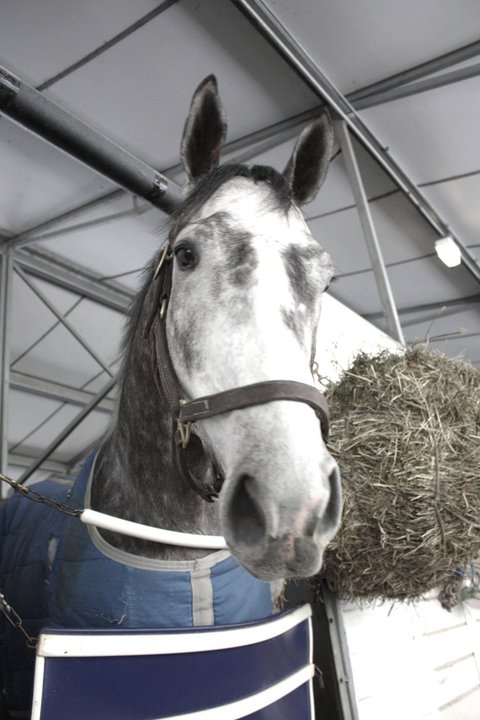
 If a tribute to that principle exists, it may lie in the undefeated two-year-old filly, Weemissfrankie, whose ownership connections include Dawn Mellen of Bran Jam Stables, the founder of After The Finish Line (ATFL), a non-profit dedicated to funding Thoroughbred rescue, retraining and retirement for ex-racehorses who can no longer race or breed.
Mellen began volunteering at Thoroughbred rescues in the mid-1990s, where she realized that a major obstacle to helping retired Thoroughbreds was funding. In response, Mellen founded ATFL in 2007. ATFL provides monthly emergency funds and yearly grants to Thoroughbred rescues to fund retraining, rescue and rehabilitation efforts.
ATFL funding is used for various purposes, including saving horses at auctions, paying for medical expenses, providing hay and feed, paying boarding expenses and transporting a Thoroughbred to safety. Through providing the monetary means, ATFL helps assist in transitioning ex-racehorses into second careers.
As a result of funding from ATFL, ex-racehorses have been retrained for dressage, trail riding or as hunter/ jumpers. If the horse can no longer be ridden, they are retrained to provide equine therapy or serve as companion animals. Through creating a funding organization for these efforts, Mellen has managed to show that every Thoroughbred has a value, even if it cannot race or breed.
In the past few years, doing good has been the sole reward for Mellen’s efforts to assist ex-racehorses in their retirement. ATFL board members receive no salary. All funding directly benefits ex-racehorses in need of monetary assistance.
 Then, along comes Weemissfrankie - a filly that has quite a gift for “goodness” on the race track. In three starts, the talented filly has captured two Grade I wins, the Del Mar Debutante and the Oak Leaf Stakes at Santa Anita, for her ownership team. Currently, Weemissfrankie is heading to the Breeder’s Cup to compete in the $2 million Grey Goose Breeders’ Cup Juvenile Fillies (Grade I) on November 4th at Churchill Downs.
It appears that goodness may truly be the breeding ground for luck in racing.
Win or lose, it should be a good race. With a little luck, Weemissfrankie will prevail, not just in this race, but in the race to raise awareness for the ex-racehorses who are in need of assistance at the close their career. And, with a little goodness, retired racehorses will receive more of the public support that they deserve at the end of their racing days.
For Mellen, it seems that her kindness toward ex-racehorses has brought her the luck that the late Mr. Sosby spoke about - The unbeaten kind. Yet, when I look at where luck appears, it often follows the good people who value a Thoroughbred at every point in their career. And, as far as being good to a horse in need, nothing can beat that endeavor at the finish line.
After The Finish Line is a 501(c)(3) non-profit organization in which donations are tax-deductible to the fullest extent of the law. Visit the ATFL website at www.afterthefinishline.org or call 858.945.1371 to learn more or make a donation. You can also visit ATFL on Facebook by clicking this link.
September 22nd, 2011 §
 Bernard Fontenelle once said, “It takes time to ruin a world, but time is all it takes.”
Perhaps, the time of ruin arrives when a single generation forgets why certain places are important. Or possibly, the importance of the events that occurred on that ground fail to excite a culture with changing values. It may take time to ruin a world, but if time is all it takes, the way we spend our time has an ever-increasing value toward determining what the future beholds.
In the case of racetrack closures, I wish I had spent time at those lost tracks prior to the final “Call to the Post.” And, in our tracks that continue to exist today, I do. Because, if it takes time to ruin a world, there is time to prevent the fall of it in the first place.
The question lies in how we can contribute to racing while we spend our time enjoying the sport. I imagine the last day at Bay Meadows race track in California, where, prior to its closure, it was the longest continually-operating track in the state. It was on this ground that Seabiscuit fought to become the two-time winner of the Bay Meadows Handicap, John Henry finished second in the same race years later, and Triple Crown Winner Citation graced the now-demolished oval near the end of his illustrious career.
In 2008, Bay Meadows was shut down after being purchased by a real estate development company. Prior the final race, “The Last Dance Stakes,” the track bugler played “Auld Lang Syne.” The crowd gave a standing ovation to the final string of horses to race that day, while the athletes broke from their post-parade to face the audience. While facing the crowd, the jockeys gave a salute to the witnesses who showed up to watch the last race ever to be run on that track. And, moments after that final salute, Bay Meadows closed for good.
When I view the six and seven figure prices paid for a single horse in a sales ring, I wonder why no one had ever thought to set up a foundation to provide funding to help save the tracks that require emergency funding, to promote the sport in general and to help fund Thoroughbred retraining and retirement.
As an owner, I would happily pay a surcharge on a sale price to ensure that the tracks can keep racing horses in the future. Further, I would pay a nominal fee when registering a foal to help provide the necessary funding to prevent such closures. And finally, I would happily give a percentage of my winning purse share toward a foundation that funds the promotion of Thoroughbred racing and retirement. Because, in the final equation, it does not serve myself, nor the industry, any good to have a racehorse without a racetrack to race upon. In the same time that leads to the closure of a track, there is time to prevent the collapse of it if funding is provided and used to promote the future of racing.
If such a foundation had existed to save Bay Meadows, the site of Seabiscuit’s two-time victory in the then-longest running race in California may not be slated to become a shopping area today. It would be a racetrack where wonder existed as to when the next Citation, Seabiscuit, or John Henry may set foot that ground.
And, if such a foundation had existed in Illinois, Washington Park would have been rebuilt in Homewood after it was destroyed by a fire in 1977. I would have enjoyed racing a horse in the same place where Triple Crown Winners Whirlaway and Citation competed on that ground. I would have felt humbled to stand where Native Dancer left that track victorious before later retiring with a record of 21 wins in 22 lifetime starts. I wish I could have watched my horses race on the same oval where Nashua and Swaps held a $100,000 match race and Jockey Eddie Arcaro became the two-time winner of the American Derby. Yet, Washington Park was sold for commercial and residential development in 1992. And, with that sale, the living monument to those moments disappeared in a dismal demolition.
If I were born a few decades earlier, I would have gone to the Wood Memorial when it was held at the former Jamaica Racetrack prior to its’ demolition in 1960. Jamaica Racetrack was where Omaha won the Wood on his road to becoming a Triple Crown Winner. Native Dancer made his debut at Jamaica. Even Seabiscuit raced there. And, before Bold Ruler retired to stud and gave the racing world Secretariat, he ended his career of 23 wins in 33 starts with his last race at the Jamaica Racetrack. Yet, I’ll never visit that park because the Rochdale Village Housing Development occupies the site now. The greatness that took flight on that soil has long been forgotten in exchange for one more residential area.
And finally, I wish I was at the former Sportsmans Park in Illinois in 2002 to watch War Emblem capture a victory in the Illinois Derby and stamp his ticket to Churchill Downs to race in the Kentucky Derby. But, it appears that Fontenelle’s proposition, “It takes time to ruin a world, but time is all it takes,” proved true for Sportsman’s far too soon. By the time War Emblem set foot in the gates to win the Kentucky Derby at odds of 20-1, Sportsman’s had already closed for good. Whatever may have been celebrated from War Emblem’s road to the roses the following year was ultimately replaced with plans to develop a shopping center on that site.
Now, Hollywood Park is facing closure with the same swan song from developers that, in time, it will become a commercial and residential development. And sadly, it seems that time may be all it takes to demolish it.
Yet, in the time it takes to close a track, there is time to try to save it. Every day spent at a track is a day that supports the continuity of its existence. I make a point to go to the track to see the races. And, because I go to the races, I stood in the crowd and saw my favorite racing moment at Hollywood Park. It was the day that Zenyatta broke the modern Thoroughbred record when she won her seventeenth consecutive start.
During the race, the crowd cheered in unison for one single mare from start to finish as if she were racing alone. And, when she claimed her seventeenth consecutive victory, Zenyatta stood on that site, a perfect Thoroughbred, and took in an ovation from a crowd that was absolutely in awe of her presence. It was not simply a horse race. It was a historical moment. And, the site of that historical event is the same site, which, if developers get their way, will be demolished and turned into a retail and residential area.
I fail to see a need for another commercial or residential development on grounds where our champions tested their limits and showed us what we had deemed impossible. Rather, there is a need to protect the monuments to those moments, and ultimately, provide a site for future racehorses to showcase their talent.
Thankfully, “It takes time to ruin a world.” Because in the time it takes, the industry can rethink how to help save our remaining tracks and fund the future of this sport. And, as participants and fans, we can use our time to think about how we spend our time enjoying this sport, contributing to this sport and protecting it.
We can take time to attend the races to show our support. We can help fund the preservation of this sport. And, in the end, we can honor the achievements of our heroes and heroines through saving the very places where they laid their hearts down and fought for a victory.
Photo Credit: Photo of Bay Meadows taken by Dylan Tweeney.
August 20th, 2011 §
 At some point, any racing enthusiast has probably heard the old adage, “Don’t go falling in love with racehorses.” In a sport where anything can happen, anything does when it comes down to its’ athletes. Victory. Defeat. Health. Illness. Friendship. Excitement. Frustration. Hope.
Just name it. They are the quickest creatures on four legs to own your sanity.
I am certain that “Don’t go falling in love with racehorses” is sound advice for those who want to keep a clear mind at the wagering window and winner’s circle. But, as I’ve found, it is simply impossible not to stand in awe and give your heart to a racehorse.
Perhaps, the old adage needs to be dusted up with a caveat, “If you fall in love with a racehorse, hope for victory, plan for heartbreak, pray for mending and put that horse first no matter where they land on the toteboard.” And possibly, find a church, therapist or wealth of superstitions to help you bear the weight of your 1,000 pound leap of faith.
One day, I found myself at Arlington Park staring at the John Henry statue. I was praying to John Henry that our horse didn’t get claimed. Yet, in the end, he was claimed.
A month later, I was praying to John Henry that we would win the two-way shake to get the same claiming horse back in the barn. And, in the end, he came home.
In the following weeks, I was praying to John Henry that my claiming horse would never have to race for a claiming tag again. And, in the end, my prayer was sadly answered in a very literal way.
My big gray horse injured himself a few days later and was retired from racing.
It led me to imagine that when Truman Capote said, “More tears are cried over answered prayers than unanswered ones,” he was at the race track that day. And, when I imagine Capote at the race track, he’d just had his heart broken by a magnificent horse as he stood in full-blown rapture of that athlete.
After my horse was injured, I asked someone, “When is it that you can safely love a racehorse?” And they replied, “When they are retired.” I suppose we could add that exception onto the old racing adage for the faint of heart.
Yet, I would rather lay my heart down and get ready for “anything” that follows. Because, what followed those prayers was the horse that I prayed to John Henry about on those desperate days. He won’t be racing for a claiming price. And, as for our marvelous plans for racing elsewhere, we amended them just as easily as we made them.
My big gray friend is on the road to recovery. With a lot of luck, he’ll race again in the future. Yet, with the little luck we treasure, he’ll reappear on the race track as a stable pony.
I can already see my gray guy, looking out on a brisk morning, surveying the horses as they carousel past him. When the workouts are over, the two of us can meet back at the barn, in quiet agreement, that it a pleasure to fall in love with a race horse.
It is a pleasure worth anything.
July 12th, 2011 §
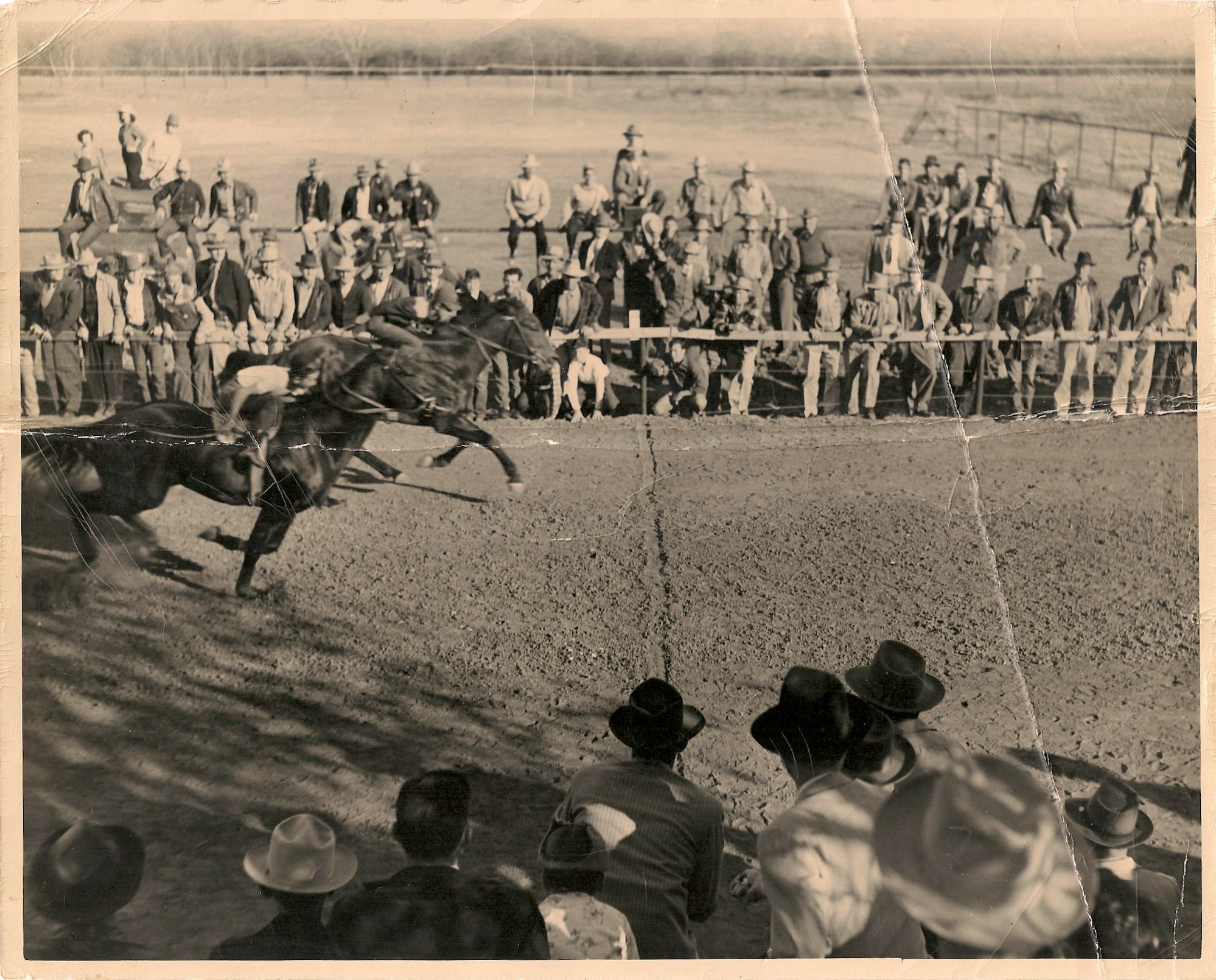
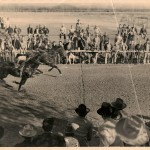 “The old-timers in Louisiana all remember Miss Pine,” said Glynn “Tee Red” Bernis, the former boy-rider of the legendary Chestnut mare who retired with an undefeated record in 32 career starts from the bush track circuit.
Now 62-years-old, Bernis remembers the powerful race mare with a reverence only matched by her legendary talent. “There was no other horse like Miss Pine. She could outrun anything.” He continued, “She was the best Quarter Horse that ever raced.”
Yet, you won’t find Miss Pine in a record book for racing. The Texas-bred mare was never registered nor did she race on any regulated track during her career.
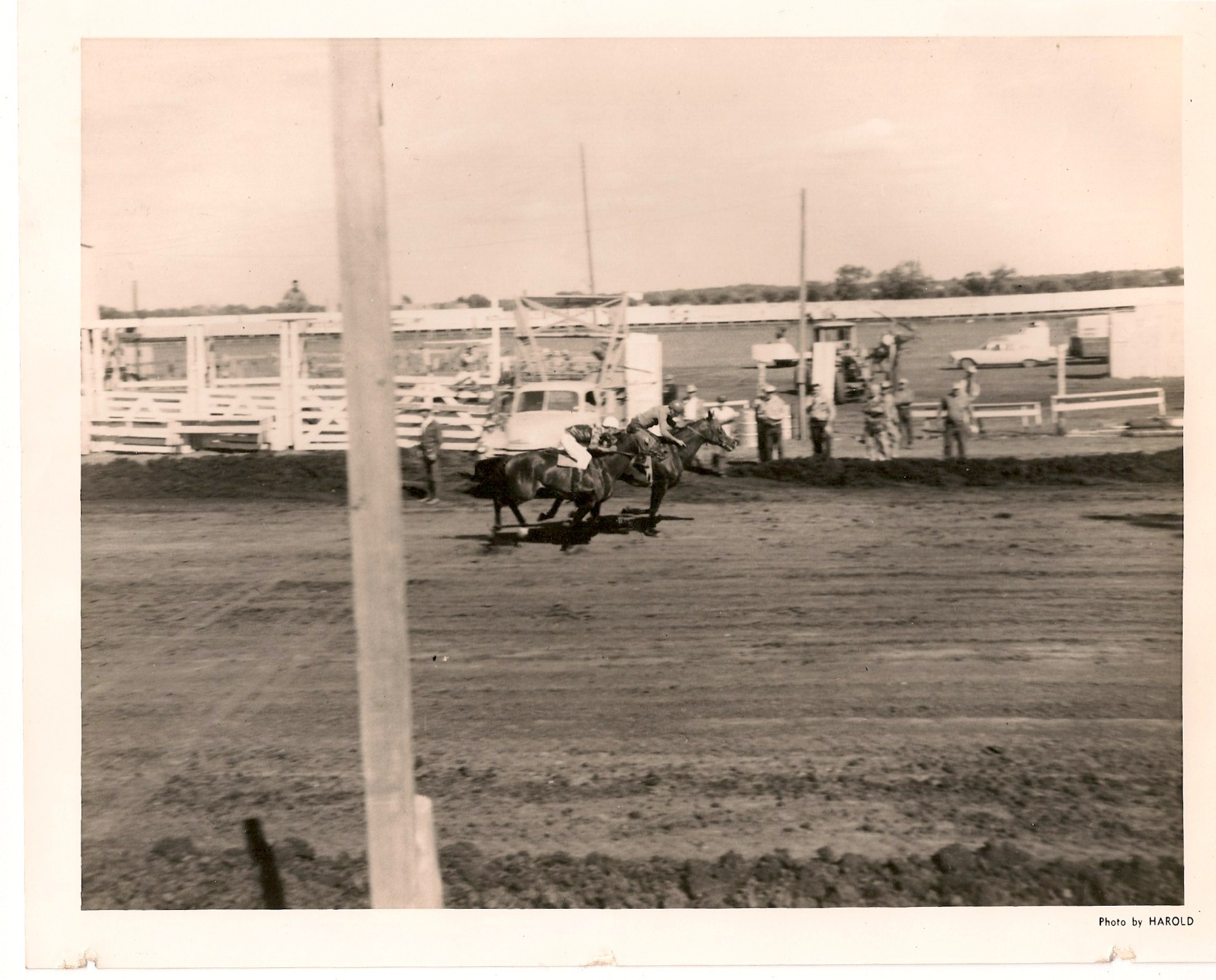
As a result, the glorious legend of Miss Pine is largely invisible today. Like many of her contemporaries, the achievements of the bush track horses aren’t neatly catalogued to preserve their legacy. Rather, their history is maintained through an unofficial, and most often, oral record of their accomplishments.
“The younger generation doesn’t remember those horses,” Bernis explained as he reminisced about Miss Pine.
Yet, for the few that remember Miss Pine, she is a legend. “For a quarter horse, she was one of the best racehorses ever. You just don’t run 32 times and win 32 races on any kind of race track. She won from Maine to Spain, so to speak. Muddy tracks. Fast Tracks. It didn’t make any difference. And, it didn’t make any difference who they brought for her to race. She never got beat,” said Bernis.
As a six-year-old, Bernis began riding Miss Pine for her late owner and trainer, Pierre LeBlanc. He explained, “I rode her about four or five times. My brother, Kerwin, rode her the rest of the time.”
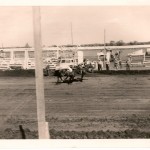 Bernis then recounted an incident in Texas in which both brothers rode Miss Pine to victory on the same day. “In the first match race, Miss Pine ran with open lanes. She had never run with open lanes and my brother, Kerwin, was riding her. She won by two or three lengths, but she was swerving all over the race track.”
After Miss Pine’s victory, Bernis recalled, “The people said they wanted a rematch. So, Pierre LeBlanc said, ‘We’ll rematch her in three hours, but we want a rope down the lane so that she can run straight.’”
Three hours later, Miss Pine was set for a rematch. However, this time, Bernis was called upon to ride the champion mare. “Instead of putting my brother, Kerwin, on Miss Pine, they said, ‘Tee Red, get on Miss Pine,’ since I was about twenty pounds lighter than him.”
Bernis explained, “She took about three jumps out of the gate and pulled down the rope on the race track. She still won though. It was like the other horse wasn’t even in the race.”
He marveled, “She was a sweetheart. All she knew how to do was run. She didn’t like any horse to come by her. She would never let anything outrun her.”
And, as the career of Miss Pine came to life in Bernis’ tales of the race mare, his statement, “She could outrun anything,” began to set in. He meant anything. Colts, fillies, maidens and champions. Simply put, any comers were doomed when the mare appeared alongside them at the starting gate.
According to Bernis, a loose horse couldn’t even outrun Miss Pine. In one race, the mare was matched against a contender that carried a rattling rock-filled can on its’ back. Despite the weight in favor of her opponent, the race went forward.
“There’s a Cajun saying, ‘You ride what you want, I’ll ride who I want,’” Bernis explained. “They don’t say anything about a live jockey.” And, in the end, the loose horse didn’t blemish the mare’s perfect record. “Miss Pine still beat him with my brother, Kerwin, riding.”
Yet, for Miss Pine, capturing a victory seemed to be a bittersweet occasion at times. Bernis recounted a tale in which Miss Pine was shipped to run a match race in Mississippi. “She was racing a horse named ‘Shoefly Baby,’ who was another champion Quarter Horse at the time. They matched for a lot of money. Pierre LeBlanc and some of the other guys had bet a lot of money on Miss Pine. They would bet five or ten thousand on a match race.”
However, Miss Pine wouldn’t get to bask in the glory of another victory if she beat Shoefly Baby. “Before she ran, Pierre LeBlanc told us, ‘After the race, pull Miss Pine up, leave the racetrack, put her in the trailer and head back to Louisiana. There is going to be a war after this race since they’ll be mad we took their money.’”
Bernis then reflected, “I’m pretty sure they knew she was undefeated, but they thought they could outrun her.” When she crossed the wire first, Miss Pine was loaded onto the trailer to Louisiana, without any praise or garland. “We never left her side during that trip,” said Bernis.
Yet, at times, Miss Pine brought home a much easier victory. Bernis recalled, “On one occasion, we leased Miss Pine to some people in Texas. There was a horse called ‘Be Sure Now.’ He was the leading Quarter Horse runner. They had organized a $50,000 race for ‘Be Sure Now,’ with a $20,000 forfeit penalty.” He explained, “If he ran, they could win $50,000. If he didn’t run, they had to pay a $20,000 forfeit.”
The lessors of Miss Pine saw an easy $20,000 profit before the match was ever held. “The people who leased Miss Pine brought her to the race to match against ‘Be Sure Now.’ Once the other side found out that they were racing against Miss Pine, they paid the $20,000 to forfeit.” Bernis reflected, “That’s how fast she was.”
“She was open to the world. If anybody thought they had a horse that could outrun her, they could bring ‘em,” said Bernis.
However, few came to try to conquer the mare. “Sometimes, Miss Pine would only run about five times a year. It was hard to get anyone to agree to match race her.”
And, in the end, Miss Pine retired with a Hollywood ending. The Western actor, Dale Robinson, reportedly purchased the mare for breeding. She never raced again after the sale. As a broodmare, Bernis remarked, “Robinson raced a couple of horses out of Miss Pine. None of them were really good racehorses.”
It seems Bernis’ belief proved true at the close of her career.
There was no other horse like Miss Pine on the bush track circuit.
“She could outrun anything.”
Photo Credits: Oscar and Patty Wells. Bush Track Photos. Used with Permission from the Wells Family.
July 1st, 2011 §
 There is something about a two-year-old racehorse that draws optimism from seasoned owners in a sport with dizzying odds of finding success at the highest tiers of the racing world.
Yet, the very nature of odds is that they judge what is probable rather than what is possible in the world.
Pryce Robertson, the namesake to a two-year-old colt named “Pryce’s Posse,” has proven what is possible through working toward raising autism awareness after being diagnosed with autism at an early age.
And now, Pryce has a winning two-year-old colt to bolster his cause.
His father, Rich Robertson, Managing Partner of Tri-Star Racing LLC, explained that Pryce was initially diagnosed with autism when he was 3 1/2 years old. “We were told that he would never speak a word and that we would probably have to institutionalize him by the time he turned thirteen. It was pretty dismal.”
However, Robertson and his wife, Vickie, didn’t accept the odds against their autistic son succeeding as an individual in the world. Instead, they focused on the possibilities for Pryce’s future.
 Robertson explained, “We just don’t quit. My wife and I don’t have the word ‘quit’ in our vocabulary. When we received the initial diagnosis, I told the doctor, ‘I accept your diagnosis, but I will not accept your prognosis.’”
In the years that followed, the Robertsons focused on autism education and awareness. Vickie Robertson put together an educational program in their home for Pryce. There were volunteers around the clock as Pryce was schooled eight-hours a day, seven days a week. The family also created “The Pryce Robertson Autism Awareness Foundation” in an effort to help fund autism awareness and education.
The Robertsons also began participating in the racing industry in 1995. Robertson explained, “Pryce is a special individual and he has always loved the horses. They were a big part of him coming out into the world, being in a crowd and watching the horses. I owe a lot to the horse business and being in the horse industry.” As part of his gratitude, a portion of the winnings from every Tri-Star horse are donated to the Pryce Robertson Autism Awareness Foundation.
This past April, the Robertson family’s involvement in racing resulted in a beautiful twist of fate to help promote autism awareness.
Robertson saw a Posse colt enter the sales ring in Texas. The colt failed to meet the reserve price at the sale. Robertson, along with his partner and friend, Alan Dean, believed that the colt was worth a second look and went to the consignor to view the colt. He ultimately purchased the two-year-old colt privately after the sale.
Robertson explained, “Pryce’s Posse is a nice, well-balanced horse. Through our private sale, we paid $12,500 for the horse. But, it’s not the size of the dog in the fight, it’s the size of the fight in the dog. He’s not a huge horse, but he has a lot of qualities that I look for in a racehorse. He’s very competitive and has the will to win. He wants to do things the right way.”
The Robertsons decided to name their colt “Pryce’s Posse,” after their son. Robertson chose the name when the horse demonstrated talent in training. “We initially thought of three or four names. Then, we realized that this may be a very special horse. So, I said, ‘Well, if he is going to be that special, and I have a special son with autism that put us in the horse business, I think he should be named after Pryce.”
On Father’s Day, Pryce’s Posse made his maiden debut at Arlington Park as Rich and Vickie Robertson stood at the rail and watched. In a stunning turn for home, the colt won by four lengths in his first outing.
 Robertson later recalled, “When Pryce’s Posse won on Father’s Day, it meant more to me than any race that I’ve ever won. I’ve won a lot of races. I’ve won stakes races. I won with a horse at Churchill on Oaks Day. But, this particular horse winning a race on Father’s Day, knowing that Pryce was at home watching it on television, meant more to me than any race I’d ever won.”
After Pryce’s Posse won his maiden debut, the phone started ringing with lucrative offers to purchase the colt, far in excess of the original sale price paid by Robertson. Robertson consulted with his partners, as well as his wife, Vickie, and son, Pryce.
Robertson explained, “Pryce said, ‘Dad, it’s a lot of money. But, I think we should keep him.”
And, as for his wife, Vickie, Robertson already had his answer. “My wife never wanted to sell the horse. And, she’s been in the horse business long enough to know that things can happen. But, she knows the difference between the horses that you should sell and keep.”
And, Robertson agreed with the decision to pass on the offers to purchase the horse. “I think one of the reasons that I love horses so much is that you can get a young horse and you’re told, ‘Well, they probably won’t do this. The breeding says they can’t do that.’ And, you’re told, ‘You’ll probably have to pay a quarter of a million dollars to get a horse that can run.’ Well, I’ve had some great horses and that’s not true.”
Yet, Robertson’s optimism regarding his two-year-old colt has a strong precedent. The colt’s namesake, Pryce, is now twenty-years-old and is currently attending his second year of college. The family is currently building a website for the “Pryce Robertson Autism Awareness Foundation.” The Foundation continues to raise money to promote autism awareness, including funding workshops for teachers to understand autism and creating a college scholarship fund for an autistic child.
When the website is completed, the Robertson’s have decided that the administrator should be a person who was never supposed to speak a word in life - Pryce Roberston.
It appears the odds of success are tricky in both life and racing.
Sure, the odds can tell you what is probable.
But, in the end, the possibilities don’t always follow the odds.
They beat them.