June 13th, 2011 §
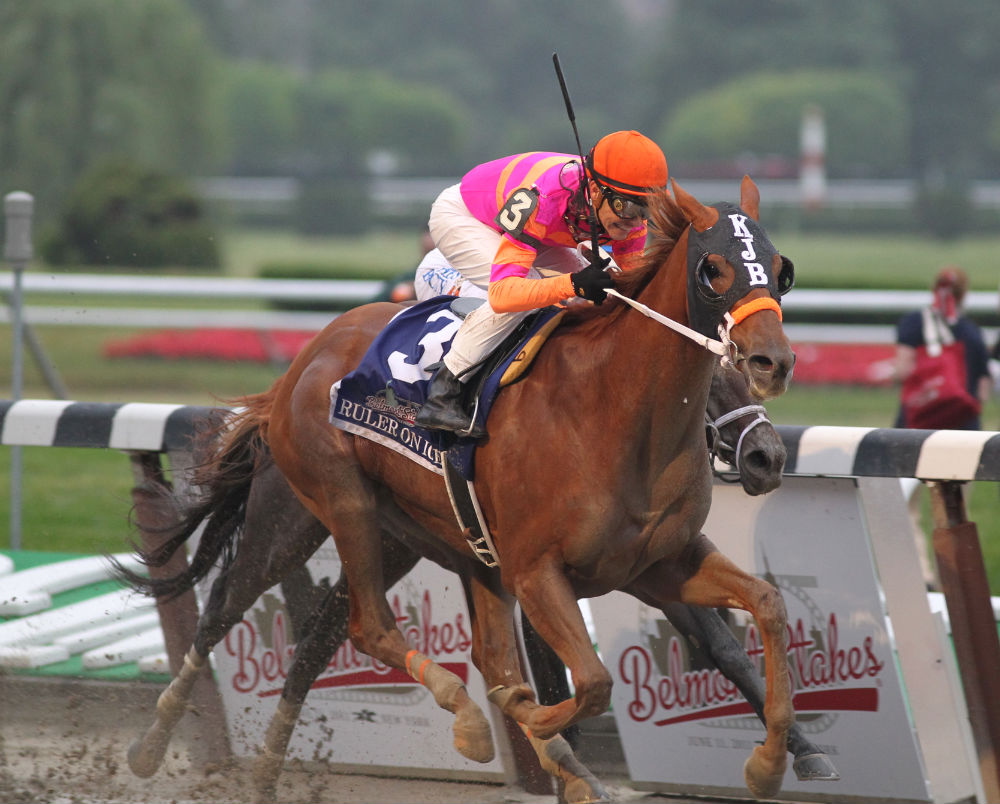
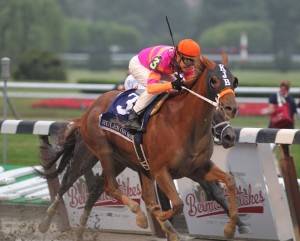 There was no coronation of a king at the Belmont this season, but a ruler emerged for fans to follow - Ruler on Ice.
In my view, the gelding is good for the sport.
Yet, Ruler on Ice didn’t always look good from my vantage point.
When he emerged from the tunnel for the post-parade in the Belmont, the gelding appeared rattled from the crowd as he made his way onto the track for the last jewel of the Triple Crown. I thought he was going to fall down in front of a national television audience. He certainly didn’t look like he had a shot in the Belmont.
At odds of 24-1, I felt downright bad for the guy as he set foot on the track. It appeared few had placed a vote of confidence in his ability to win at the wagering windows. The sad sight of him made me place a bet in his favor just to show support. As I viewed it, I didn’t want to see the poor guy go out there all alone.
If I had researched a thing about Ruler on Ice before making my bet, I would have known there was nothing particularly sad about his entrance into the Belmont.
At his stable, Ruler on Ice had always been the underdog, and, the gelding seemed perfectly fine with it. The top selection for the Triple Crown trail at the start of the year was Sweet Ducky. After Sweet Ducky was sold, Pants on Fire emerged as the hopeful in the barn for the Triple Crown outings. And, as the first two legs of the series came and went, Ruler on Ice didn’t seem to be targeting a single jewel.
It appears Ruler on Ice was busy sorting out his “likes” and “dislikes” as a racehorse.
As I read through the post-race transcripts for the Belmont, Ruler on Ice emerged as quite a salty character. He was gelded in an effort to calm his disposition. Yet, gelding him didn’t seem to change the bulk of his quirky behavior. Ruler on Ice decided that he didn’t like his trainer’s main barn. Instead, the gelding preferred his plain stall in the trainer’s “B” Barn at Monmouth Park. Further, Ruler on Ice didn’t like being shipped. In an effort to simply make it the Belmont, the gelding was given his own van and an attendant to pet him during the sixty mile trip to Belmont Park.
Yet, in the end, Ruler on Ice went to the wire all alone, awarding his connections with their first victory in a Triple Crown race. The “poor guy” that prompted my “sympathy bet” had just captured a commanding victory in the Belmont.
And, in his fickle-fashion, the gelding didn’t want to wear a blanket of carnations or pose for days of photos with the media. Instead, the Belmont-winner simply wanted to head back to his plain stall in his “B” barn with a single gem – a Triple Crown victory.
At the end of the day, the gelding did just that.
Yet, in my view, the victory of Ruler on Ice provided a perfect close to the Triple Crown season. As the television cameras and non-industry publications showcased the sport, the athlete and his connections rose to the occasion.
It was good for horse racing.
His owners, George and Lori Hall, seemed genuinely humbled and awestruck by their Belmont-winning racehorse. It was their first Triple Crown victory.
The trainer, Kelly Breen, appeared in an elegant hat and told the tale of how he wasn’t born into a racing family. Breen graciously thanked the winning owners for the opportunity to train their horses during the moment of glory. It was his first Triple Crown victory.
And finally, Jose Valdivia, the winning rider, stood in a beautiful juxtaposition to Breen, describing what it feels like to win the Belmont having come from a racing family. He relayed that his first congratulatory call came from his Uncle, a trainer in Peru. The rider beamed, saying he felt like he was “on cloud nine right now.” It was his first Triple Crown victory.
And, Ruler on Ice took his first step toward providing the longevity that many racing fans crave from the equine athletes in the sport. At the end of the Belmont, the salty gelding took the trip back to his plain stall at Monmouth Park and gave fans something to bet on future race cards – a Belmont-winner. It was a victory for the sport.
Yes, there was no coronation of a king at the Belmont this season, but there certainly remains a ruler.
Ruler on Ice.
I think the gelding, and his gracious connections, are good for the sport.
Thank you to horsephotos.com for the photo of Ruler on Ice in the Belmont. To visit the horsephotos.com website, please click here.
May 24th, 2011 §
 Every now and then, a remarkable racehorse can elude you when it is in your direct line of sight.
And, in our home, there are few places to fix your eyes without finding a photo of some racehorse that was a remarkable horse for varying reasons, ranging from claimers to Triple Crown Winners.
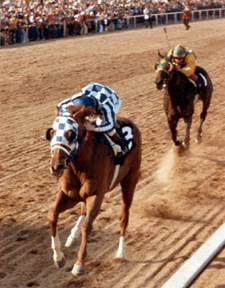
It makes it hard to see the forest through the trees at times, especially when a big red oak like Secretariat has a photo of his Belmont stretch run posted squarely in the middle of the room.
When I think of the Belmont, my mind immediately drifts toward Secretariat and his 31-length victory. The photo of that moment has been hanging in the same spot for years, and, I never dream of moving it. In my view, it is a perfect snapshot of the level of otherworldly talent that deserves the honor of the Triple Crown.
 Yet, this year, as two jewels of the Crown divided in the Kentucky Derby and Preakness, I was left to ponder the importance of the achievement of winning the Belmont when there is no Triple Crown in contention. And, as I stared at my pictures of beloved Triple Crown winners, another remarkable horse emerged to answer my question of the importance of the Belmont when there is no Triple Crown at stake this season.
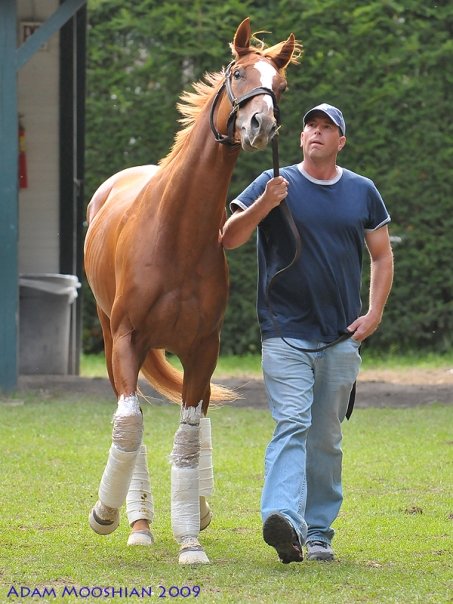
A picture of Summer Bird and my husband emerged from the tapestry of photos hanging around the house. In the photo, they are walking together in the grass like two old pals on a Sunday outing. My husband has a look of admiration on his face as he is watching Summer Bird toss his head in the air without a care in the world.
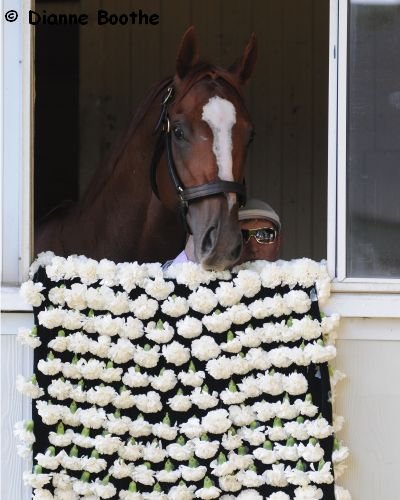
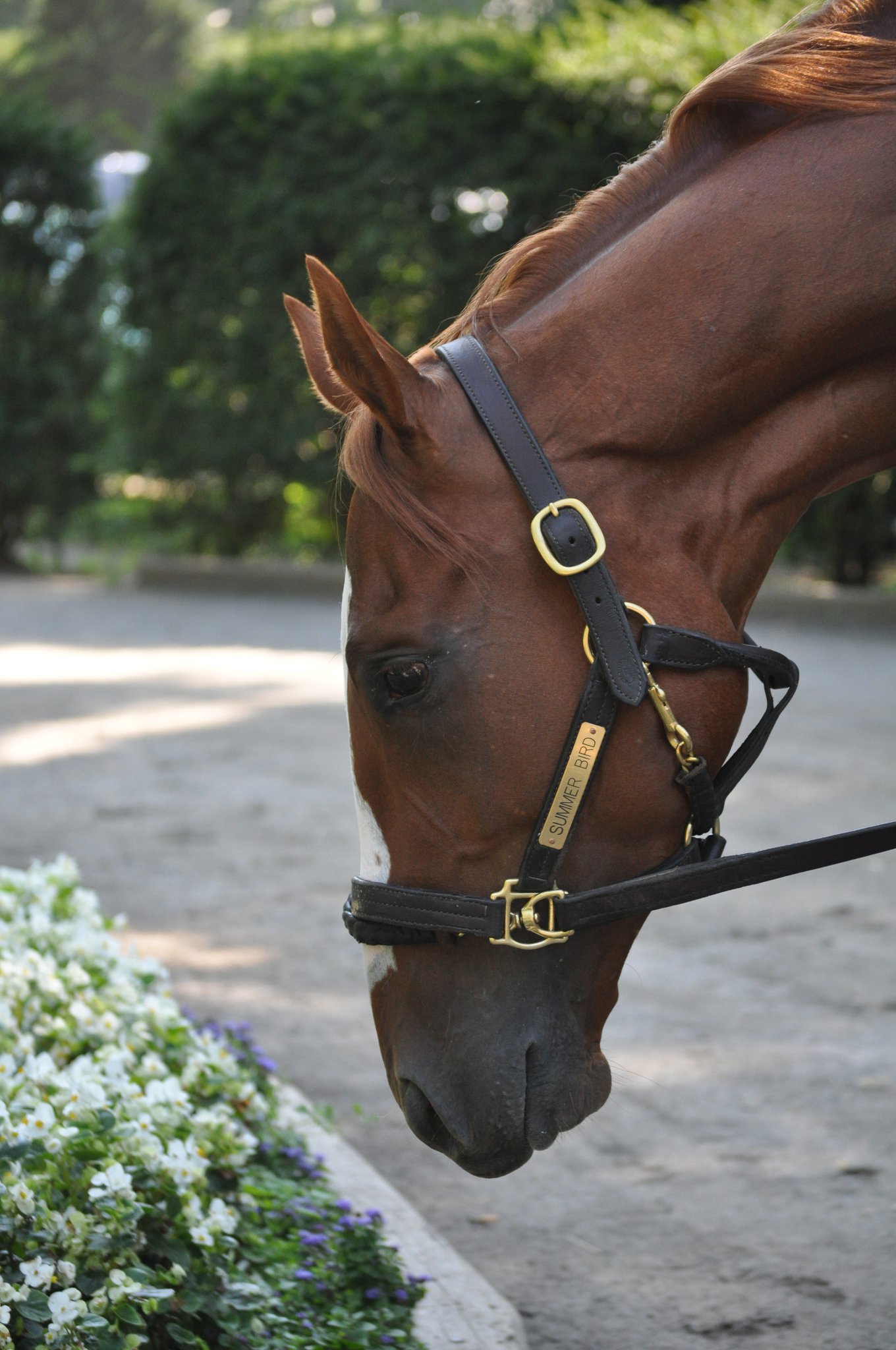
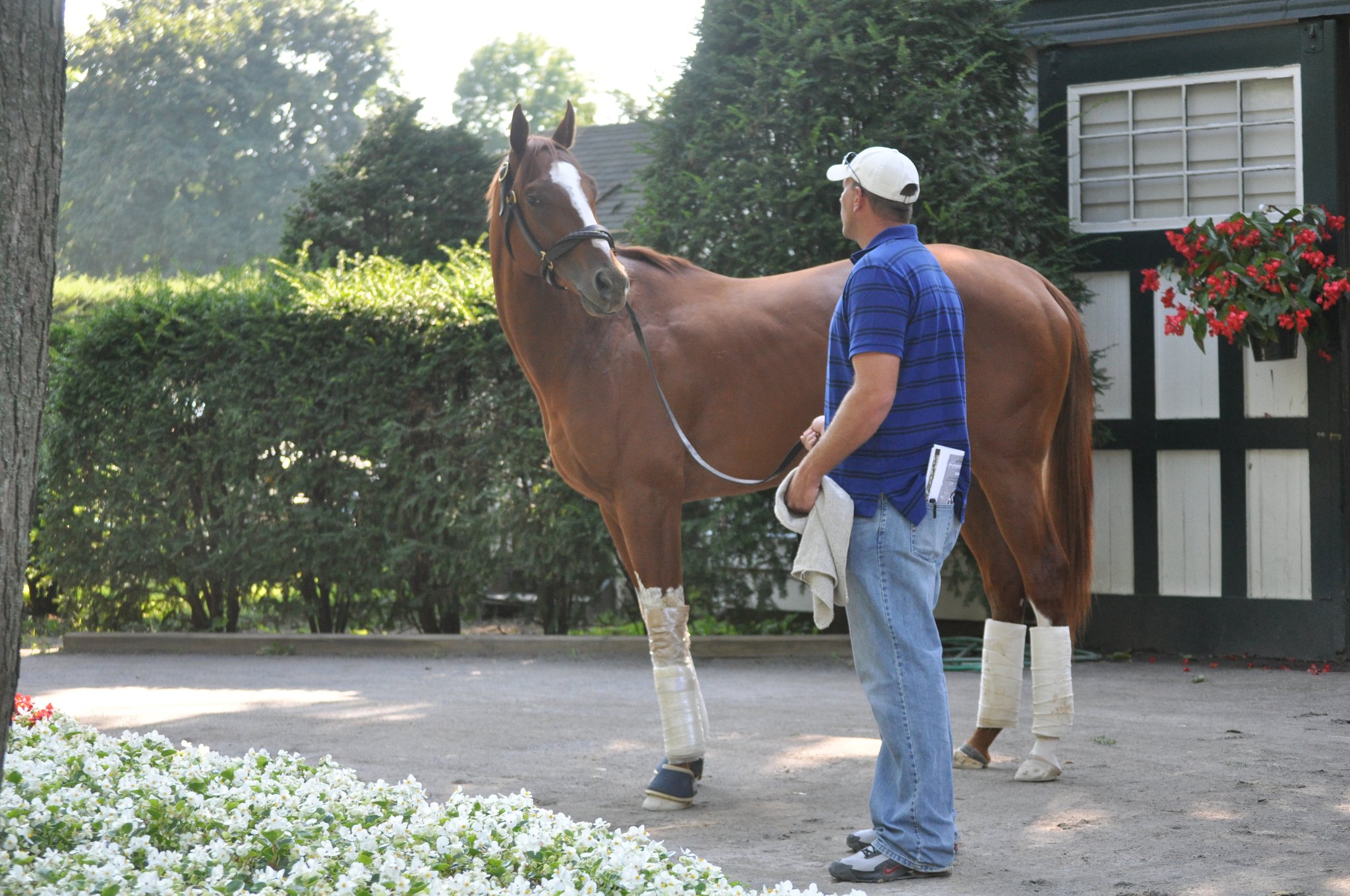
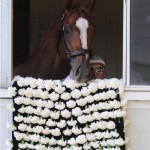
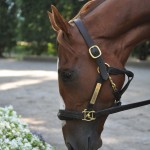
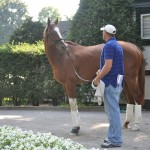 While I looked around the room at the array of racehorse photos, Summer Bird continued to peek out in various situations. In one photo, the big Chestnut is stopping to smell the flowers at Saratoga before the Travers Stakes. In another snapshot, Summer Bird is staring down my husband while he grins back at the horse, beaming with joy. And, in a final picture, Summer Bird is sniffing his new blanket of white carnations after he just won the Belmont in 2009.
As it turns out, Summer Bird’s items are such a fixture in our house that I barely even notice him anymore. He has his trophies positioned in the dining room, saddle towels in various frames and his halter hangs quietly on the kitchen wall from his start in the Kentucky Derby. On any ordinary day, I just live with his things. His presence is barely noticeable on a conscious level.
Yet, on this particular day, Summer Bird took center stage in my mind as the Belmont approaches and there is no Triple Crown in contention. I looked at my husband, Trainer Tim Ice, studying the Daily Racing Form across the room in perfect tranquility.
Unbeknownst to him, he was about to get bombarded with questions from his wife about the personal importance of Summer Bird capturing a lone jewel in the Triple Crown.
I turned to him and asked, “What do you think is the importance of the Belmont without a Triple Crown in play?” He looked up and replied without much thought, “It’s the oldest race in the Triple Crown series and the first time that a three-year-old horse is asked to run a mile and a half.”
In his mind, the matter was closed.
Yet, it wasn’t closed at all in my mind. I shot back, “What about when you went to the Belmont with Summer Bird. How did you feel when you realized he had won the race?” He looked up at me and considered his answer more carefully this time around.
He gave a humble smile and answered, “When Summer Bird got clear in the stretch, I stood watching and said to myself, ‘Oh my God. He’s going to win the Belmont.’”
His description of the moment seemed to prove the magnitude of the race in its own right and the glory that falls upon any horse that claims the final jewel.
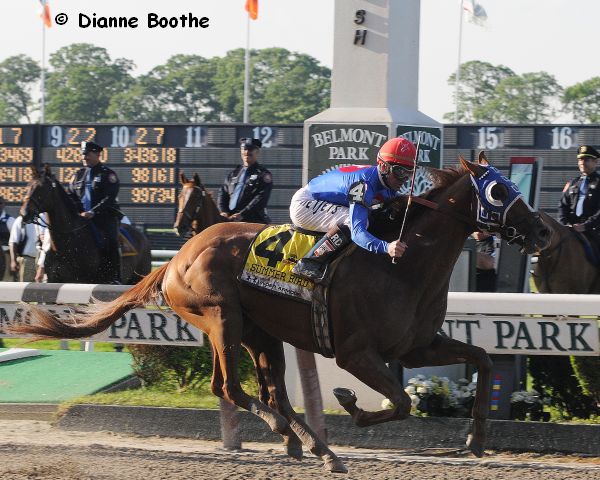
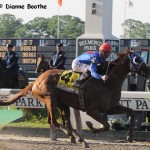 Then, I looked over at the Belmont trophy that sits in our home. Suddenly, it stood out as I considered the moment Summer Bird earned that trophy as he shot out from the pack to claim his victory in the Belmont Stakes.
I also considered the other Belmont-winning horses, whether they won the Triple Crown or solely the final jewel in the Belmont, and was awestruck by the idea that all of the winners stood next to same trophy.
A Triple Crown trophy itself, in any race of the series, holds something sacred. They are holding the same trophy that all Triple Crown winning teams stood next to at some point in racing history.
It occurred to me that holding a single jewel of the Triple Crown makes a horse a king, even if it is just for a day, whether they hold all three gems or a lone jewel. And, for those who have stood in the winner’s circle in any Triple Crown race, it appears that the moment lasts long beyond the winning garland.
It lasts a lifetime.
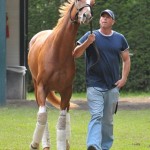 I considered the original picture on the wall, the two of them walking side-by-side, without a care in the world. And, I had to ask, “What was it about Summer Bird that made you so happy?”
Tim replied without any hesitation, “Just being with him made me happy. You see, I wasn’t just his trainer. I was a fan of him.”
And, in retrospect, it seems that Summer Bird was just as happy to be walking side-by-side with his friend and admitted fan, whether they were en route to a race or simply enjoying an ordinary day.
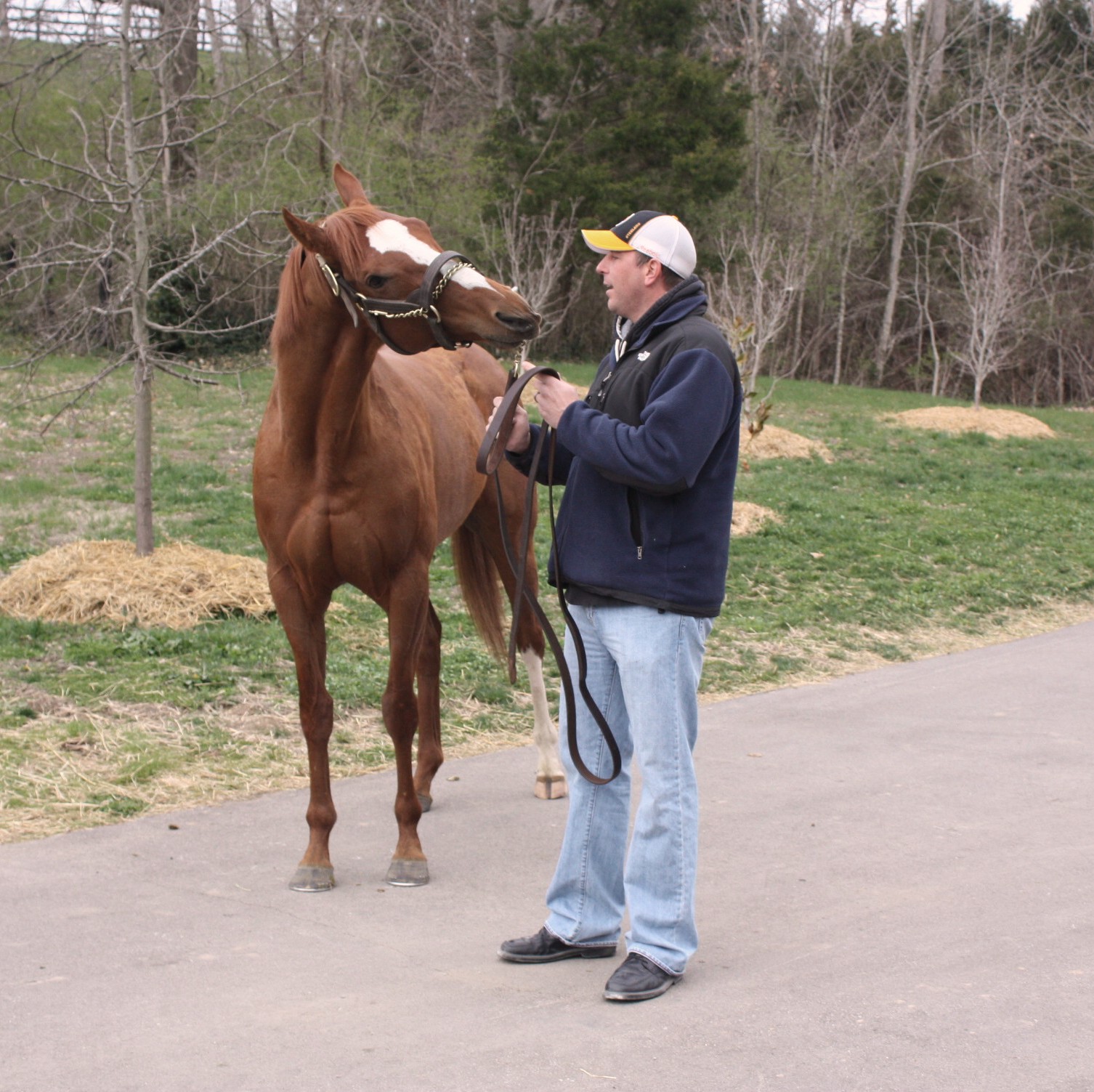
In a recent trip to Kentucky, we visited Summer Bird at Paul’s Mill Farm. And, that morning, the portrait of the friendship between the two standing side-by-side was brought to life before my eyes.
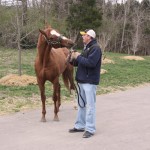 There is no doubt that Summer Bird recognized his old friend when his former trainer entered his sight. It was as if they maintained a repertoire with each other that outlasted the stallion’s racing career. Summer Bird was downright giddy and appeared to bask in moment the two of them took a walk together outside of the barn. It was as if the photo in our home had come alive for a brief moment in time.
As we left the stable that morning, the Champion made a long noise as he watched his old friend walk away. I asked Tim, “Do you think he recognizes you?” And, in an easy reply, he answered, “I think he recognizes me. We spent a lot of time together.”
I replied, “Did you hear him make that noise at you?”
Tim laughed, “Yes. He was hollering at me.”
I joked, “What did he holler at you?”
Tim smiled and said, “He hollered that he would love to race again.”
And, as we walked away, it appeared that the two of them would never forget the day they captured a jewel in the Belmont.
PHOTO CREDITS:
Summer Bird with Carnations. Photographer: Dianne Boothe. (Website: http://www.nyraracingphoto.com)
Summer Bird at Saratoga with Flowers. Photographer: Cathleen Duffy. (Website: http://www.thehorsewhisper.com)
Summer Bird Winning Belmont. Photographer: Dianne Boothe. (Website: http://www.nyraracingphoto.com)
Summer Bird and Tim Ice Staring at Each Other in Stable Area. Photographer: Cathleen Duffy. (Website: http://www.thehorsewhisper.com)
Summer Bird and Tim Walking With Each Other. Photographer: Adam Mooshian. (Website: http://www.adammoosh.com)
September 14th, 2010 §
In 1969, an ordinary coin was tossed into the air that held three sides – winning, losing, and everything beyond the two polar outcomes.
The outcome of the coin toss was a testament to the principle that an extraordinary life doesn’t lend itself to pre-existing realities or expectations.
It is a life that surveys common notions and ideas, and ultimately, carves out a new definition for the world.
Secretariat did just that.
Before Secretariat ever set a hoof on this earth, he twirled a simple coin flip into a monumental loss to the seemingly straightforward winner.
Ogden Phipps had technically won the coin-toss that governed the existing Phipps-Chenery breeding arrangement when Secretariat was among the three foals to be picked between the parties. However, the win only allowed Phipps to receive first choice between two foals born in 1969. In losing the coin flip, Penny Chenery automatically received the second foal born in 1969, as well as the only Bold Ruler foal that would be born in 1970 – Secretariat.
Through a two-sided coin, Secretariat had already redefined “winning” before he even entered the world.
Yes, Secretariat did just that.
On January 20, 1972, Secretariat left his home and set out on an extraordinary journey in his life. He arrived at Hialeah Park in Florida and began training to be a race horse. It was no small endeavor.
You see, before Secretariat became a “Superhorse,” he was just a red horse that garnered little respect. His groom, Eddie Sweat, stated “I didn’t think much of him when we first got him. I thought he was just a big clown. He was real clumsy and a bit on the wild side, you know.”
And, his trainer, Lucien Lauren, didn’t mince words when reporting to Chenery on Secretariat’s progress at the track. Lauren’s updates to Chenery were reportedly filled with remarks like, “I have to teach him how to run. He’s big, awkward, and doesn’t know what to do with himself.”
Yes, Secretariat seemed just like that.
Awkward.
As a two-year-old, Secretariat experienced the feeling of defeat. Lauren would report to Chenery, “He hasn’t shown me much.” And, in his first maiden race, Secretariat didn’t.
He lost.
Yes, Secretariat started out just like that.
He was defeated in his first race.
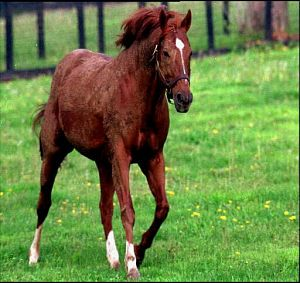 And then, Secretariat felt the feeling of victory.
In July of 1972, Secretariat won his first maiden race while finishing six-lengths in front of the rest of the field. Writer William Nack, reported, “Secretariat had raced the fastest six furlongs of his life,” at the time of his maiden victory.
Nack went on to comment, “Secretariat raced as if he had a future.”
Yes, Secretariat did it just like that.
He saw the future laid before his eyes.
In his third race, Secretariat had his first brush with fame.
While he was being saddled for an allowance race, a circle of people had collected at the paddock to view him. Among the crowd, was veteran turf writer, Charles Hatton.
When Hatton first laid eyes on Secretariat, he would later report, “You carry an ideal around in your head, and boy, I thought, ‘This is it.’ I never saw perfection before. I absolutely could not fault him in any way. And neither could the rest of them and that was the amazing thing about it. They body and the head and the eye and the general attitude. It was just incredible. I couldn’t believe my eyes, frankly.”
Yes, Secretariat was just like that.
A vision of perfection.
And, by the end of his two-year-old season, Secretariat was infamous.
Between July and November of 1972, Secretariat had officially won 7 of his 9 races and became the first two-year-old in history to be named “Horse of the Year.” His breeding rights were syndicated for a world-record total of 6,080,000 before he even began his three-year-old career.
Yes, Secretariat did all of that.
He broke records before he ever began his bid for the Triple Crown.
And then, Secretariat set out to become unstoppable in his three-year-old career.
When he entered the post parade for his first race as a three-year-old in the Bay Shore Stakes, Trainer Syd Walters reportedly told Lauren, “Good luck… You get one of those in a lifetime.”
And, when he won his three-year-old debut by 4 ½ lengths, Roger Lauren was said to exclaim from his box seats, “He’s too much horse! They can’t stop him! They can’t even stop him with a wall of horses!”
Yes, Secretariat was all of that.
He appeared to be unstoppable.
And then, Secretariat experienced doubt.
As Secretariat headed toward the Derby, the rumor mill swirled about Secretariat’s soundness after losing the Wood Memorial. Jimmy Snyder, an odds maker, reportedly told an Associated Press reporter that he had heard Lucien Lauren was icing one of Secretariat’s knees. Lauren was incensed when he heard the remark.
In response, Lauren offered to fly Snyder to Kentucky, allow Snyder to pick his own veterinarian, and personally view an examination of Secretariat’s knees to prove the soundness of the horse.
When Snyder didn’t accept the offer, Lauren reportedly went on to publicly bet Snyder a thousand dollars that Secretariat was sound. Snyder refused the bet.
Yes, Secretariat saw all that.
He bet on his own ability.
And, Secretariat experienced friendship.
During his racing years, Secretariat would reportedly wait for Eddie Sweat, his groom, every morning in his stall.
When Sweat approached, Ron Turcotte reported, “He’d grab the tip of Secretariat’s tongue to wish him ‘Good Morning.’ Before you knew it, every time Eddie passed his stall, the horse stuck out his tongue.”
You see, Sweat had a philosophy about being a friend to a racehorse that Secretariat seemed to admire in his groom. He reportedly told writer William Nack, “Only way horses win is to sit there and spend time with ’em. Love ’em. Talk to ’em. Get to know ’em. Now, that’s what you gotta do. You love ’em and they’ll love you too. People may call me crazy, but that’s the way it is.”
Secretariat didn’t find it crazy.
People noticed the beautiful bond that Sweat had formed with Secretariat. Ted McClain, Barn Foreman for Lucien Lauren, provided a testament on their relationship to writer Lawrence Scanlan, in saying “Eddie and that horse were like brothers. Eddie lived with him; traveled with him. They were joined at the hip.”
Yes, Secretariat treasured all of that.
He appreciated the value of a good friend.
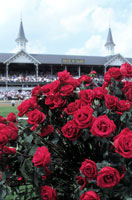 And then, Secretariat won the Kentucky Derby.
He had awoken at 4 o’clock in the morning and spent most of the day hanging around the back of his stall. According to Sweat, this was a good sign. He reportedly didn’t want to be bothered on race days.
When the gates opened, Secretariat delivered a beautiful response to his critics. He ran every quarter mile faster than the preceding quarter. And, in the home stretch, he passed his final rival – Sham – to claim a 2 ½ length victory.
Secretariat set a new winning track record of 1:59 2/5 for the Kentucky Derby.
Yes, Secretariat did just that.
He holds the Kentucky Derby track record to this day.
And then, Secretariat set his gaze on the second jewel of the Triple Crown – The Preakness.
Once he broke from the gate, Secretariat did something astounding. As he headed into the first turn, Secretariat was dead last. Within seconds, Secretariat passed the entire field by the end of the first turn and drove through the rest of the race like a big red Bentley. Secretariat ultimately captured a 2 ½ length victory in the Preakness.
Ron Turcotte never used his whip during the race. Turcotte would later comment, “The pace was slow and he wanted to run… He was determined to run. I figured, if this is the way he wants to do it, I’ll let him have his way.”
Those who watched the race were in awe of Secretariat’s performance in the Preakness. Baltimore Handicapper, Clem Florio, reportedly shook his head in amazement and said, “Horses just don’t do what he did here today… They just don’t do that and win.”
Yes, Secretariat could do all that.
He could make a person marvel over his ability to accomplish a seemingly impossible feat.
And then, Secretariat performed pure magic in the Belmont.
Prior to the race, Secretariat had a fun secret that he wasn’t sharing. He was going to change the very definition of “Winning the Belmont.”
Penny Chenery noticed his mood. Prior to the race, she reportedly stated that Secretariat had come back from a workout wanting to play, “as if he thinks racing is a game we thought up for his amusement.”
And, Lauren also saw that Secretariat had something up his sleeve. The night before the Belmont, the trainer reportedly stated, “I think he’ll win by more than he’s ever won in his life.”
As Ron Turcotte talked with Lauren before the race, Lawrence Scanlan wrote that the trainer reportedly told the jockey, “Neither send the horse nor hold him back. Just let him roll. Use ton proper jugement. Use your own judgment and let your horse use his.”
And Secretariat had made a judgment call.
When he broke from the gates, Secretariat set out to deliver what is arguably one of the finest performances in horse racing. Secretariat and Sham stood alone from the first turn through the middle of the second turn in an apparent match race. When Sham faded, Secretariat stood all alone in an otherworldly moment.
Turcotte hadn’t used a whip and the rest of the field was nowhere to be found.
The jockey would later explain the moment in saying, “I heard Sham’s hooves disappear behind me… And then, there was nothing. All I could hear was Secretariat’s breathing and his hooves hitting the ground. It was very quiet.”
Turcotte hand-rode Secretariat to a 31-length victory. The horse had not only broken the Belmont track record, but also, he set the world dirt track record for running a mile and a half in 2:24 flat.
He was coronated the first Triple Crown Winner in 25 years.
And, Secretariat did it just like that.
He raced in the Belmont in a way no one had imagined to be possible.
Later that year, Secretariat retired from racing.
After a farewell ceremony at Aqueduct, Secretariat was flown to Lexington, Kentucky to begin his stud career at Claiborne Farm.
As Secretariat’s plane headed for the Bluegrass Airport, the airport tower reportedly called to the pilot, Dan Neff, “There’s more people out here to meet Secretariat than there was to greet the governor.” The pilot allegedly responded, “Well, he’s won more races than the governor.”
Secretariat was led down the ramp and a police escort followed his van to Claiborne Farm. He was placed in the stall of Bold Ruler, his father, to begin his own legacy as a sire.
 Eddie Sweat, his longtime groom, reportedly stared at Secretariat in his new stall and mourned the end of his racing career in saying, “Well, it’s all over now. They’ll never forget you, big fella. Never.”
And, Secretariat would later show that he didn’t forget Sweat’s friendship that existed throughout his racing days.
A year later, Sweat returned to Claiborne to pick up a foal for Lucien Lauren. Sweat told a reporter that he was in awe that Secretariat remembered him. “Secretariat, he came over and pulled on my shirt, just like he always did.”
Secretariat missed his racing friend.
And, Secretariat showed all that.
He walked right up to him and greeted him as if they were at a reunion.
And through the years, Secretariat would entertain many guests who came to visit him at Claiborne Farm.
In 1974, an Ohio-based reporter wrote that Secretariat played “pickup sticks” during their visit. Secretariat would hold a stick in his mouth and wait for the reporter to take it from him and give it back.
Secretariat also loved the camera eye. Retired Farm Manager John Sosby explained, “With a camera, he’d pose. He was showman, but he was kind. You could walk right up and get your picture taken with him.”
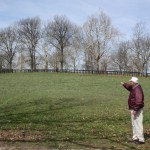 John Asher later told of how Secretariat posed for him when he went with a groom to see the horse in his paddock. “He was at the top of the hill. The groom I was with didn’t speak loudly. He just said, ‘Hey, Red.’” In a flash, Asher recalled Secretariat charging toward them, “BOOM! Here he comes. Flying down the hill. Absolutely flying down the hill. He gets to the fence at the end of the paddock where we were standing… Stops. And poses.”
Vickie Byrd told the story of how she visited Secretariat during a business trip. She reflected, “The big star in the barn was Secretariat. We were allowed to pet him and pose for pictures. It was like getting our picture taken with a movie star.” And, Secretariat left quite an impression on film. Byrd stated, “The funniest thing was after we got our pictures developed, we looked at one and saw that Secretariat had his tongue sticking out… Like a little kid!”
Secretariat also entertained children who came to visit the farm. Michele Valenta recalls that she visited Secretariat as a five-year-old girl, “I got to pet his nose and we turned around and walked away, looking at the other horses in the barn.” Valenta continued, “Shortly after, we heard clip-clop-clip-clop-clip-clop. We turned around to see Secretariat in all his red glory.” Valenta stated, “He was obviously perturbed when he was escorted back to this stall. Ears back, very annoyed.” She reflected, “He stole my heart then. He was so full of personality and I could see it, even at a young age.”
When Robin Porcelain visited Secretariat with her husband, Warren, he proved himself a showman. She stated, “Secretariat obviously knew how special he was and majestically pranced and strutted for us.”
Dorothy Henderson, wife of Secretariat’s final groom at Claiborne, Bobby Henderson, remembers him for his kind nature. “I’ve never seen a horse like him. He was just like a big pet. He had a big heart, it was almost as big as two hearts, and you could almost see that.”
And finally, John Sosby reminisces about Secretariat’s sharp intellect during his time at Claiborne Farm. Sosby joked, “He never learned to play checkers because we didn’t know how to teach him.”
Through racing and retirement, Secretariat proved himself to be everything.
And, his legacy remains intact.
Years after Secretariat left racing, Charles Hatton marveled at his perfection, “He’s the greatest horse that anyone has ever seen. Don’t let anyone kid you. He could do anything, and he could do it better than any horse I ever saw. No question about it in my mind.”
And it seems, Secretariat knew that.
Through his entire life, he demonstrated the beauty of being everything.
He was called awkward before he was deemed perfect.
He was defeated before he knew victory.
He was a celebrity and an icon.
He was a Triple Crown Winner.
He was a friend.
He was a father.
He was Secretariat.
And, Secretariat was everything.
» Read the rest of this entry «
June 1st, 2010 §
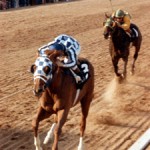
In her famous poem, One Art, Elizabeth Bishop begins by pondering “The Art of Losing” with the idea that some things are fated to be lost.
In the moment of loss, Bishop starts the poem with the notion that losing should not be viewed as a heartbreaking event.
In fact, she goes on to write that it should be practiced.
In my view, it is hard to point to many horses that practiced “The Art of Losing” with the same grace of Sham.
And, decades after Sham raced, there is a certain lingering sadness over Sham’s fate of being born at the wrong time – the year Secretariat was making his bid for the Triple Crown.
As Secretariat shattered records in his Triple Crown season, Sham stood in the shadows waging a beautiful racing performance.
He was a great horse in his own right.
And, in a sport where winning is nearly everything, Sham demonstrated that there is an “art” to losing.
As Sham entered the 1973 Kentucky Derby, the colt banged his head on the side of the starting gate, knocking out two of his teeth.
As he bled throughout the race, Sham never stopped chasing after Secretariat with his determination to win.
At the wire, Secretariat beat Sham by 2 ½ lengths – capturing the record time of 1:59 2/5 in the Kentucky Derby.
However, Sham also broke the Kentucky Derby record during his loss – finishing at a time of 1:59 4/5.
As Secretariat was draped in roses, Sham was guided toward his barn to cauterize the wounds to his two teeth.
Although Sham received no records or roses for his efforts, he stood a victor in ”The Art of Losing.”
Two weeks later, Sham set foot on the track in the Preakness.
As Secretariat began his graceful stride from last to first, Sham banged the rail on the clubhouse turn.
However, despite being rattled, Sham kept his eyes on his rival.
He raced onward to chase Secretariat to the finish line.
In the end, Secretariat beat Sham by 2 ½ lengths in the Preakness – the champion arguably breaking the record time for the race in his victory.
However, Sham didn’t stop in the face of an impossible rival.
As a master of “The Art of Losing,” Sham went back to his barn and prepared to challenge Secretariat in the longest race in North America.
And, when the day of the Belmont arrived, Sham demonstrated a powerful lesson in “The Art of Losing.”
When he entered the gates, Sham was soaking wet and nervous.
But, he didn’t back down.
Instead, Sham broke from the gates and challenged Secretariat to a virtual match race in the backstretch.
In the golden seconds that followed, Sham gave everything he had to challenge fate and beat his rival.
But, having been practiced at “The Art of Losing,” Sham found that fate isn’t subject to argument.
As Secretariat blasted forward to win by 31 lengths, Sham tired and fell back to finish dead last.
While Secretariat received a Triple Crown coronation, Sham was led back to the barn in defeat.
However, Sham proved himself a champion though his losses.
He poured his entire heart into trying to win.
And, quite possibly, Sham may have won the Triple Crown in a different field.
But, he was racing a giant that could not be matched.
After the Belmont, Sham never raced again. He retired to Spendthift Farm in July of 1973 and eventually moved to Walmac International.
On April 3, 1993, the nightwatchman discovered that Sham had passed away from an apparent heart attack in the early morning.
Upon examination, it was discovered that Sham had a heart that weighed eighteen pounds – roughly double the size of the average Thoroughbred.
There was only one known Thoroughbred heart larger than his on record in North America.
The heart of his lifelong rival – Secretariat.
In three single races, two amazing horses met their fate in 1973.
Thorough his victories, Secretariat set new records for the racing world to marvel over for countless decades.
And, through defeat, Sham delivered some of the most poetic moments in racing by practicing “The Art of Losing.”
May 8th, 2010 §
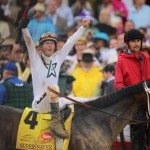
Jim Tyrrell www.horsephotos.com
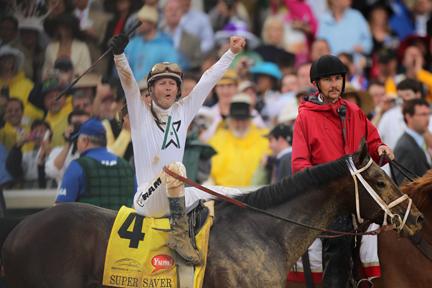
On Saturday, a mud-soaked colt trampled past the finish line at Churchill Downs into a Kentucky Derby victory.
In that golden second, Super Saver delivered the first Kentucky Derby victory to his ownership - WinStar Farm.
Todd Pletcher received the first Kentucky Derby victory in his training career.
Calvin Borel became the first jockey to win the Kentucky Derby three times in a four-year period.
As Borel headed to the winner’s circle, he shot out a bold statement that set fire to the wonder of racing enthuasists.
“We’re going to win the Triple Crown this year.”
In the magic dust of the moment, Borel spoke the words with such cool confidence that it seemed as if he had already made a reservation in the Belmont winner’s circle.
As the Preakness approaches, Borel’s prediction peaks the curiosity and arouses the hopes of many racing enthusiasts.

Doug Cauthen CEO of WinStar Farm
Racing fans have been dreaming of the next Triple Crown winner since Steve Cauthen rode into the history books with Affirmed in 1978.
Three decades later, Steve Cauthen’s younger brother holds the potential as President and CEO of WinStar Farm to deliver the twelfth Triple Crown winner in history with Super Saver.
Recently, I spoke with Doug Cauthen about Super Saver’s Kentucky Derby victory and the quest for the Triple Crown.
JW: Super Saver was the first horse owned and bred by WinStar Farm to win the Kentucky Derby. How does it feel to win your first Derby?
DC: It is truly hard to describe.
There was overwhelming joy, pride and thankfulness that Super Saver was able to do it.
To see so many people – from the owners, managers, grooms, maintenance crew, basically everybody – to get so much happiness and pride out of it is a real positive and satisfying thing.
I felt like we all should thank God for the victory.
JW: Your older brother, Hall of Fame Jockey Steve Cauthen, rode Affirmed to win the last Triple Crown in 1978. Do you think Super Saver could win the Triple Crown for your farm?
DC: I hope he can – I like Calvin’s prediction.
It was his Steve’s 50th Birthday on Derby day, so I felt like we had a little bit of good ‘mojo’ going there - that maybe something could happen. When the clouds parted and the sun came out right before the race, I had a calm and peaceful feeling.
I’m not quite as aggressive as Calvin with my predictions, but I’m on his side.
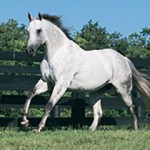
JW: Super Saver is by Maria’s Mon – sire of the fastest living Kentucky Derby Winner, Monarchos. Was this a factor in your breeding decision?
DC: We were very fortunate. We got Super Saver as part of a deal.
We bought Super Saver’s mother, Supercharger, when she was carrying Super Saver at the 2006 Keeneland November Sale. We were very blessed to have Super Saver as part of the purchasing package.
Supercharger’s got a beautiful pedigree – it’s one of the best pedigrees in the Stud Book. Supercharger is a full sister to a mare that we already had, called “She’s a Winner,” who is the dam of Bluegrass Cat. He is a multiple Grade I winner that we own and was second in the Kentucky Derby.
I hope that Super Saver can continue forward. He’s a beautiful horse – a balanced horse – with a great pedigree.
His pedigree is from one of the royal pedigrees in the Stud Book. With all the horses that are popping out of it that are so good - currently and in the last thirty years – it’s just been a magnificent family.
Being by Maria’s Mon, he’s going to offer a lot of outcross for breeders as well. It is a real positive for the breed.
JW: What do you see at the strengths in Super Saver as a racehorse?
DC: He’s got tactical speed and is very agile.
He can make his own race. He can be on the lead or sit back behind.
He’s got a tremendous amount of determination – he’s a very gutsy horse.
You can see that in his earlier races this year and during his races last year as a two-year-old.
It’s a combination that’s not only good for a racehorse, but for future stallions, so we are really excited about that.
JW: What is the general temperament of Super Saver?
DC: When he was on the farm being raised, he was a popular horse with everybody. He always had a forward attitude and a positive temperament.
JW: How did your farm make the determination to have Super Saver trained by Todd Pletcher and chose Calvin Borel as a rider?
DC: I think Elliott Walden (Racing Manager at WinStar Farm) deserves a lot of credit on that choice.
Todd is one of our primary trainers and gets a lot of horses that we think have potential. The fact that he trained Super Saver’s cousin, Bluegrass Cat, may have factored into it a little also. But, it clearly was a good choice!
We thought Super Saver was one of our early potential runners. Elliott said that we should give him to Todd. That’s what we did.
With Calvin, he was the best available rider when he came to the Kentucky Jockey Club race. Elliott sought him out – or encouraged Todd to seek him out – and the rest is history.
Super Saver won the Jockey Club last year as a two-year-old real impressively. He broke the stakes record, which was over a hundred-year-old record.
Calvin just gets along with Super Saver well. It is great to have him on board.
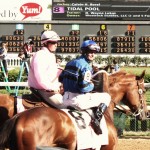
JW: Did Calvin Borel hold any special allure to your farm as a jockey in light of his recent Kentucky Derby victories?
DC: There is no doubt that he is an exceptional rider anywhere.
At Churchill Downs, he has that extra “Calvin Factor,” as I like to call it.
He really has a high level of confidence and horses run for him. He deserves credit at any race track.
He’s certainly got some good current form and it would be crazy not to take advantage of that if you can get him on your horse.
JW: How do you feel about owning the horse that delivered Todd Pletcher his first Kentucky Derby victory?
DC: For the farm, I think it was a really big feeling of satisfaction and pride in Todd. He was one of the first guys that we gave horses to when we divided the horses up between trainers.
He’s one of the best trainers in the country and will go down as one of the best trainers in history.
It seems like the press was focusing on his [Kentucky Derby] record unduly. It was great to see him win it and even greater to see his humility in taking the win.
He is a class act.
It is always fun to see people like that succeed.

JW: How did your farm celebrate your first Kentucky Derby victory?
DC: We’ve had quite a few celebrations.
We try to do something before the Derby because you obviously can’t expect to win – and we don’t. We just go there with the best horses we can and do the best we can.
On Thursday, we had a farm picnic for all of the staff. We had games, piñatas and plenty of food.
On Friday, we had another pre-Derby gathering with all the managers with the owners. It was a very nice event.
After the victory, some neighbors at Castle Post kindly invited us to celebrate with a hundred of our favorite friends. They hosted a wonderful gathering. It was really kind of Mr. Post.
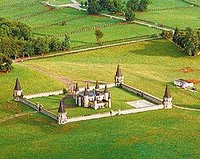
It was also a great pleasure to see the inside of the Castle. We use it as a landmark to tell people how to get to WinStar quite often. It was great to see it and it was quite a nice spot.
JW: Where is the Rose Garland?
DC: It is currently getting preserved.
Hopefully, it will reside in the office sometime soon.
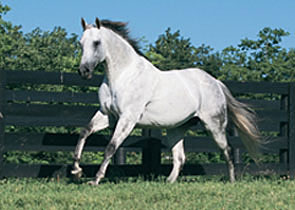
The Saturday Post would like to thank Doug Cauthen for his interview. We also appreciate the image of Super Saver provided by www.horsephotos.com. To view the photos from the Kentucky Derby at horsephotos.com, please click here.
April 1st, 2010 §
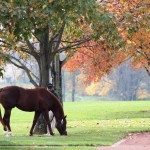
Smarty Jones captivated the nation in his bid for the Triple Crown in 2004. When he won the Kentucky Derby, the track announcer called out more than his victory. “Here is the first undefeated winner of the Kentucky Derby since Seattle Slew in 1977.” The public and industry began to marvel at the Triple Crown potential of Smarty Jones.
Following the Derby, Smarty Jones maintained his undefeated record by delivering an electrifying 11-1/2 length victory in the Preakness Stakes. As he pointed toward the Belmont, Smarty Jones had captured more than another win in his career – he had enlivened the imagination of spectators and won the hearts of fans across the nation.
As he entered the gates in the Belmont, Triple Crown dreams weighed heavily on Smarty Jones. Throughout most of the race, he ran at the top of the field. At the wire, Birdstone defeated Smarty Jones in a one-length victory. As the jockeys of both horses galloped from the finish line, Edgar Prado, rider of Birdstone, leaned toward Smarty Jones’ jockey, Stewart Elliott, and apologized.
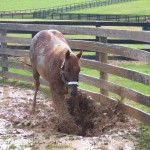 Smarty Jones retired in 2004 with a career record of winning eight of his nine races. He was sent to Three Chimneys Farm and housed in the former stall of Seattle Slew, the only undefeated Triple Crown winner in history.
In 2005, Smarty Jones reportedly had visitors every day at the farm, except for Christmas. Three Chimneys Farms graciously allowed me to join the many individuals who have come to visit Smarty Jones and provided me with an interview about this exceptional horse.
JW: What were the primary factors that led to the decision to retire Smarty Jones to Three Chimneys Farm?
TCF: The Chapmans had never before had a horse of this caliber and were very thorough when choosing a farm at which to stand Smarty at stud. They obviously wanted a farm that was well-versed in successfully marketing and developing young stallions, but they were also keenly concerned about finding a farm that would allow the public to maintain their relationship with Smarty once he was retired to stud.
With Three Chimneys having managed the careers of such popular fan favorites as Seattle Slew, Silver Charm and others, we knew how to accommodate the public’s desire to have access to the horses without jeopardizing the horses’ stallion careers and the focus on presenting them in the best possible light to potential breeders.
‘Three Chimneys was such a great fit. They are used to having the public visit their horses like Seattle Slew, Silver Charm and Point Given,’ said Pat Chapman, who raced Smarty Jones with her late husband, Roy, and still maintains significant ownership in the horse as a stallion. ‘They believe in limiting a stallion’s book of mares, and they are experienced in standing an important horse and making him a success as a sire. It’s just a really great fit.’
At the time of the announcement that Smarty Jones would stand at Three Chimneys upon retirement, Three Chimneys owner Robert Clay was quoted as saying the following:
‘We are grateful for this awesome responsibility. This is a very special horse in so many ways. The Chapmans and the Servises have earned the gratitude of the entire racing world by the way they have served the needs of the press, and the public, and of Smarty Jones all at the same time. We hope, and plan, to do just as good a job as they have done. We have always welcomed fans to Three Chimneys Farm and look forward to sharing Smarty Jones with his public.’
JW: Was the decision to retire Smarty Jones to Three Chimneys Farm made prior to the Belmont race or afterward?
TC: The decision to retire Smarty was made after the Belmont Stakes, but not in any way due to that race being his first and only loss. When the Chapmans chose Three Chimneys as the farm to stand Smarty at upon his retirement, it was with the intention that he would get a nice rest after a demanding Triple Crown bid, then go on to race in the late summer and fall of his three-year-old year and possibly as a four-year-old.
Soon after the Belmont Stakes, it was found that Smarty had significant bone bruising on the bottom of all four cannon bones. While it is a fairly common injury for racehorses to sustain and many come back after some time off to race successfully, the Chapmans were not willing to risk putting Smarty Jones in harm’s way.
‘After all he’s done, I couldn’t live with myself if I thought we were putting him in harm’s way,’ said Pat Chapman. ‘He doesn’t owe us anything, and we owe him A LOT.’
JW: Was the decision to house Smarty Jones in the former stall of Seattle Slew a tribute to Smarty Jones’ near-miss in his Triple Crown bid?
TC: In a way, yes. Smarty was one of few horses that has truly captured the attention and interest of the general public. Whether someone was a horseracing fan, a general horse enthusiast, or simply an ‘average Joe,’ they knew about Smarty Jones and his ‘Rags to Riches’ story. Seattle Slew was another horse who carried with him that ‘celebrity status.’
When Smarty retired to Three Chimneys, we wanted to pay homage to all that he had accomplished on the track as a runner, but also for the sport in general. He brought so many new fans into the racing industry. Even in his retirement here at Three Chimneys, he gets tens of thousands of fan visits each year.
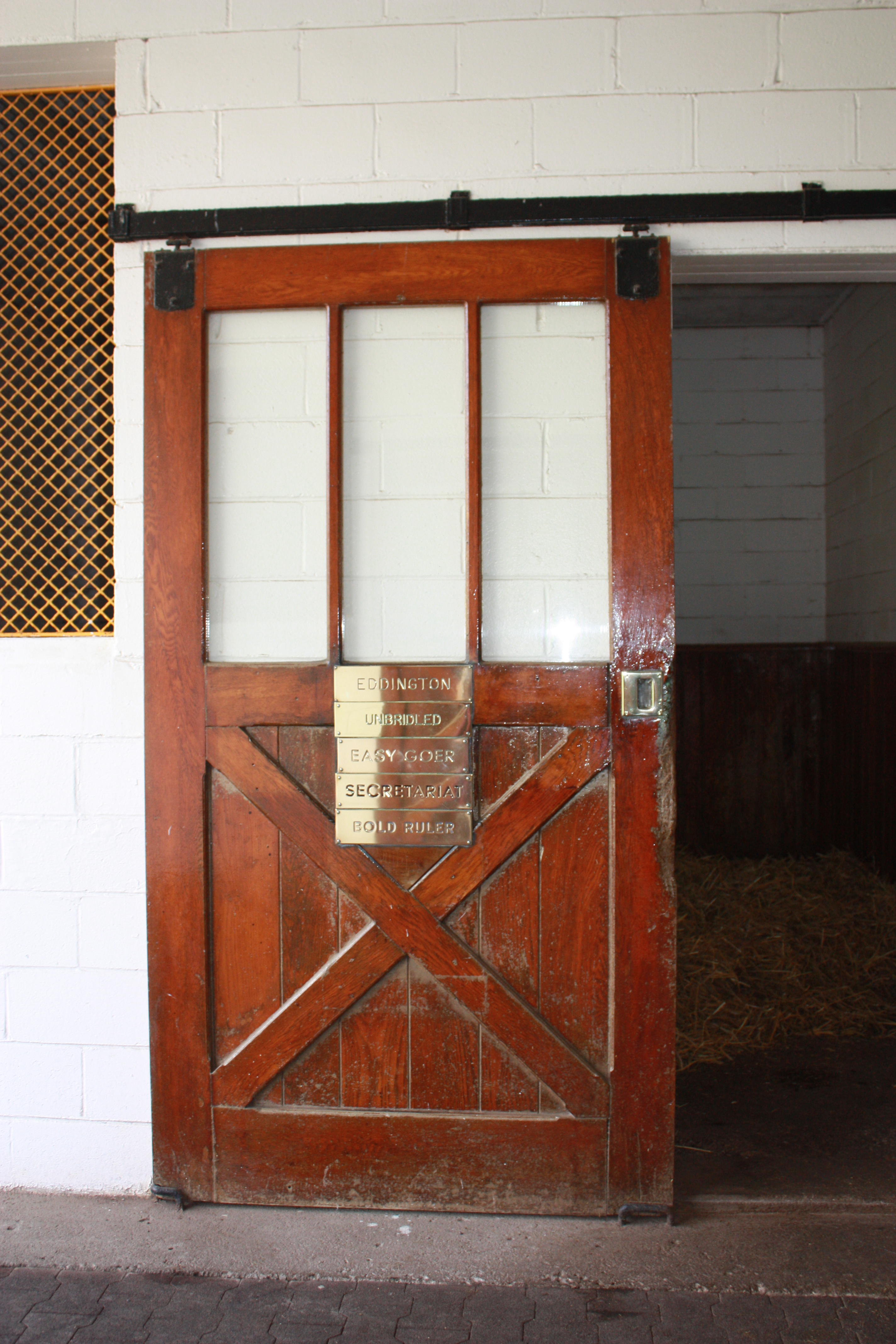
When visitors walk up to his stall, they see his nameplate on the door and, as with every stall in our stallion barn, if they look up to the right corner above his stall, they will see the nameplate of the previous occupant. Above Smarty’s stall is the nameplate of Seattle Slew.
JW: Why do you think the public experienced such a strong connection to Smarty Jones?
TC: Smarty was kind of a blue collar horse. He was modestly bred, hailing from, at the time, a $10,000 stallion and was born and raised in Pennsylvania, which was also where his home track of Philadelphia Park was located.
He overcame adversity as a youngster when he had a serious, potentially career and even life-threatening, accident while schooling in the starting gate. Then, when it came time to show what he was made of, he just kept on winning and winning.
Every bar that was set for Smarty, he exceeded, which is how he got to the Kentucky Derby as one of only a handful of horses to ever win the Derby to remain undefeated.
Another very compelling side to the story was the connections of smarty Jones. His owners/breeders Roy and Patricia Chapman were living a fairytale. Smarty Jones was the best horse they had ever raced and they were kind and gracious with both the media and his many fans.
Their trainer, John Servis, was also living the dream, as Smarty was his first Kentucky Derby starter and propelled his career to new heights. The public was able to connect with the Chapman’s and John Servis because they were appreciative of Smarty’s many fans and willing to give them access to their lives.
 JW: How would you describe the character and temperament of Smarty Jones?
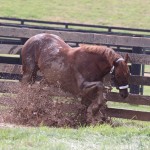
TC: Smarty sure isn’t a dummy! He enjoys his daily routine, which includes coming in from his paddock in the morning and being walked, bathed, and fed (he’s especially a fan of the feeding portion of that routine). He’s actually not one to crave a lot of human interaction. If it was his choice, he’d probably opt out of his daily grooming and would prefer to say dirty.
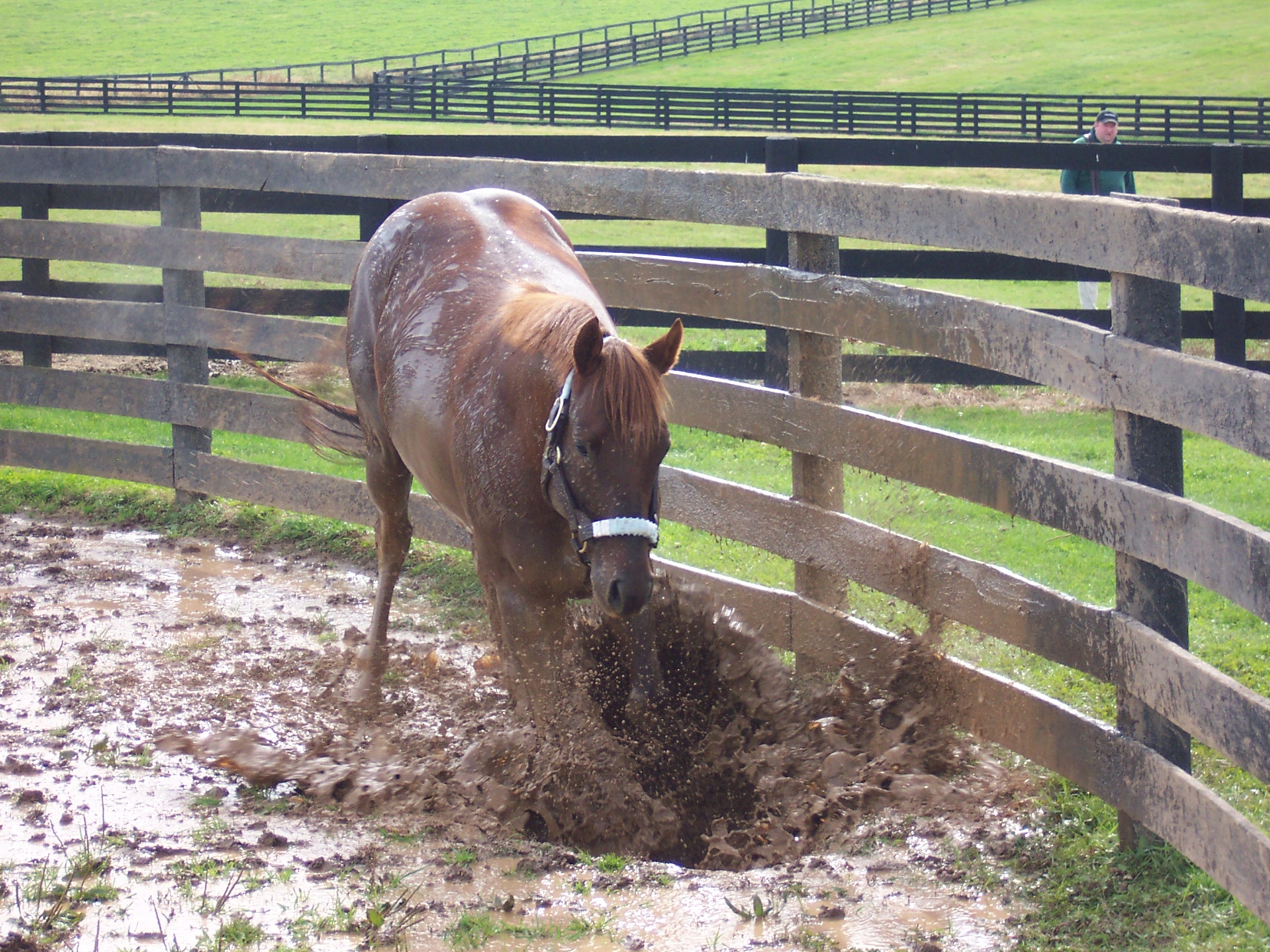
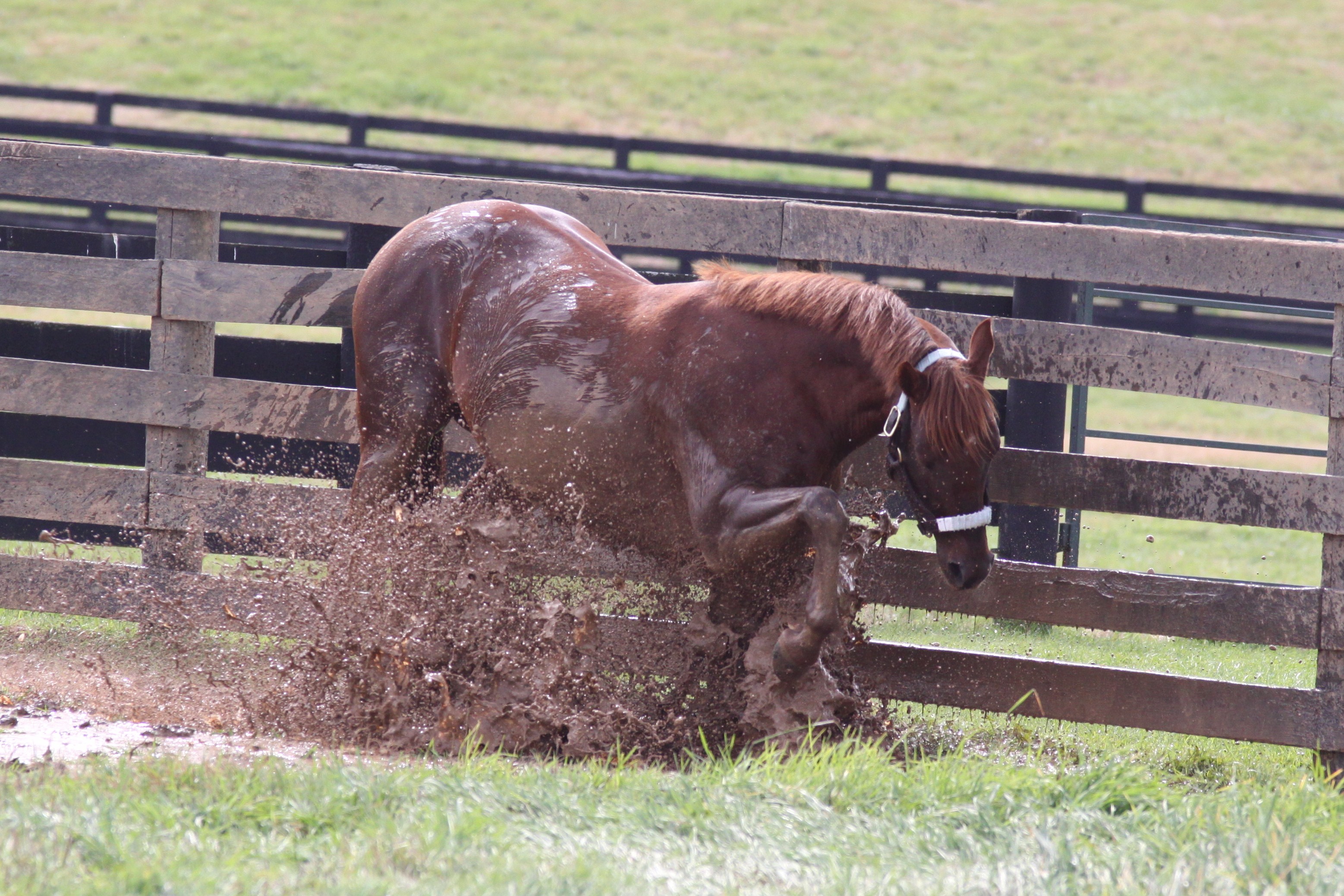
He’s a huge fan of mud, which seems to fit right in with his disdain for grooming. After a good rain, the lower corner of his paddock can get especially soggy and, as soon as he’s turned out on a day like that, he goes straight for that corner and starts working on his ‘mud masque.’
He loves peppermints and, while we can’t give him all of the treats his fans send him throughout the year, we do make sure that there is a never-ending supply of mints in the tack room that the grooms pamper him with.
JW: Smarty Jones has produced several foals in the past few years. Can you discuss some of the notable racehorses among his progeny?
TC: Admittedly, Smarty’s offspring didn’t give his career at stud the launch we had anticipated initially, however, he has had high caliber runners each year since his first crop hit the track and recently he’s had several of the best few months of his career. Some of his current budding stars include:
Backtalk is going to the Illinois Derby and, if all goes well, to the Triple Crown
Brilliant Sunshine was so impressive with her last two wins (broke maiden by 4-1/4 under wraps, then won an allowance by 7 being geared down) that she’s being pointed for her first stakes start next time out; she was profiled in the TDN’s “Sharper Focus” section last week as a horse to watch.
Follow the Leader is 4-3-1-0 (all in Msw and Alw company) and is likely headed for stakes competition – owned by the President of Oaklawn.
Keiai Gerbera won an allowance in January and came back to score a 5 length win in a stakes race in Japan over a field of 15 males – she was the only female in the race.
No Equipment won first time out by 8 lengths at Philly Park
Gracie Jones won second time out so impressively that she’s being pointed toward the Oaks Trial S. with the goal of starting in the South African Oaks later this year. Creating a LOT of buzz in South Africa – Smarty’s only runner in that country.
Sommelier Smarty is unbeaten in 2010 and is riding a 3 race winning streak.
JW: In terms of breeding, what are traits that make Smarty Jones desirable at a stud?
TC: Smarty Jones has a unique and obviously very favorable combination of good looks, balance and athleticism. He is a 16-hand powerhouse and his offspring resemble him, with that distinctive head, big hind-end, and cocky attitude.
Some of his best foals have been out of mares from the Seattle Slew and Deputy Minister lines and is working well with mares carrying Northern Dancer blood, especially Danzig and Storm Cat daughters.
JW: In your estimation, how many fans have visited Smarty Jones since he retired to Three Chimneys Farm?
TC: Smarty Jones and the rest of our stallions are greeted by at least 25,000 a year. Due to the high demand from fans to see our stallions, starting way back with Seattle Slew, we had to build a visitors’ center separate from our main office and an auxiliary parking lot due to all of the additional traffic.
We expect to FAR exceed that 25,000 visitor estimate this year. Due to the World Equestrian Games being in Lexington this fall, we have had numerous requests (we’re talking about hundreds upon hundreds) to see Smarty and the rest of the stallions and the farm. Due to the vastly increased demand during this event, we are modifying our tour schedule to be able to accommodate as many requests as possible.
To comment on this post, click here. The Saturday Post has recently launced a Facebook Page. To follow us on Facebook, click here.
 There was no coronation of a king at the Belmont this season, but a ruler emerged for fans to follow - Ruler on Ice.