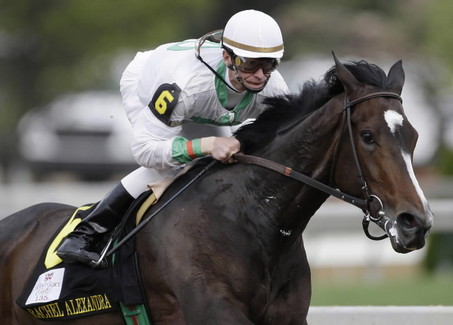
After a contentious debate over the 2009 “Horse of the Year” Eclipse Award, Rachel Alexandra prevailed over Zenyatta when the winner was finally announced on January 19, 2010. Prior to the announcement, the owners of both champion fillies had committed to race their horses in the 2010 season. With the final ballots cast, the industry has moved from the “Horse of the Year” debate toward speculation regarding a match race between these two female rivals in 2010.
Since 1975, there have not been any major thoroughbred match races involving champions in America after Ruffian sustained a terminal injury while competing against Kentucky Derby winner, Foolish Pleasure. In that race, the undefeated filly Ruffian met Foolish Pleasure at Belmont Park in New York. A national television audience watched as Ruffian broke down shortly after the start and had to be euthanized the following day.
Before the sad ending to match racing with Ruffian’s injury, there were several other major match races throughout the century. In 1955, Kentucky Derby winner, Swaps, met Nashua, the Preakness and Belmont Stakes winner of that year. Nashua won the race, but speculation did not cease after the match. Swaps had been nursing a sore foot in days prior to the race. Eddie Arcaro, rider of Nashua, admitted many years later that he doubted Nashua could ever have beaten a healthy Swaps.
In 1947, Triple-Crown winner and 1946 Horse of the Year, Assault, held a $100,000 match race against Calumet Farm’s horse, Armed. Armed beat Assault by eight lengths and went on to win the 1947 title of Horse of the Year.
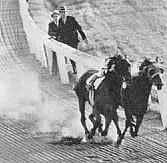 One of the arguably most talked-about match races of the century occurred in 1938, between the rags-to-riches underdog, Seabiscuit, and the Triple-Crown winner and reigning horse of the year, War Admiral. Seabiscuit tracked War Admiral across the country and quickly became the “People’s Horse” during the depression era. After he defeated War Admiral in the 1939 showdown, Seabiscuit went on to win Horse of the Year.
However, match racing existed before the popular match race between Seabiscuit and War Admiral. In 1923, the Kentucky Derby winner, Zev, took on the English Derby winner, Papyrus. The race was dubbed the first “international” race and exorbitant prices were charged for tickets. Zeb won the match race against Papyrus, but doubts lingered about the victory due to track conditions and a mistake in shoeing Papyrus prior to the race.
Finally, in 1920, Horse of the Century, Man O’ War, met Sir Barton, the first horse to win what would later be dubbed the “Triple Crown,” in a match race in Canada. Man O’ War won the race by seven lengths, but the importance of the race was questioned because it was widely-regarded that Sir Barton was not at his peak performance.
With a new century, the industry is faced with the prospect of a major match race between two champion fillies – Rachel Alexandra and Zenyatta. From a brief look at the history of match racing, the unasked question is “What purpose would a match race serve?”
The most obvious answer is financial gain to the industry and owners, as well as reinvigorating public interest in the sport of horseracing. But, aside from these interests, does a match race serve either filly in cementing their championship status over the other filly?
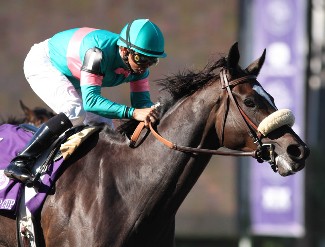 From the historical view, Zenyatta appears to have more to gain while Rachel Alexandra more to lose if the two are pegged against each other in a match race. In the races in which a reigning Horse of the Year accepted and lost a match race, the prevailing horse went on to win “Horse of the Year” in the following season. Therefore, Zenyatta’s most important targeted race for 2010 should be a match against Rachel Alexandra if she wants to attempt to clinch the much sought-after title of “Horse of the Year.”
In the same vein, if Rachel Alexandra were to lose a match to Zenyatta, Rachel Alexandra’s “Horse of the Year” victory over Zenyatta may be called into question all over again. Rachel would be forced into a rivalry with Zenyatta that could last over several races in an attempt to gain the lead over her rival in the court of public opinion.
Further, the historical record shows that match races rarely seem to settle the score between two rival champion horses. In the case between Ruffian and Foolish Pleasure, there was no true winner since Ruffian was injured during the race. Between Swaps and Nashua, Nashua’s own jockey, Arcaro, felt that Swaps would have won if he had been in better health. The race between Zev and Papyrus only clouded the debate since Papyrus encountered track difficulties and there was a mistake in shoeing the horse. Finally, Man O’ War’s victory over Sir Barton was also questioned since Sir Barton was not at his peak-performance level at the time of the match.
If a match race were to be held between Rachel Alexandra and Zenyatta, it would seemingly do little to settle the debate regarding who is the greater horse between the two champions. However, it would make for an electrifying spectacle to watch these two fillies face off on the track.
Rather than aiming to have a match race settle the ongoing debate of who is the greater horse between Zenyatta and Rachel, a match race, if held, should serve only to showcase the two great fillies of our decade. Their championship status has already been proven in different races, on different tracks.
