 Recently, I read a book entitled, “Letters to Seabiscuit,” that published various letters written to the horse and his owner, C.S Howard, throughout the racing career of this legendary athlete. Howard’s wife, Marcella, had lovingly saved the collection in a treasure chest for several decades.
While reading the various letters, one thing became clear: The admiration that people expressed for this horse went well beyond his racing accomplishments. Among the collection, Seabiscuit received congratulations, birthday wishes, suggestions on the name for a foal, drawings, poems, pleas to retire him, requests to continue to race him, and even a valentine.
One writer, Mrs. Magie, sparked my curiosity about this phenomenon, by stating, “I am not a horsewoman or a racetrack follower. I do, however, love Seabiscuit.” I began to think about what peaked her interest in this horse.
Later in the book, a woman named Helen Thompson, added some clarity to Mrs. Magie’s sentiment. Thompson wrote to Howard, “You own the greatest racehorse in the world today – at least you think you own him – actually he is the property of all of us who love thoroughbreds – and recognize that a horse has something else besides the ability to earn a few dollars for the gaming public.”
Ms. Thompson’s statement hit upon something profound. Seabiscuit was a public horse. He was a living representation of American ideals, dreams, and principles. No single person could own these concepts.
After reading these letters, I started to wonder about the rare horses that have been able to stir public adoration outside of the winner’s circle. Not every champion racehorse is as beloved by the public as was Seabiscuit. I began to consider what wins a racehorse the “Crown of Love” in the public field.
Seabiscuit.
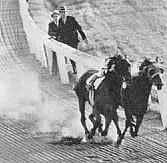
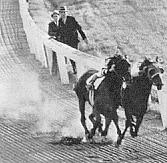 In the case of Seabiscuit, his career embodied the dreams and ideals of many Americans. As the Great Depression and World War II weighed upon the nation, Seabiscuit was running in rock bottom claiming races when he was purchased by the wealthy C.S. Howard. After Howard invested in Seabiscuit, the horse went on to beat the Triple Crown winner, War Admiral, in a nationally broadcast match race that captivated an audience of roughly one in three Americans. Seabiscuit later suffered an injury that threatened to end his career. He defied retirement and recovered to win the Santa Anita Handicap – a victory that had previously eluded him.
The accomplishments of Seabiscuit amounted to more than a moment in the winner’s circle. This horse mirrored the dreams of the general public during the depression. As stated by Director Gary Ross, Seabiscuit illustrated the “American idea that hidden inside you is huge potential that is untapped and undiscovered… If only people had the understanding to explore it, or to nurture it a little bit, what could possibly emerge?” To Ross, Seabiscuit demonstrated the potential for outstanding achievement if given a second chance.
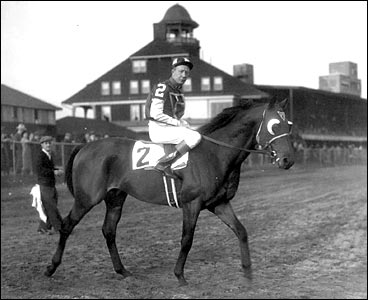 In a time of war and financial desperation, Seabiscuit illustrated the ideal of struggling against the odds. In his career, Seabiscuit fought the stigma of being a lesser horse by virtue of racing on the west coast in a time when the east coast horses dominated the sport. In his famous match race, Seabiscuit, the clear underdog, demolished the stigma of being a low-grade horse by defeating his east coast rival, War Admiral. When he returned from injury to clinch a victory in the Santa Anita Handicap, he only reinforced the theme of prevailing against the odds. With the nation embroiled in struggle, Seabiscuit’s victories touched upon their own hopes and dreams. He represented the ideal that an underdog can succeed through hard work, determination, and endurance. In his struggle to victory, Seabiscuit became a principle owned by a nation.
Man O’ War.
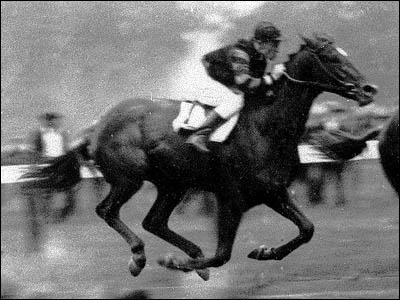 Man O’ War illustrated throughout his career that public favor is also won through awakening human imagination and rewriting record books. Likened to a “living flame,” Man O’ War embodied the raw perfection that captivates the human heart and spirit.
In his sixteen month career between June 1919 and October 1920, Man O’ War won twenty of his twenty-one races. He was the favorite in all of his races, with odds of 1-100 in three of his starts. He won one race, the Lawrence Realization, by 100 lengths. Man O’ War set three world records, two American records, and three track records. He retired as the greatest money-winning Thoroughbred in history.
During his career, the public was in rapture by Man O’ War. Police had to protect the horse at tracks from souvenir hunters who tried to grab hairs from his mane and tail. His notoriety also attracted death threats. His Owner, Samuel Riddle had to hire a private detective to watch the horse’s trainer.
 At the time of his retirement, Riddle was reportedly offered $500,000 for Man O’ War by Texas oil millionaire, William Waggoner. Riddle rejected the offer. Waggoner made a second offer to purchase for $1 million, in which Riddle again rejected. When Waggoner provided his third offer in the form of a blank check, Riddle countered, “You go to France, and bring back the sepulchre of Napoleon from Les Invalides. Then you go to England and buy the jewels from the crown. Then to India and buy the Taj Mahal. Then I’ll put a price on Man O’ War.”
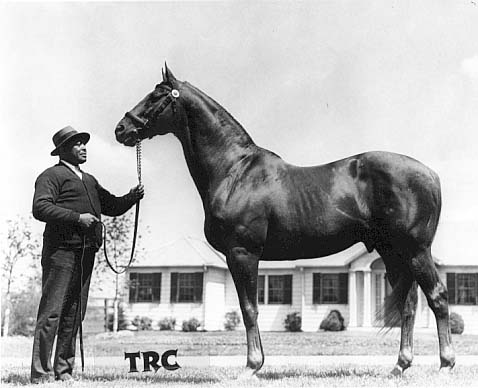
After his retirement, Will Harbut, the groomsman for Man O’ War, managed the farm tours for visitors who traveled for a glimpse of the legend. It is estimated that the number of visitors ranged between 1.5 to three million. Harbut, having become a famous figure for being the groomsman to Man O’ War, would display the horse to the crowd and explain, “He broke all the records and he broke down all the horses, so there wasn’t nothing left for him to do but retire.”
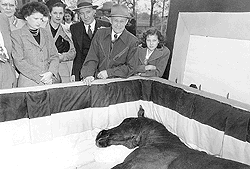 When Man O’ War died at age 30, he was the first horse to be embalmed and he lay in state for two days in a specially-made casket lined with his racing colors. It is estimated that nearly 2000 people attended his funeral and the burial service was broadcast nationally with nine speakers providing eulogies.
Man O’ War remains a portrait of beauty, strength, power, and perfection. In the 1920 Travers, the starter described the awe that drew people toward the legend. “He was so beautiful that it almost made you cry, and so full of fire that he made you thank your God you could come close to him.”
Secretariat.
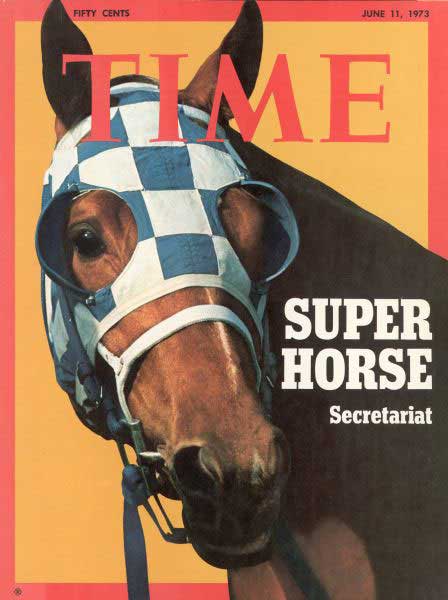 Secretariat exploded into the public eye through producing mind-bending victories that shattered all records in Triple Crown racing. Secretariat’s record left the public speechless and captivated by his magic.
When he arrived at the Belmont Stakes for the third leg of the triple crown, Secretariat led the news headlines in North America and had captured the covers of Newsweek, Time and Sports Illustrated. The sport has never enjoyed the same media attention since Secretariat’s 1973 Triple Crown season.
“Secretariat generates a crackling tension and excitement wherever he goes… When he accelerates… he produces a breathtaking explosion that leaves novices and hardened horsemen alike convinced that, for one of those moments that seldom occur in any sport, they have witnessed genuine greatness,” explained Pete Axthelm from Newsweek.
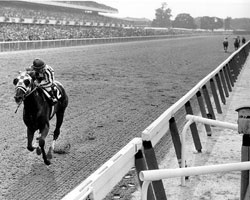 After his 31-length victory in the Belmont Stakes, his greatness has never been matched. In two minutes and twenty-four seconds, Secretariat set the world’s dirt track record for 1 1/2 miles, which many argue may never be broken. As Charles Hatton wrote in The Daily Racing Form, “His only point of reference is himself.”
In his sixteen-month career, Secretariat won sixteen of his twenty-one races. He was the odds-on favorite seventeen times. He won back-to-back “Horse of the Year” awards. He still holds the record time in the Kentucky Derby – 1:59:25. The Daily Racing Form clocked him as setting the record in the Preakness at 1:53 2/5. Because the track clock was malfunctioning, the official time was recorded as 1:54 2/5 and Canonero II remained the holder of the official record with his time of 1:54 2/5 the 1971 Preakness.
Secretariat was retired to stud at Claiborne Farms. His popularity continued long after his racing career ended. He received many letters and birthday cards each year from his fans and thousands of vistors came to Claiborne Farms to see Secretariat during his lifetime.
In the fall of 1989, he was afflicted with laminitis and was euthanized on October 4. He was buried at Claiborne Farm, receiving, in death the ultimate honor for a horse. By tradition, the only parts of a Thoroughbred buried at a gravesite are their head (to symbolize intelligence), heart (to symbolize strength), and legs (to symbolize power). As homage to the greatness of this legend, Secretariat was buried whole.
The legacy of Secretariat endures over two decades after his death. Penny Chenery, Owner of Secretariat, explained “It’s hard to believe after all these years, but hardly a day goes by that I don’t get mail about Secretariat.”
The Last Decade - Barbaro.
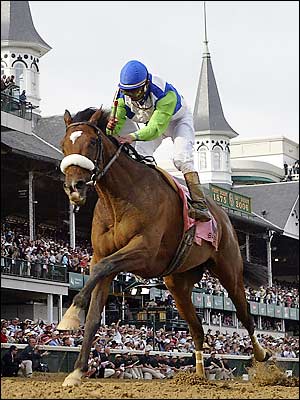 In recent years, Barbaro arguably captivated public interest and adoration more than any other horse – both for his performances on the track and after the races. After entering the Kentucky Derby with an undefeated record, he romped to the finish line to win by six lengths. I was among the 40,000 fans in attendance and could barely catch my breath as he drove alone toward the finish line. It was my first Derby.
When Barbaro broke down in the Preakness, I sent him a dozen roses in remembrance of his victory at the Kentucky Derby. I certainly was not alone. As the nation hung on for months in hopes that Barbaro would recover from the life-threatening injury, cards, flowers, carrots, and other gifts flooded the New Bolton Center. Signs were hung outside the gates of the facility. National news coverage covered the story on a regular basis. It is somewhat bittersweet that the most attention the sport had gained in years was a product of one of its’ saddest moments – the ultimate loss of this great horse.
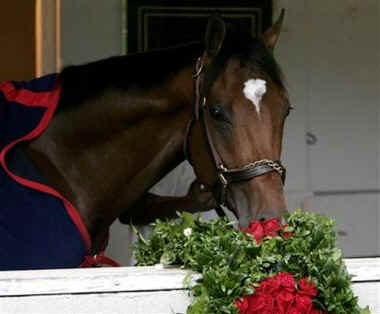 When it was announced at the subsequent Derby that Barbaro would be buried at Churchill Downs, I watched as schoolchildren, who had sent letters and drawings to Barbaro, lined up to deliver Gretchen Jackson individual roses in the winner’s circle during a tribute ceremony. As she held a full bouquet of roses in the end, I was overwhelmed by the dignity and grace of Mrs. Jackson.
The Jacksons, along with Barbaro, had fought the odds and lost. In their journey, the Jacksons demonstrated honor, dignity, and concern for the well-being of the horse above all financial motives. Barbaro illustrated courage and determination throughout his fight for survival. He had the qualities that not only won on the track, but captured the hearts of the public.
Of the horses that have generated widespread national reverence, they all possessed common traits – strength, ability, power, and excitement. They mirror the human spirit in its’ purest form, and, in turn, these athletes become larger than the sport. They become a reflection of our greatest dreams and ideals.
Please feel free to email me directly with questions or comments at blog@thesaturdaypost.org.
NOTE: There are many other horses and facts that were not mentioned due to space restraints - I would have had to write a book. I hope to add more to this post in the future.