Truman Capote once said, “More tears are cried over answered prayers than unanswered ones.”
I would like imagine Capote was a horse racing fan when he conjured up those words.
When a legendary horse shows up, it is an answered prayer. They aren’t beholden to the result of a single race. Instead, the great ones take fans on a journey. They aren’t defined in minutes, but rather, through moments. And, as a result, it seems as if the clocks simply stop ticking. A timeless horse doesn’t answer to seconds on a stopwatch. They answer to their own legacy.
When a great horse concludes their racing journey, they leave a deep void among their fans. It can make you wonder if you’ve already seen everything that is possible in racing. And, when the clocks start ticking again, it can seem as if there is no reason to keep watching. It is moment where your prayer was answered, but you are left without the rapture of a dream.
 Zenyatta was the horse that took me on a journey that traveled in moments, rather than minutes on a race track. And, when she retired, I wondered if I would ever see a horse that could follow in her dizzying footsteps. I had just seen my once-in-a-lifetime racehorse. The possibility of her coming around twice didn’t seem plausible.
And, in all reality, there won’t be another 19-1 dancing race horse that can charm the birds from the trees with her friendly disposition while parading across the national media circuit. I know better than that. Zenyatta is one-of-a-kind, which is the true mark of legend.
Yet, I’m not done with horse racing because Zenyatta has entered retirement. In fact, I’m watching even more closely now.
You see, the great ones simply appear from time to time, without notice of their impending arrival. And, if you’re not watching, you’ll miss it.
I wouldn’t have missed Zenyatta’s career for the world. Yet, the world couldn’t have convinced me that a dancing mare was going to show up and rocket through a nineteen-race winning streak. I had to see her with my own eyes to believe it. And thankfully, I was watching when my once-in-a-lifetime horse showed up.
Zenyatta will not be the last “great one” in this sport. Racing has had plenty of legends. And, although we love to compare them, you will never take the same journey twice in the racing world.
When Man ‘O War retired, turf writer Joe Palmer wrote that he “was as near a living flame as horses get… he smashed his opposition, sometimes by a hundred lengths, …he set world records… You felt that there had never been, nor could ever be again, a horse like this.”
He was right. There will never be another Man ‘O War.
But, there is always the impending arrival of the next “great one.”
When Secretariat ended his career, turf writer Charles Hatton stated, “He’s the greatest horse that anyone has ever seen. Don’t let anyone kid you. He could do anything, and he could do it better than any horse I ever saw. No question about it in my mind.”
He was right. There will never be another Secretariat.
But, there is always the impending arrival of the next “great one.”
When Seattle Slew left racing, his groom, John Polston, walked away from the sport. He explained, “After a horse like Slew, there was nothing. I didn’t want to be around horses anymore, because I knew it wouldn’t be the same.”
He was right. There will never be another Seattle Slew.
But, while Seattle Slew was capturing the Triple Crown, the next “great one” was already grazing in the fields. One year later, that horse would come to be known as “Affirmed.” And, since Affirmed, we haven’t seen a Triple Crown winner again.
But, there is always the impending arrival of the next “great one.”
Within a few years, John Henry reminded the sport that anything is possible when he won the Arlington Million in a seemingly-impossible, come-from-behind victory in 1981. And, he reminded us again when he won the Million a second time as a nine-year-old.
When John Henry was gone, Chris McCarron reflected, “…He did so much for racing, even after he retired. He will be impossible to replace.”
He was right. There will never be another John Henry.
But, there is always the impending arrival of the next “great one.”
And, in recent years, we’ve seen greatness in ways that weren’t imaginable until it simply showed up.
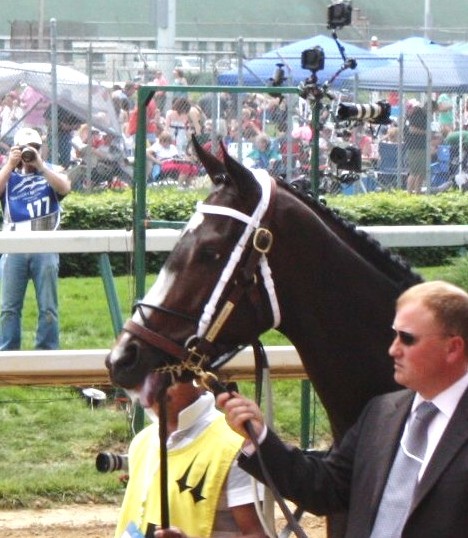
 You saw it in Rachel Alexandra.
When she retired, Jess Jackson marveled, “…She set standards and records that no filly before her had ever achieved. And I suspect that it will be quite a while before a three-year-old filly ever equals or surpasses her achievements.”
He was right. There will not be another Rachel Alexandra.
She was one-of-a-kind.
But, there is always another “great one.”
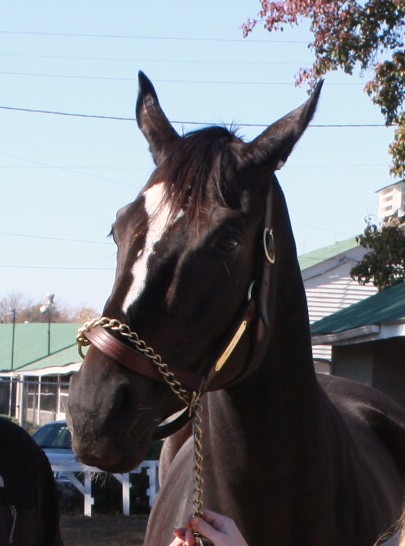
 You saw it in Zenyatta.
After her final race, Peter Ellis remarked, “I don’t think people are going to realize just how special she is until she is gone because there will never be another one like her.”
He was right. There won’t be another Zenyatta.
But, there is always the impending arrival of the next “great one.” And, like Affirmed, “the one” could be grazing in the fields at the moment. Or maybe, “the one” is already racing right now.
I’m watching closely.
Because, if history teaches us anything, it is that the “great one” arrives unexpectedly.
In a flash, they show you something unimaginable.
And, the journey begins again.
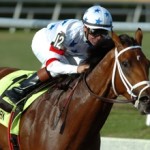
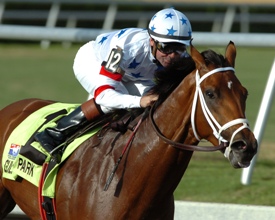
In 2008, Big Brown captivated the American public with his flashy wins and charismatic bid to win the Triple Crown. With a career record of seven wins in eight starts, he defied the odds in several races and produced mind-bending accomplishments on the track.
As a two-year-old, Big Brown broke his maiden at Saratoga in a dazzling 11-1/4 length victory. When he entered his three-year-old season, Big Brown won four consecutive races between March 5 and May 17, including the Kentucky Derby and Preakness.
In the Kentucky Derby, Big Brown won by a thrilling 4-3/4 length victory after having had only three prior career starts. He became the only horse in history to win from the 20th gate post.
Entering the Preakness, Americans fixed their attention on Big Brown after his dominating win at the Derby. Big Brown delivered an astonishing 5-1/4 length win in the Preakness. When all eyes turned toward Big Brown in the Belmont, he experienced the sole heartbreaking loss in his career. However, his tremendous presence and star quality drew new fans into the sport of horse racing – the fourth largest crowd in history showed up at the Belmont Stakes to watch Big Brown make his bid for the Triple Crown.
Prior to retiring, he won his last two career starts – the $1,000,000 Haskell Invitational (Grade 1) and the $500,000 Monmouth Stakes. Jockey, Angel Cordero, encapsulated the exceptional talent of Big Brown: “He’s like a car – he comes with everything. Just step on it, and you’re there.”
 Since his retirement, Big Brown has bred over 100 mares at Three Chimneys Farm. As the first foals by Big Brown are emerging at various stables, he continues to make his mark on the sport of horse racing. This year, Big Brown will travel to Australia to stand at Hunter Valley farm.
Prior to his anticipated departure for Australia, Three Chimneys Farm graciously provided me with an interview. After chasing him from the Derby to the Belmont, I was elated to finally catch up on Big Brown.
JW: After winning the Kentucky Derby and Preakness in 2008, Three Chimneys Farm struck a deal to stand Big Brown prior to the Belmont race. At the time the decision was made, did the farm believe that Big Brown was going to win the Triple Crown?
TCF: We thought he had a better chance than just about any horse in recent decades. From his first start to his runaway win in the Preakness, he really hadn’t been tested. His rivals couldn’t even get close to him and in the Preakness, running against some of the best of his generation, he won under wraps by 5 ¼ lengths.
JW: What are the overall qualities about Big Brown that led to the decision of Three Chimneys Farm to acquire him for breeding?
TCF: Obviously the brilliance he showed in his first three races was a major factor. He achieved a series of “firsts” and “bests” that rank him with the all-time greats, such as being the first horse to win from the 12 and 20 posts in the Florida Derby (G1) and Kentucky Derby (G1) respectively. On top of that, he ran the best Ragozin number in Kentucky Derby history. He’d come to the Derby virtually untested, and on racing’s biggest day, left the rest of the field eating his dust.
Combined with that is his physical appearance. He is beautifully conformed and well-balanced. He’s not too big or small; not too heavy or light. The way he’s built makes for an effortless stride, allowing him to float across the track with minimal exertion.
From a pedigree standpoint, he’s inbred 3 x 3 to Northern Dancer, making him a likely candidate for crossing well with Mr. Prospector-line mares, not to mention Halo, Roberto, Seattle Slew, and Blushing Groom strains as well.
Also factored into the mix is his temperament, which couldn’t be better. We saw time and time again during his racing career that he took everything in stride. He’s level-headed, intelligent and kind. He doesn’t fight his rider in the morning or in a race and, as a result, is not hard on himself whatsoever.
JW: Big Brown has bred with over 100 mares in his first season. How is it determined which mares are bred with Big Brown?
TCF: We have an expert pedigree consultant on staff at Three Chimneys by the name of Anne Peters. She looks at the pedigree of each mare submitted to Big Brown and also considers the physical qualities the mare possesses, any soundness issues on either the sire or dam’s side, and other factors.
Based on what similar breedings have resulted in the past and what the mare has produced or accomplished herself on the racetrack, Anne makes a judgment as to whether the mare would be a suitable mate for Big Brown (this is done with mares submitted to all of our stallions).
If, for example, she feels the mare would not pair up well with Big Brown, she then suggest other mating options (either stallions at our farm or at other farms) that might pair up more favorably.
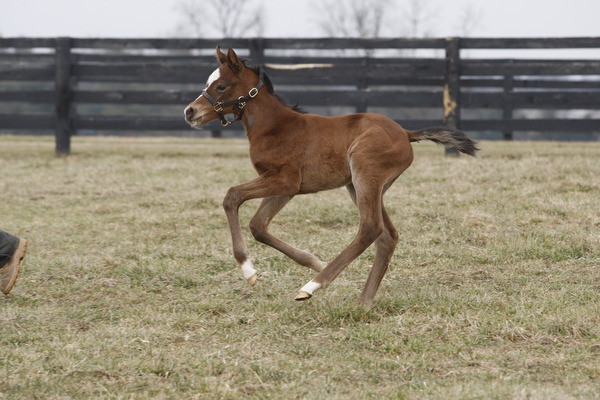
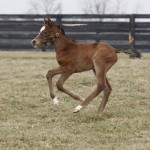 JW: The first reported foal by Big Brown was born on January 12, 2010. How many foals by Big Brown do you anticipate being born this year?
TCF: We limit all of our stallion’s books so as not to saturate the market with their offspring and so the horse is not over-used, so we expect Big Brown to have a crop of around 100 foals. 71 of the mares he was bred to are either stakes performers or stakes performing producers, so it is definitely a quality book.
So far, the feedback we’ve received has been extremely positive regarding his foals. He’s really stamping them with his build, athleticism and balance and they seem to have his temperament as well. Obviously mares come in all shapes and sizes, but his foals are surprisingly similarly built.
JW: On the track, Big Brown produced flashy wins and had an intimidating build. Having had the opportunity to establish a more intimate understanding of this horse, how would you describe Big Brown’s personality?
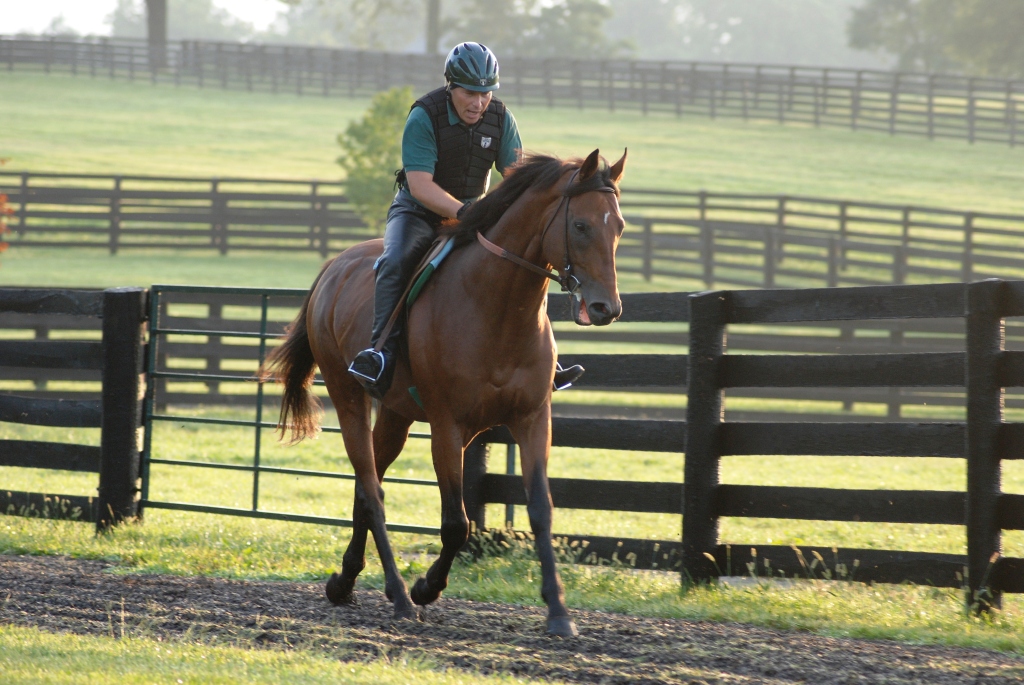
TCF: Big Brown is the epitome of a healthy, happy horse. He has an outstanding temperament in that he is not easily rattled and is quite personable. We ride our stallions 6 days a week (they gallop a mile and a quarter) and Big Brown just floats around the track with his ears pricked – if horses could smile, they would look like Big Brown under saddle.
That’s not to say he doesn’t have a bit of a wild side. Some days he puts on quite a show in his paddock for visitors who come to the farm for our daily tours. He loves to kick up his heels and tear around his paddock, throwing in a playful rear here and there just for fun.
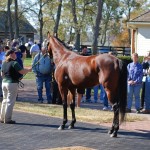 JW: In his retirement, does Big Brown continue to receive attention from fans and visitors?
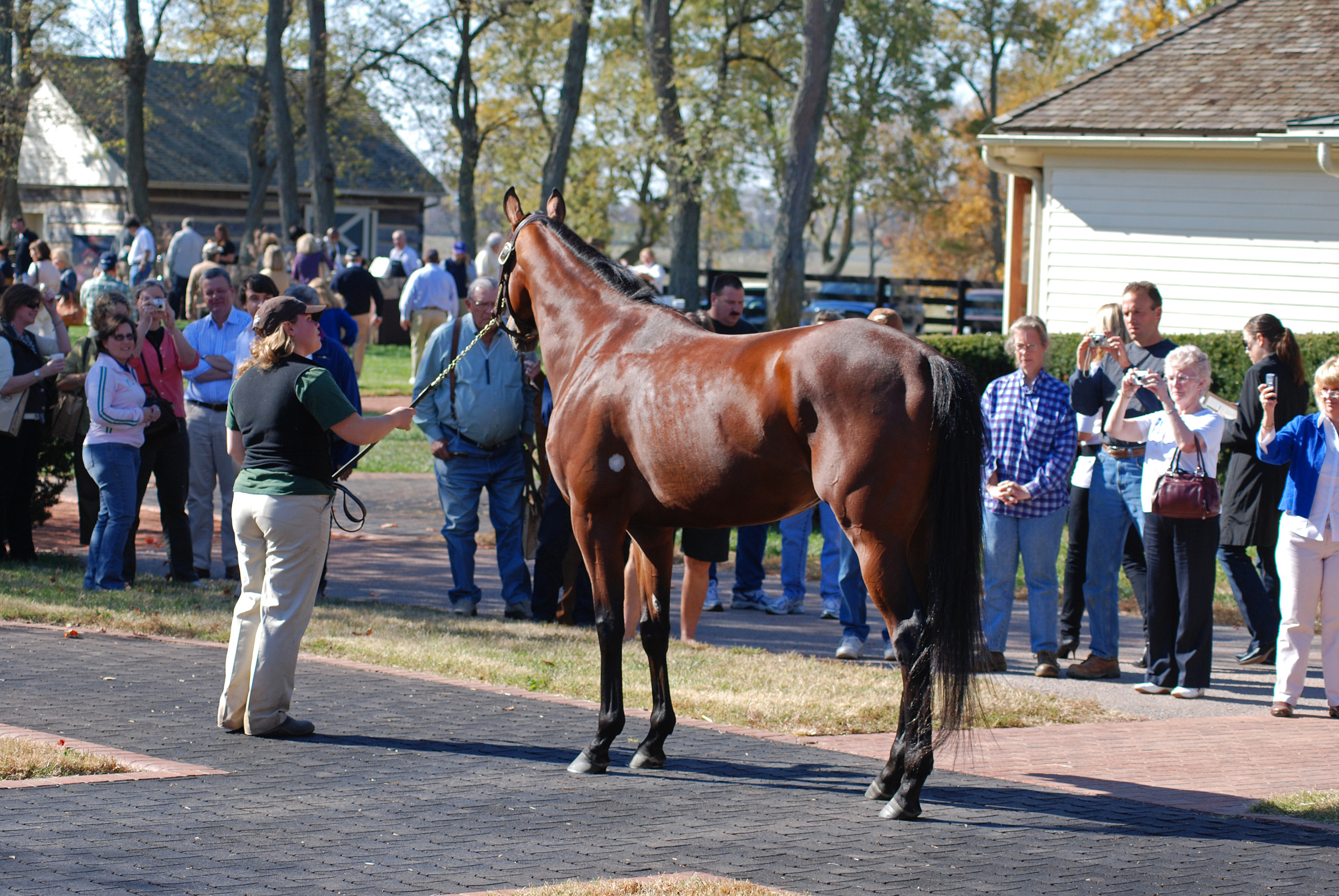
TCF: Three Chimneys began offering daily public tours when Seattle Slew stood here and still conducts them five days a week. We estimate that our stallions receive more than 25,000 visitors a year from the tours alone and the horses that we receive the most requests to see are Big Brown and Smarty Jones.
We also have a visitors’ center near our main office, where tourists gather before and after the stallion division tour to see photos of the stallions, purchase hats with a stallion’s name and silks on them, and look through farm literature and all of the fan mail our stallions, especially Big Brown and Smarty Jones, receive (and they do receive A LOT of fan mail).
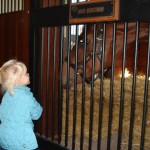 JW: Does Big Brown have any unique personality traits or favorite items?
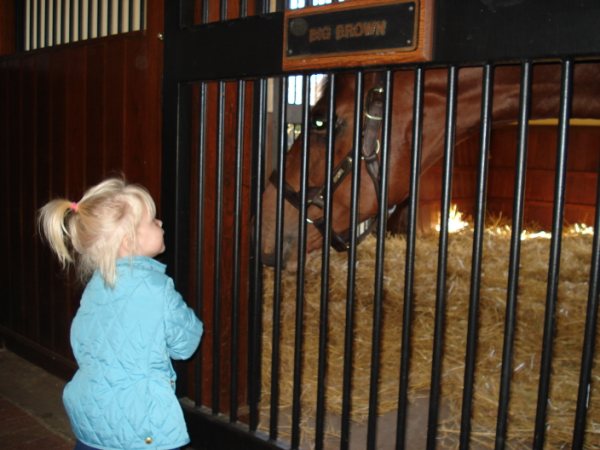
TCF: Big Brown loves peppermints and butterscotch candy. He also seems to be fascinated with children. Anytime a child comes to the front of his stall, Big Brown lowers his head to greet them.
This past fall we also saw Big Brown’s uncanny ability to adapt to any situation. Make A Wish brought a child out to meet Big Brown. The child had severe disabilities, so petting Big Brown was a very slow process (and wouldn’t have been possible without that wonderful temperament he possesses). Big Brown stood like a statue while the child pet his mane and shoulder and even pressed the “go button” birthmark on his side. The child’s eyes were wide and bright and he let out numerous giggles, bringing tears to the eyes of his parents and just about everyone else in attendance.
JW: Recently, it was announced that Big Brown will be shipped to Australia to stand at Hunter Valley Farm. What led to this arrangement and do you anticipate that Big Brown will return to Three Chimneys Farm in the future?
TCF: Big Brown’s pedigree is highly desirable in the Australian market, as it matches up favorably with many of the mares in that part of the world. Big Brown will shuttle, meaning that he will ship to Australia (accompanied by his groom) and stand the Southern Hemisphere breeding season, which is during the opposite time of year as our Northern Hemisphere breeding season.
Once the Southern Hemisphere breeding season has concluded, he will travel back to the United States to Three Chimneys. This will be an ongoing arrangement, so long as Big Brown handles the physical and mental demands of shuttling (which we expect him to have no problem doing).
Click here to comment on this article or email Jennifer Wirth at blog@thesaturdaypost.org.
For more information on Three Chimney’s Farm, please visit their website.
Three Chimneys Farm also has a fan club, “Club Three Chimneys.” For a $35 annual membership fee, members receive trial subscriptions to the Blood-Horse and Thoroughbred Times (8 week subscriptions to each, with the option to subscribe on an annual basis at a heavily discounted rate) a hat, weekly emails about stallions, progeny and farm updates, free farm tours, quarterly newsletters, contests, and more. You can find more information about the club at on their membership page for Club Three Chimneys.
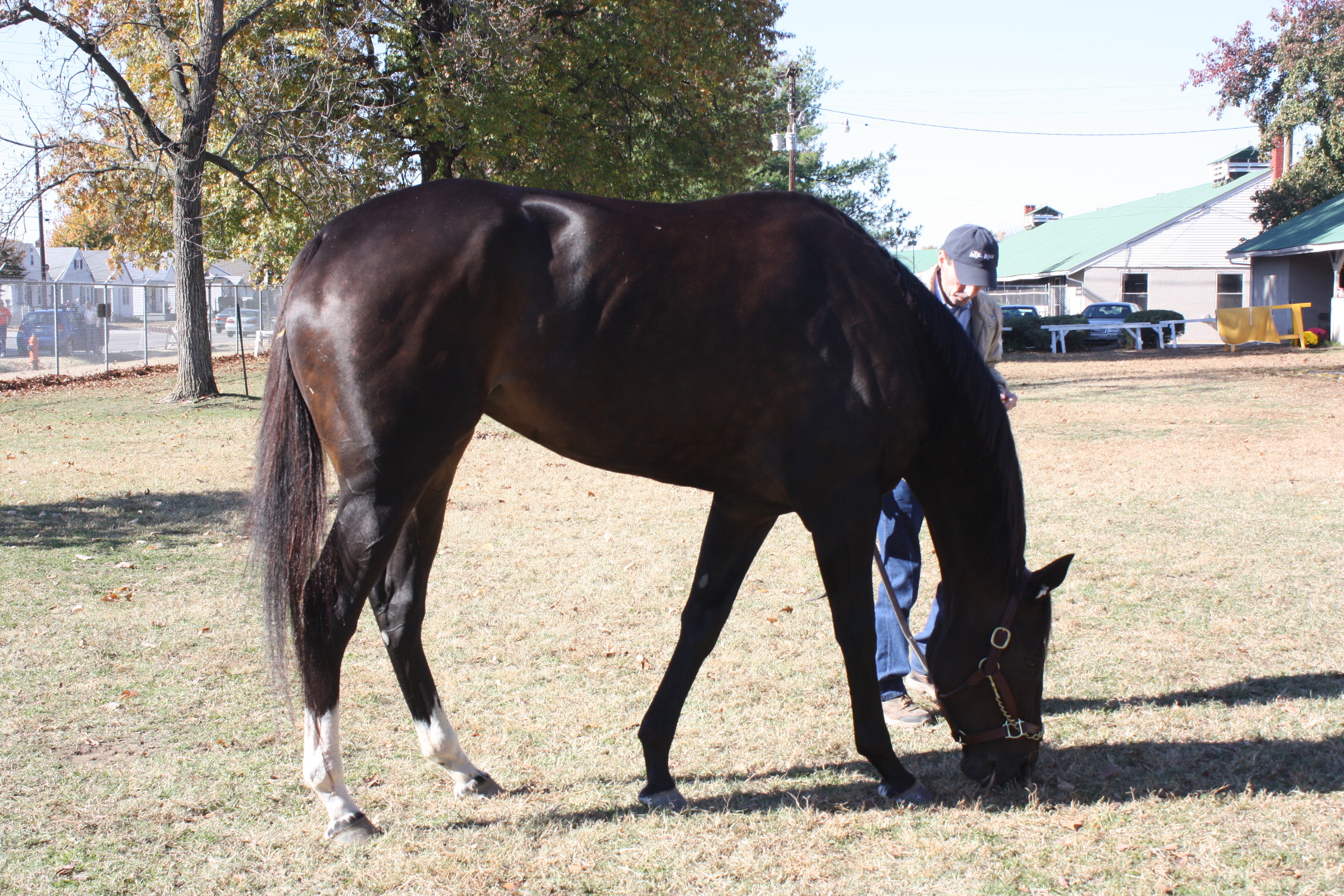
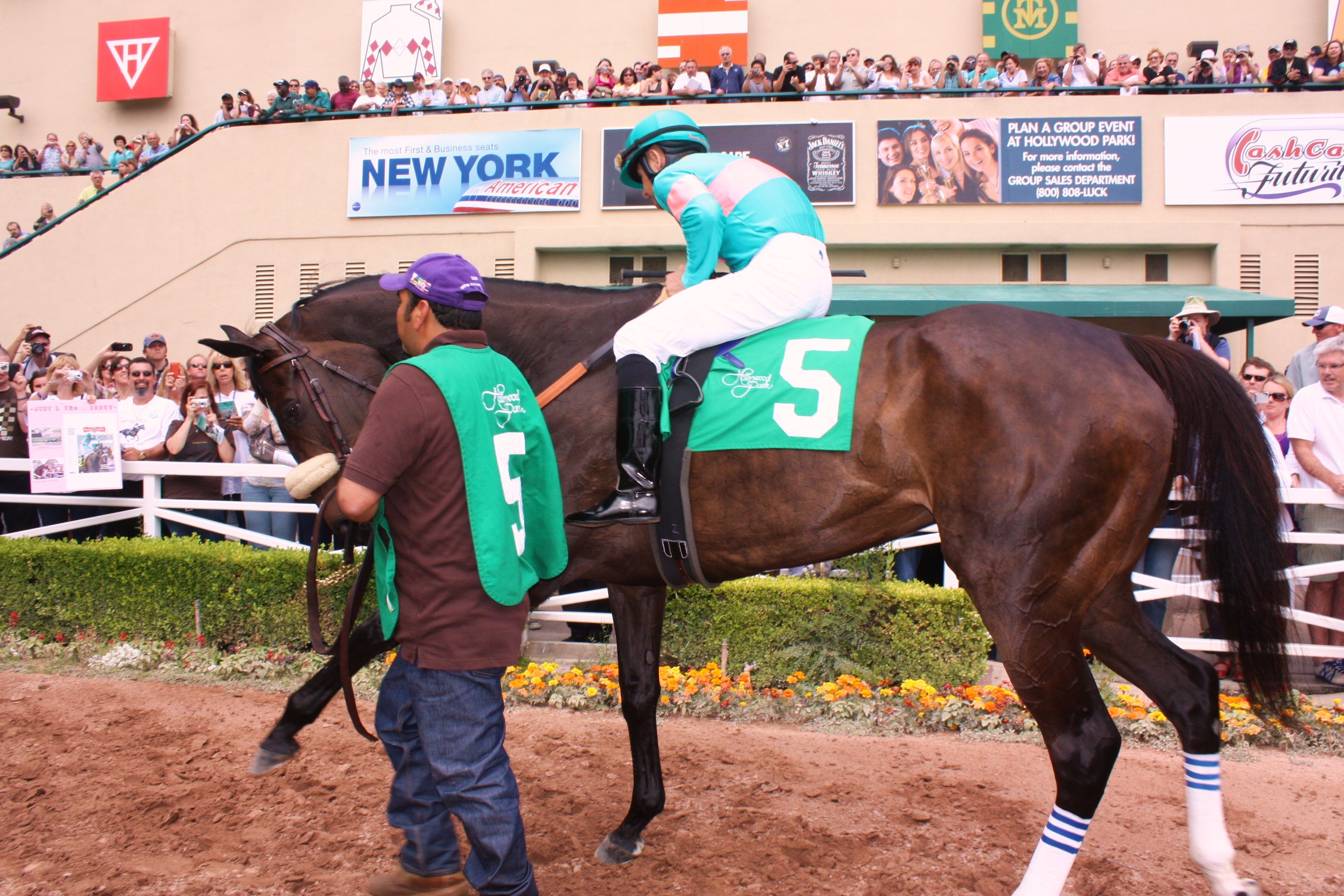 Zenyatta was the horse that took me on a journey that traveled in moments, rather than minutes on a race track. And, when she retired, I wondered if I would ever see a horse that could follow in her dizzying footsteps. I had just seen my once-in-a-lifetime racehorse. The possibility of her coming around twice didn’t seem plausible.
  You saw it in Rachel Alexandra.
 You saw it in Zenyatta.