May 19th, 2010 §
I have a word in my arsenal that can start conversations about horse racing with people who have never bet a nickel on the nose of a horse.
It’s a great word.
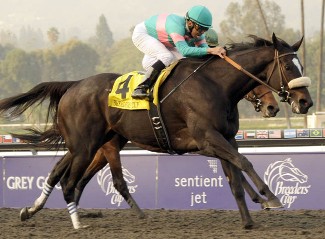
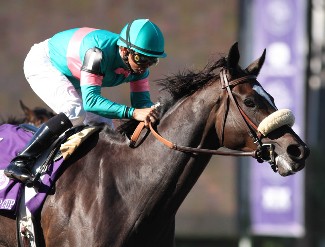
“Zenyatta.”
For those of you who struggle to define the allure of horse racing to non-enthusiasts, Zenyatta is a fun character to parade around in discussions at cocktail parties.
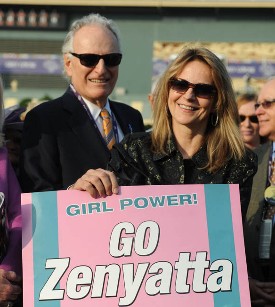
Why? Zenyatta appeals to pop culture and makes horse racing relatable to non-enthusiasts.
In a perfect world, I would live in a place where all my friends followed horse racing.
My social calendar would be full of trackside parties in which guests wore their handicapping picks as an icebreaker on their nametag.
However, I am young and live in Chicago.
And, until Zenyatta, any mention of horse racing to people in my age group led to blank stares and a quick change in topic.
Then, Zenyatta showed up and did something brand new for the modern era of racing.
 Instead of trying to lure non-enthusiasts to the race track, Zenyatta stomped out into mainstream culture and joined the party.
I have to admit - she’s a sharp girl at marketing.
Zenyatta joined Facebook and made some new friends.
This was no small adventure.
According to Facebook, the average user has 130 friends.
In contrast, Zenyatta has amassed roughly 15,500 friends on her fan page.
As for her friends, Zenyatta started hanging out with people in the younger crowd. The highest age demographic on Facebook currently falls between ages 18 through 44.
Regarding her connections, they embraced Zenyatta’s new friends and lifestyle.
Her trainer, John Shirreffs, started a YouTube channel so that her fans could watch Zenyatta’s activities from their home computer.
On YouTube, Zenyatta’s friends can experience a workout between Zenyatta and her stable mate, Green Cat.
Since the video was posted by Shirreffs, over 83,000 fans have taken a virtual ride on the back of Zenyatta.
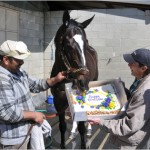
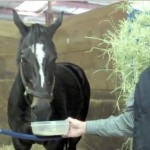 In another YouTube video, Shirreffs gives Zenyatta a Guinness beer while she is relaxing after a workout.
The clip of Zenyatta drinking a Guinness, initially posted by Shirreffs, generated nearly 4,700 views.
Apparently, many of Zenyatta’s friends enjoy meeting up with her for a drink.
However, Zenyatta is perhaps best-known for her dancing – which is catalogued in many videos across YouTube.
In the pre-race television broadcast of the 2009 Breeder’s Cup, an entire segment was devoted to Zenyatta’s dance moves. The network coverage of her dancing has since been viewed on YouTube by nearly 50,000 fans.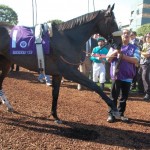
However, dancing appears to come easily to Zenyatta with the musical background provided by her ownership – Jerry Moss, co-founder of A & M Records.
Her name itself speaks volumes in this regard.
Zenyatta is named after the album, “Zenyatta Mondatta,” in recognition of Moss signing the band The Police to A & M Records.
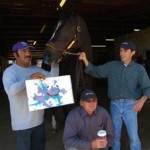 But, Zenyatta doesn’t stop on the dance floor.
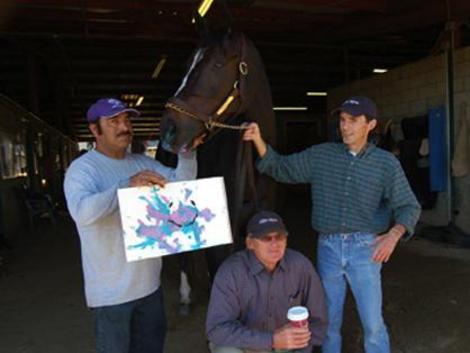
She has learned to paint pictures for auction to help fund Thoroughbred rescue efforts.
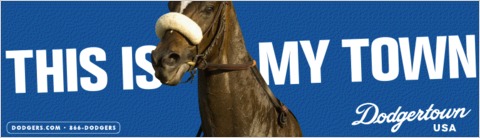
And, Zenyatta recently started marketing for the Los Angeles Dodgers baseball team.
Near her home base of Hollywood Park, a billboard stands at the corner of 106th and Hawthorne Avenue.
The billboard features Zenyatta’s familiar mug shot, with the caption, “This Is My Town,” as a marketi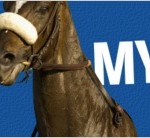 ng promotion for the Los Angeles Dodgers.
Take a minute and think about the victory embodied in that billboard.
A race horse is doing the marketing for baseball - one of the most popular sports in the United States.
Yet, Zenyatta’s crossover endeavors have not detracted from her racing talent.
As Zenyatta approaches the Vanity Handicap, she sets out to become the only race horse to remain undefeated in seventeen unrestricted top-level races in North America.
If she wins, she’ll make racing history for the third time in her career – having already captured two Breeder’s Cup records.
However, win or lose, Zenyatta has set a model for the industry to attract newcomers to the sport.
It’s simple: Zenyatta didn’t ask non-enthusiasts of racing to come to the track for a visit.
Instead, she waltzed in the world of pop culture and drew public attention to her sport.
Zenyatta embraced the Facebook trend, danced across the television screen, painted pictures for charity and offered a virtual “racehorse ride” on YouTube.
When she finished marketing her profession, she went back to her stable, drank a Guinness Beer and waited for her next start in the Apple Blossom.
And, in the end, people came to visit Zenyatta at the race track.
The hotels in Hot Springs, Arkansas were booked solid.
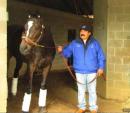 Fans stood outside the airport as she exited the plane.
They showed up in droves.
Official attendance for the 2010 Apple Blossom was recorded at 44,973 people – more than double the 21,782 guests that attended the race in 2009.
And, among the fan fare, Zenyatta continues her racing campaign.
As she prepares for her next start at Hollywood Park, people are again heading to the track to see if one single horse can maintain her undefeated record.
It’s all because of one word.
It’s a great word.
“Zenyatta.”
April 7th, 2010 §
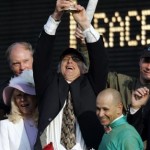
Trainer John Shirreffs has established himself in the racing world as the man who can deliver some of the most magical moments in the sport. From beating some of the toughest odds at the Kentucky Derby to racing Zenyatta into the history books, he has drawn his own path down the winning stretch.
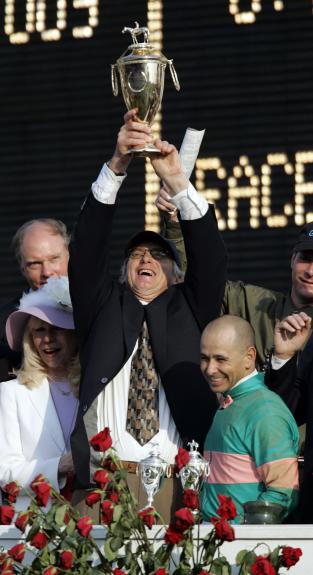
Five years ago, Shirreffs arrived at Churchill Downs for the Kentucky Derby with a gray colt who entered the gates with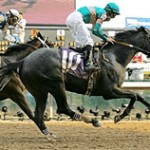 odds of 50 to 1. Roughly two minutes later, that gray colt smashed those odds as he won the race by half a length to the surprise of the nation. At the time, Shirreffs’ colt, Giacomo, had delivered the second biggest upset in the history of the Kentucky Derby.
After the race, Shirreffs’ win at the Kentucky Derby with Giacomo could have been dismissed as mere luck by critics in the sport. However, luck is a fleeting thing. A few years later, Shirreffs would prove in a big way that his training talent falls far beyond luck as he crossed into the realm of magic with his superstar mare, Zenyatta.
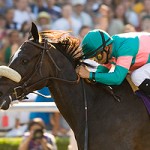 On November 7, 2009, Zenyatta stepped into the gates as the lone female in the Breeder’s Cup Classic. She was not only challenging the gender divide in racing, but also history. The Breeder’s Cup had never been won by a female horse.
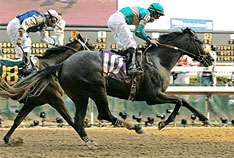
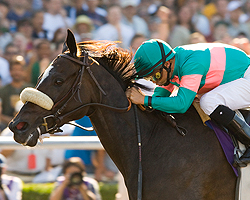
As she stood alongside 2009 Kentucky Derby Winner, Mine that Bird, and 2009 Belmont Stakes Winner, Summer Bird, she set her sights toward the finish line. In the span of two minutes, she delivered one of the greatest racing moments in the sport. 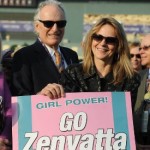 Zenyatta cut down all of her male rivals and stomped into the pages of the history books through her victory in the Breeder’s Cup Classic.
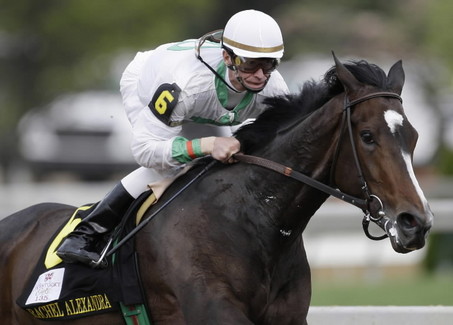
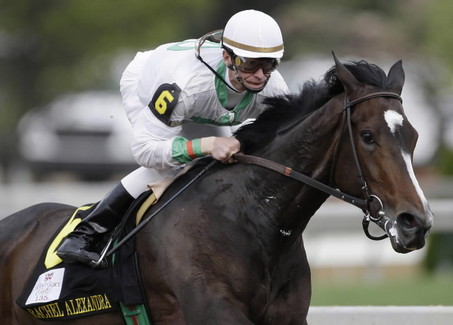
Following the Classic, the debate ensued as to whether Zenyatta should be crowned “Horse of the Year.” Despite Rachel Alexandra winning the debate in the ballot box, Zenyatta has remained undefeated on the track.
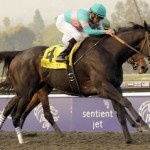 With fifteen career starts, Zenyatta enters the Apple Blossom this Friday to defend her perfect winning record. In the days leading up to the race, I sought to obtain an interview with John Shirreffs about the magic of Zenyatta. I was told by friends that it would be impossible since the Apple Blossom was this Friday.
Yesterday, Shirreffs delivered the impossible again by graciously providing me with an interview. I extend my deepest thanks to him.
JW: Prior to Zenyatta’s victory in the 2009 Breeder’s Cup Classic, no female horse in history had ever won the race. Facing such odds, what led to the decision to run her in the Classic?
SHIRREFFS: [The decision was based on] giving her an opportunity to show everyone how great and historical she is.
JW: Zenyatta’s history-making win in the Breeder’s Cup Classic earned the 2009 Eclipse Award for “Moment of the Year.” How did you feel at the moment Zenyatta won the Breeder’s Cup Classic?
SHIRREFFS: I felt proud to be her trainer and blessed to be her caretaker.
JW: In fifteen career starts, Zenyatta has maintained an undefeated record. Going into the Apple Blossom this Friday, do you get nervous about maintaining her winning streak?
SHIRREFFS: Racing is about controlling nerves, believing in your horse and accepting the results.
JW: The “Horse of the Year” debate between Zenyatta and Rachel Alexandra captivated the public and the media. How did you feel about a “match race” between these two horses and do you regret that they did not get a chance to race each other in the Apple Blossom?
SHIRREFFS: Everyone was looking forward to the Apple Blossom race. It would have been exciting. A scheduled race where the attention is spread between several horses is a more relaxed atmosphere, and, for me, better.
JW: Zenyatta already has made history with her victory in the Breeder’s Cup Classic and stands in rare company with her undefeated record in fifteen starts. In the simplest terms, what else do you think Zenyatta can accomplish as a race horse that she has not already proven in her racing career?
SHIRREFFS: We wanted to share her with as many of her fans as possible. [Through continuing to race,] maybe someone who couldn’t get to Santa Anita would have a chance to see her.
JW: As a trainer, you have accomplished some unique milestones. Going back to your 2005 Kentucky Derby win as the trainer of Giacomo, what did you see in Giacomo that led you to believe he could win the Kentucky Derby?
SHIRREFFS: Giacomo had a great mind, a very smooth stride and never ever quit no matter what. And then, there was all that talent.
JW: How did it feel for you when Giacomo won the Kentucky Derby?
SHIRREFFS: [I felt like I was] on a magic carpet - flowing among 100,000 spectators who looked excited - but I couldn’t hear anything.
JW: As an accomplished trainer, what do you believe are some important principles to follow when training a race horse?
SHIRREFFS: [Put the] horse first.
JW: Throughout your experience in training Zenyatta, has she demonstrated any unique traits or capabilities? If so, what makes her different?
SHIRREFFS: She [has] never stopped developing. In the morning, she is waiting for more.
JW: What is the general temperament of Zenyatta?
SHIRREFFS: She is a sweet lady. It is hard to describe. Today, a young girl - about age eleven - was petting Zenyatta. Zenyatta turned around the other way. The girl didn’t back [up], but just kept her hand on Zenny and pet her. Can you imagine how most fit, sharp racehorses would react? I really wasn’t worried. Zenyatta is that kind.
JW: What are some of Zenyatta’s favorite things?
SHIRREFFS: Carrots, of course! And, [she likes] having her neck scratched.
To comment on this article, click here. The Saturday Post is now on Facebook. To join our Facebook Page, click here.
March 10th, 2010 §
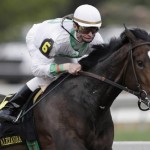
With the $5 Million Apple Blossom showdown between Rachel Alexandra and Zenyatta scheduled for April 9, Jess Jackson, co-owner of Rachel Alexandra, has begun an interesting media poker game in the past few days.
In a recent New York Times Article, Jackson appeared to be gearing up for an excuse to back his horse out of the Apple Blossom. Jackson stated that he gauged her fitness at “about 85 percent” of where she should be now. He then elaborated, “We are targeting the Apple Blossom. We are stretching to get there. But if we’re not in top shape, we’re not going.”
It seemed like a pretty basic statement. The industry and fans would not want to jeopardize the health of Rachel Alexandra for any race. In all honesty, I wondered why he even emphasized it at all since it was fairly obvious.
Then, I read a recent post by NTRA Blogger Bob Ehalt and began to rethink the New York Times interview. In his blog, Ehalt saw what I missed – two possible bluffs by Jackson in the ongoing “poker race” between these camps. Ehalt wrote:
If you also read the words of Rachel Alexandra’s co-owner Jess Jackson in the New York Times last week, you have to wonder if the Apple Blossom might wind up a walkover.
Jackson certainly did not sound like someone who is eagerly awaiting the race. He continually stressed in the article that he would not run his filly unless she is 100 percent fit, which is hardly the year’s biggest scoop.
Yes, Jess, we know. Guys who own claimers do not run their horses when they have problems, so it’s a given that a horse as beloved and valuable Rachel Alexandra will not be risked. So why remind of us that. Why not follow the lead of Zenyatta’s owners Jerry and Ann Moss and just say you’re on course for the Apple Blossom and you hope to make it. If you can’t, let us know. Otherwise we’ll see you in Hot Springs on April 9. Don’t keep reminding us of what we know already. It’s sort like pointing out that we all have to pay taxes and die.
One of the possible explanations for comments like that from Jackson is that he is looking for an excuse.
In my mind, Ehalt called the first bluff. No one wants to risk an injury to this beautiful horse. If Rachel is not physically sound at the time of the Apple Blossom, she can decline to race at that point.
Then, I began to wonder. If Rachel is admittedly only at “85 percent” of where she should be now, why is Jackson racing her this weekend in the $200,000 New Orleans Ladies Stakes? It seems like a great risk to take a highly-prized horse to a relatively minor career race when she is only performing at “85 percent.”
It may be that Rachel Alexandra isn’t fit for a Grade 1 race at this point in the season and Zenyatta is still performing as a Grade 1 horse. It may be as simple as that. Or maybe not.
Where Ehalt’s article calls the heart of the bluff is Jackson’s newest comments about a three-race series between Rachel Alexandra and Zenyatta. In the New York Times, Jackson plainly states, “If they beat us in one race, they might just disappear and retire her undeafeated… If they commit to the best of the three, it would be great for the sport and a better way to judge both of these great horses.”
Ehalt sees Jackson tip his hand in the Poker game. “How do we rationalize Jackson’s newest comments about a three-race series? Everyone would love to see these magnificent horses race three times. Yet Jackson says his desire for a three-race series is just in case Zenyatta wins the Apple Blossom and her connections retire her. He wants another crack at her.”
And, Ehalt calls the bluff. “Why bring that up as a concern? It certainly wasn’t the type of comment one expects from an owner who believes his horse is as good as Ruffian.”
He’s right. Why is this a concern? This is a test of who wins when pegged against the other champion. It is not a “two-horse triple crown” series.
Neither horse should race if they aren’t sound. The welfare of these two amazing horses preempts any other concern or interest. This is not a subject of debate.
If both horses are sound on April 9, there should be one single race. Rachel Alexandra won a single title – Horse of the Year. Zenyatta waged a serious challenge to Rachel Alexandra’s nomination for the title in one single win – The Breeder’s Cup Classic. Neither horse had three tries to match the crowning accomplishment of their rival.
If Rachel Alexandra loses the race, and Zenyatta retires, both horses remain champions. It’s time to stop playing poker with race cards. It’s time for the match.
February 1st, 2010 §
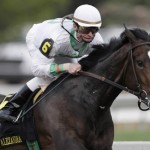
After a contentious debate over the 2009 “Horse of the Year” Eclipse Award, Rachel Alexandra prevailed over Zenyatta when the winner was finally announced on January 19, 2010. Prior to the announcement, the owners of both champion fillies had committed to race their horses in the 2010 season. With the final ballots cast, the industry has moved from the “Horse of the Year” debate toward speculation regarding a match race between these two female rivals in 2010.
Since 1975, there have not been any major thoroughbred match races involving champions in America after Ruffian sustained a terminal injury while competing against Kentucky Derby winner, Foolish Pleasure. In that race, the undefeated filly Ruffian met Foolish Pleasure at Belmont Park in New York. A national television audience watched as Ruffian broke down shortly after the start and had to be euthanized the following day.
Before the sad ending to match racing with Ruffian’s injury, there were several other major match races throughout the century. In 1955, Kentucky Derby winner, Swaps, met Nashua, the Preakness and Belmont Stakes winner of that year. Nashua won the race, but speculation did not cease after the match. Swaps had been nursing a sore foot in days prior to the race. Eddie Arcaro, rider of Nashua, admitted many years later that he doubted Nashua could ever have beaten a healthy Swaps.
In 1947, Triple-Crown winner and 1946 Horse of the Year, Assault, held a $100,000 match race against Calumet Farm’s horse, Armed. Armed beat Assault by eight lengths and went on to win the 1947 title of Horse of the Year.
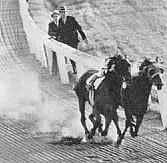
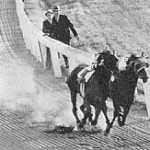 One of the arguably most talked-about match races of the century occurred in 1938, between the rags-to-riches underdog, Seabiscuit, and the Triple-Crown winner and reigning horse of the year, War Admiral. Seabiscuit tracked War Admiral across the country and quickly became the “People’s Horse” during the depression era. After he defeated War Admiral in the 1939 showdown, Seabiscuit went on to win Horse of the Year.
However, match racing existed before the popular match race between Seabiscuit and War Admiral. In 1923, the Kentucky Derby winner, Zev, took on the English Derby winner, Papyrus. The race was dubbed the first “international” race and exorbitant prices were charged for tickets. Zeb won the match race against Papyrus, but doubts lingered about the victory due to track conditions and a mistake in shoeing Papyrus prior to the race.
Finally, in 1920, Horse of the Century, Man O’ War, met Sir Barton, the first horse to win what would later be dubbed the “Triple Crown,” in a match race in Canada. Man O’ War won the race by seven lengths, but the importance of the race was questioned because it was widely-regarded that Sir Barton was not at his peak performance.
With a new century, the industry is faced with the prospect of a major match race between two champion fillies – Rachel Alexandra and Zenyatta. From a brief look at the history of match racing, the unasked question is “What purpose would a match race serve?”
The most obvious answer is financial gain to the industry and owners, as well as reinvigorating public interest in the sport of horseracing. But, aside from these interests, does a match race serve either filly in cementing their championship status over the other filly?
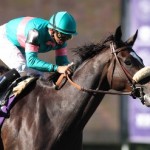 From the historical view, Zenyatta appears to have more to gain while Rachel Alexandra more to lose if the two are pegged against each other in a match race. In the races in which a reigning Horse of the Year accepted and lost a match race, the prevailing horse went on to win “Horse of the Year” in the following season. Therefore, Zenyatta’s most important targeted race for 2010 should be a match against Rachel Alexandra if she wants to attempt to clinch the much sought-after title of “Horse of the Year.”
In the same vein, if Rachel Alexandra were to lose a match to Zenyatta, Rachel Alexandra’s “Horse of the Year” victory over Zenyatta may be called into question all over again. Rachel would be forced into a rivalry with Zenyatta that could last over several races in an attempt to gain the lead over her rival in the court of public opinion.
Further, the historical record shows that match races rarely seem to settle the score between two rival champion horses. In the case between Ruffian and Foolish Pleasure, there was no true winner since Ruffian was injured during the race. Between Swaps and Nashua, Nashua’s own jockey, Arcaro, felt that Swaps would have won if he had been in better health. The race between Zev and Papyrus only clouded the debate since Papyrus encountered track difficulties and there was a mistake in shoeing the horse. Finally, Man O’ War’s victory over Sir Barton was also questioned since Sir Barton was not at his peak-performance level at the time of the match.
If a match race were to be held between Rachel Alexandra and Zenyatta, it would seemingly do little to settle the debate regarding who is the greater horse between the two champions. However, it would make for an electrifying spectacle to watch these two fillies face off on the track.
Rather than aiming to have a match race settle the ongoing debate of who is the greater horse between Zenyatta and Rachel, a match race, if held, should serve only to showcase the two great fillies of our decade. Their championship status has already been proven in different races, on different tracks.
January 16th, 2010 §
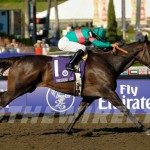
On Monday, the winner of the prestigious “Horse of the Year” Eclipse Award will be announced and two breathtaking fillies remain in a dead heat for title. Throughout most of the 2009 racing season, Rachel Alexandra dominated the sport with flashy wins against other fillies, taking down the boys in three separate races, and, ultimately, being the first filly in 85 years to capture the Preakness Trophy. Of her eight starts as a three-year-old in 2009, she remained undefeated and ended her racing year as the first filly to win the Woodward Stakes.
By September of 2009, I believed Rachel Alexandra was the clear choice for “Horse of the Year” having watched her trample the field in the Kentucky Oaks, take down the Derby Winner in the Preakness, and close her season with her historical win in the Woodward Stakes. If anyone had challenged that notion, I wouldn’t have hesitated to hold a good old-fashioned yelling match to defend Rachel’s right to the title. In my mind, it was inconceivable that any horse could out-perform this “Super Filly.”
And then, the unconceivable arrived. On November 7, 2009, an undefeated five-year old female named Zenyatta walked onto the track at Santa Anita and dared every boy standing at the gate to defeat her in the richest race in America.
It was such a bold move that I skipped a wedding to watch her try.
As the gates opened, Zenyatta trailed the field. Throughout middle of the race, I watched with heartbreak as she hung in last place. It looked as if expectations had exceeded her ability. When it appeared near hopeless, Zenyatta made the bid for her place in history. She began to pick off her opponents near the last turn and went wide on the home stretch to deliver a seemingly late charge for the finish. In the final seconds, Zenyatta drove seamlessly past her contenders at the wire to win the Breeder’s Cup Classic. In this historical moment, my allegiance for “Horse of the Year” shifted from Rachel Alexandra to the first filly to ever take the most expensive race in America – Zenyatta.
Admittedly, Zenyatta’s contention for “Horse of the Year” would not be such a threat to Rachel Alexandra without her historical win in the Breeder’s Cup Classic. However, I am not in the business of rewriting history. In fact, Zenyatta’s bid for “Horse of the Year” is perfectly in sync with the historical background and ultimate spirit of the Eclipse Awards.
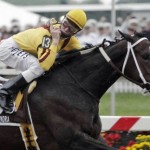 When the Eclipse Awards were founded in 1971, they were named in honor of a British racehorse and sire from the 1800s, named “Eclipse.” As a racehorse, Eclipse did not begin his career until he was a five-year-old and remained undefeated throughout the eighteen races in his career. In recognition of his legacy, Eclipse became the namesake to what are arguably considered the most prestigious achievement awards within the American horse racing industry.
By the very nature of the Eclipse Awards, the award categories provide a separation for age and overall achievement. Aside from “Horse of the Year,” which encompasses all ages and genders, the Eclipse Awards also maintain separate categories for the best “Three-Year-Old Filly” and “Three-Year-Old Male.” The scenario between Rachel Alexandra and Zenyatta appears to have been given some forethought prior to this moment.
Eclipse himself could not have won the best “Three-Year-Old Male” Award, just as Zenyatta can no longer compete for the best “Three-Year-Old Filly” award due to the age restriction. The Awards appear to follow the design that a “Three-Year-Old Filly” may become “Horse of the Year,” but that the rapture of the Triple Crown racing season cannot discount the outstanding performances of all racehorses during a given year.
Admittedly, Rachel Alexandra had an electrifying year as a three-year old horse – irrespective of her gender. If she had shown up to Santa Anita on November 7th to win the Breeder’s Cup Classic, there would be very little debate that she had earned the “Horse of the Year” Award. But, as Zenyatta trampled down the full field of skilled male horses to earn the distinction of the first filly to win the Breeder’s Cup Classic, Rachel Alexandra quietly stepped aside and placed her bets on her three-year-old season. When Zenyatta was first at the wire, Rachel lost her bet.
Zenyatta’s win in the Breeder’s Cup Classic holds more historical significance than any of Rachel Alexandra’s wins within this season. Zenyatta won the most expensive race in the United States. She is the first filly to ever accomplish this feat. The Breeder’s Cup Classic is one of the most contentious races in America – the field is full of great horses from varying backgrounds who are proven winners.
In contrast, Rachel Alexandra’s first Grade One win was in the Kentucky Oaks – among other fillies. Her next race, among males in the Preakness, is an impressive win – but not a “Game Changer.” Prior to Rachel, four fillies had already won the Preakness Stakes – the most recent win being in 1924. Further, the Preakness is the shortest distance of all three Triple Crown races, the Belmont being the longest race in the United States at a distance of 1 ½ miles. When Oaks-Winner Rags to Riches beat Curlin in the 2007 Belmont Stakes, Curlin was still awarded the distinction of “Horse of the Year” despite the fact that a Filly had not won the Belmont in over a hundred years when she crossed the finish line.
Zenyatta also holds distinction for building her undefeated record on a higher grade of races than Rachel Alexandra. In her career, Zenyatta has consistently run in only Grade 1 and Grade 2 races – remaining undefeated. In contrast, Rachel Alexander gradually worked from Grade 3 races into Grade 1 races, finishing second in both of her Grade 3 races. When viewing the overall career record of both horses, Zenyatta is the only undefeated horse who never delved below a Grade 2 race.
Finally, Zenyatta’s wins earned more money in 2009 than Rachel Alexandra. In 2009, Zenyatta was the second-highest ranking horse, boasting $3,330,000 in earnings. In comparison, Rachel Alexandra ranked fifth in 2009, bringing in a total of $2,746,914.
With the entry of more fillies in the prestigious male-dominated horse races, the industry is now squarely-faced with “The Filly Eclipse” for the Horse of the Year. Fillies are running alongside their male-counterparts and winning. When Rachel Alexandra ended her racing season in September, many believed that she had earned “Horse of the Year” over her potential male rivals for the Award. On November 7th, 2009, Zenyatta placed herself in undisputed contention with Rachel Alexandra as she moved past the finish line at the Breeder’s Cup Classic. Those watching the Breeder’s Cup Classic witnessed the first “Filly Eclipse” in history for the Horse of the Year Award.
After the Breeder’s Cup Classic, there have been arguments to hold a match race between Rachel Alexandra and Zenyatta. This would not add or subtract anything from this competition. Zenyatta and Rachel Alexandra are two distinct horses at different places in their career with their own unique character. They race in two separate fields - Rachel performs better on dirt and Zenyatta excels on synthetic track. If they ever settled where to run this race, the next question would be why the race should be run. This is a competition for the “Horse of the Year”- not “Best Filly of the Year.” It just happens to be that the two final contenders are fillies.
In the case of Rachel Alexandra, I truly believe that she has gone above and beyond to win the distinction of being the best three-year-old filly for 2009. She took on the boys, outran them, and bested the field with her astounding margins of victory in filly races.
Then, in a rare moment in November, “The Filly Eclipse” occurred and Zenyatta obscured all opposition.
When Zenyatta crossed the wire in the Breeder’s Cup Classic, she took my vote for Horse of the Year through pioneering a win in the most expensive race in America amidst a field a hard-tested males from various ages and backgrounds. It was an electrifying performance that not only earned her a place in the history books, but also, the well-earned distinction as “Horse of the Year.” I had seen my first ”filly eclipse.” It was breathtaking.
January 14th, 2010 §
 On January 1st, 2010, the next group of Derby hopefuls all turned the three as the nation celebrated the new year. As the days begin to roll by, many trainers and owners will begin to set their gaze on one of the most prized accomplishments in sports - the winning of the Triple Crown in horseracing.
Although the first leg of the Triple Crown doesn’t arrive until May 1, 2010, when all eyes turn to Churchill Downs for the 136th Running of the Kentucky Derby, the prep races to qualify for the highly-coveted positions in the Derby are shifting into gear. As with every year, I begin to watch the Saturday prep races, with a hope that this year will bring the next Triple Crown Winner.
This year is no different - with the exception of this Blog. You might ask - Why are you starting a Blog about horseracing? The answer is simple. I love the sport. I love the players. I love to talk about horseracing. It makes me scream with excitement, cry with heartbreak, and leaves me endlessly studying the details of races to try to master the mysteries of the sport.
During this month, I will begin considering the new horses positioning themselves for the Kentucky Derby, making travel plans to go to Churchill Downs for the first Saturday in May, and reminiscing about my past “loves” who thrilled me (or left me heartbroken) at the wire. I study the video footage of all the prep races, read the handicapper’s picks, look for the standout performances, until finally, I fall in love with a new horse for the year. And, once I fall in love with a horse, I am unshakeable in my devotion.
After seeing Barbaro win the Derby, I actually bought a farm with the dream of owning a racehorse. When he died, my racehorse dreams hit reality. A friend called my office the day of his death to tell me the sad news. The first sentence out of his mouth was, “What is the worst thing you can imagine in this world right now?” My immediate response was “If Barbaro died.” Unfortunately, I had picked the right horse that day. I sent a dozen roses to his hospital and had my first major lesson in horseracing - These great atheletes are not infallable.
After Barbaro, I maintained my enthusiasm for horseracing despite the peaks and valleys that are inherent to great love. Prior to the historic Belmont when Rags to Riches beat Curlin, I had a hair-trigger temper for anyone who told me a filly couldn’t win the Belmont. When she stomped across the wire, it felt like I won that race with her. She taught me the next lesson - Fillies are a force to be reckoned with and should never be discounted on the basis of gender alone.
When Big Brown showed up on the scene, it was love at first sight. By then, I had sold my farm, having learned that you can’t “grow” racehorses without lots of money. I sat in my Chicago apartment and watched his races for the pure joy of witnessing such raw talent. At the Derby, I watched him thunder to the finish line first from the twentieth post. When he won the Preakness, I booked my first trip to New York City in life. I was convinced that I was going there to witness the coronation of the next Triple Crown Winner. When he finished dead last, my heart was broken and I learned the most important lesson to date - Any horse can win or lose a race. Even Big Brown.
This past year, I saw the fillies take center stage and slam the door on the gender divide in horseracing. Rachel Alexandra’s stunning wins made me stand in awe of her ability. I thought she was the easy pick for “Horse of the Year.” And then came Zenyatta - who closed the Breeder’s Cup with a historical victory that changed the landscape of horseracing for fillies forever. As I write this story, the 2009 “Horse of the Year” will be picked in less than a week. My mind spins in circles between the two of them and wishes that they both could hold the title.
However, in horseracing, there is only one winner. And, the answer only arrives when the race is won. It could be a filly. Or a longshot. It could be the favorite of the betting public. The horse could be a former claiming horse or have cost a fortune. One thing is certain - There are extensive amounts of money and lifelong dreams on the line. Everyone from the owners to the betting public pays to watch the performance. So, who will be the next Triple Crown Winner? It is among the most expensive questions in the world.
Do you have a comment, question, or idea? You can contact Jennifer at blog@thesaturdaypost.org.
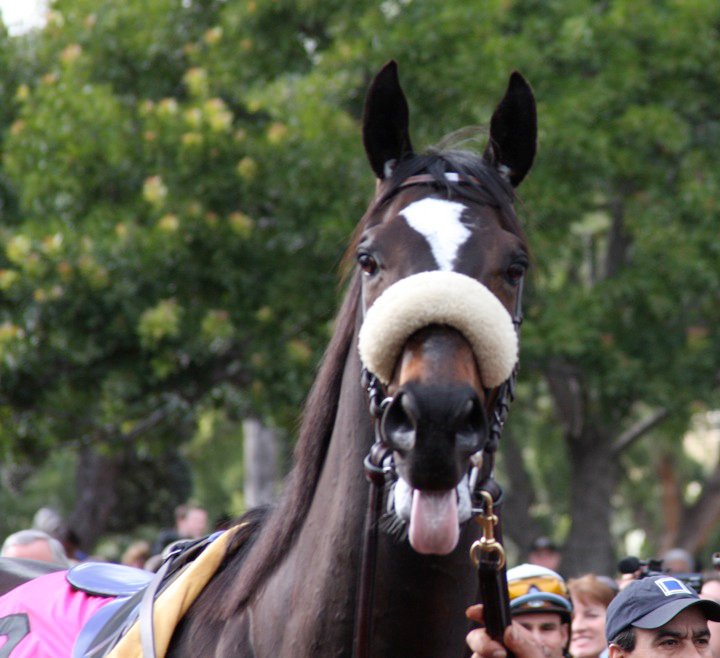
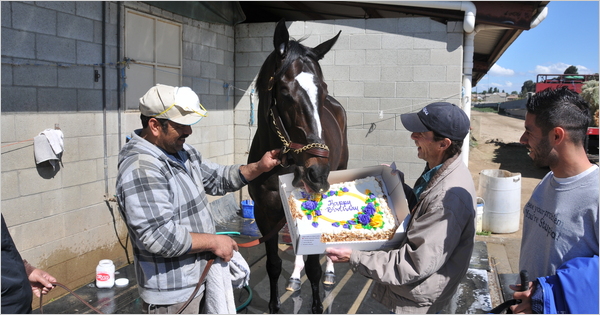 Instead of trying to lure non-enthusiasts to the race track, Zenyatta stomped out into mainstream culture and joined the party.
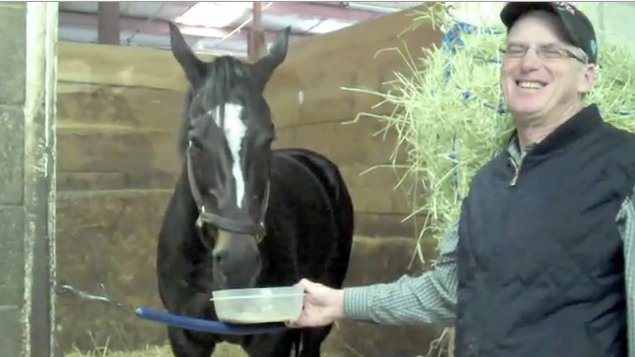 In another YouTube video, Shirreffs gives Zenyatta a Guinness beer while she is relaxing after a workout.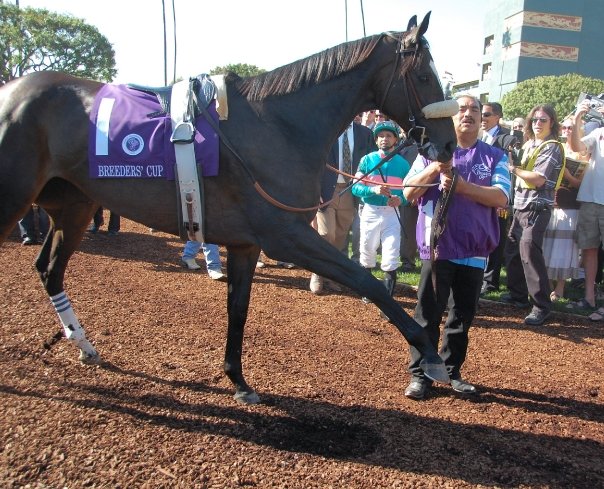
 ng promotion for the Los Angeles Dodgers.